QUESTION IMAGE
Question
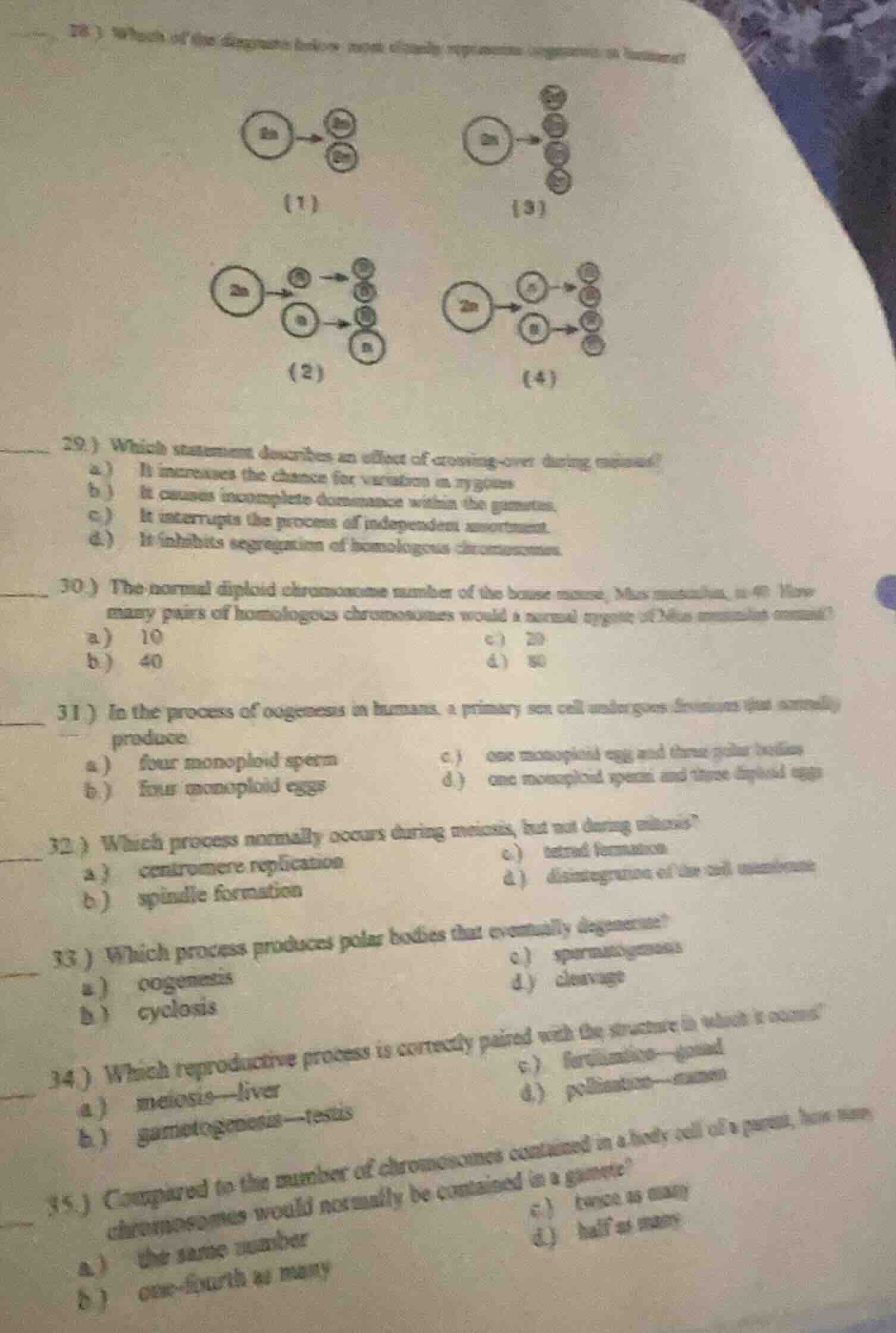
28 ) which of the diagrams below most clearly represents components of meiosis? (diagrams omitted) 29 ) which statement describes an effect of crossing - over during meiosis? a) it increases the chance for variation in offspring b) it causes incomplete dominance within the gametes. c) it interrupts the process of independent assortment. d) it inhibits segregation of homologous chromosomes. 30 ) the normal diploid chromosome number of the house mouse, mus musculus, is 40. how many pairs of homologous chromosomes would a normal zygote of mus musculus contain? a) 10 c) 20 b) 40 d) 80 31 ) in the process of oogenesis in humans, a primary sex cell undergoes divisions that normally produce a) four monoploid sperm c) one monoploid egg and three polar bodies b) four monoploid eggs d) one monoploid sperm and three diploid eggs 32 ) which process normally occurs during meiosis, but not during mitosis? a) centromere replication c) tetrad formation b) spindle formation d) disintegration of the nuclear membrane 33 ) which process produces polar bodies that eventually degenerate? a) oogenesis c) spermatogenesis b) cyclosis d) cleavage 34 ) which reproductive process is correctly paired with the structure in which it occurs? a) meiosis—liver c) fertilization—ovary b) gametogenesis—testis d) pollination—anther 35 ) compared to the number of chromosomes contained in a body cell of a parent, how many chromosomes would normally be contained in a gamete? a) the same number c) twice as many b) one - fourth as many d) half as many
Question 29
Crossing - over occurs during meiosis when homologous chromosomes exchange genetic material. This exchange increases the genetic variation in the resulting gametes. Option a says it increases the chance for variation in offspring (since gametes combine to form offspring), which is correct. Option b: incomplete dominance is about allele expression, not related to crossing - over. Option c: crossing - over does not interrupt independent assortment; they are both sources of variation in meiosis. Option d: crossing - over does not inhibit segregation of homologous chromosomes.
Step 1: Recall the definition of diploid and homologous pairs
A diploid cell has two sets of chromosomes, one from each parent. The number of homologous chromosome pairs in a diploid cell is equal to the total number of chromosomes divided by 2 (since each pair has 2 chromosomes).
Step 2: Calculate the number of homologous pairs
The normal diploid chromosome number of Mus musculus is 40. To find the number of homologous pairs, we use the formula: Number of homologous pairs=\(\frac{\text{Diploid chromosome number}}{2}\)
Substitute the value: \(\frac{40}{2} = 20\)
Oogenesis is the process of egg (ovum) formation in females. A primary oocyte undergoes meiosis. In the first meiotic division, it produces a secondary oocyte and a polar body. In the second meiotic division, the secondary oocyte produces an ovum (egg) and another polar body, and the first polar body may also divide. Overall, a primary oocyte normally produces one monoploid (haploid) egg and three polar bodies (which degenerate). Option a: four monoploid sperm is spermatogenesis. Option b: four monoploid eggs do not form in oogenesis. Option d: sperm are produced in spermatogenesis, not oogenesis.

Snap & solve any problem in the app
Get step-by-step solutions on Sovi AI
Photo-based solutions with guided steps
Explore more problems and detailed explanations
a) It increases the chance for variation in offspring