QUESTION IMAGE
Question
2nd half - place in the correct order (oldest to youngest... 1st event on topic, most recent event on the bottom)
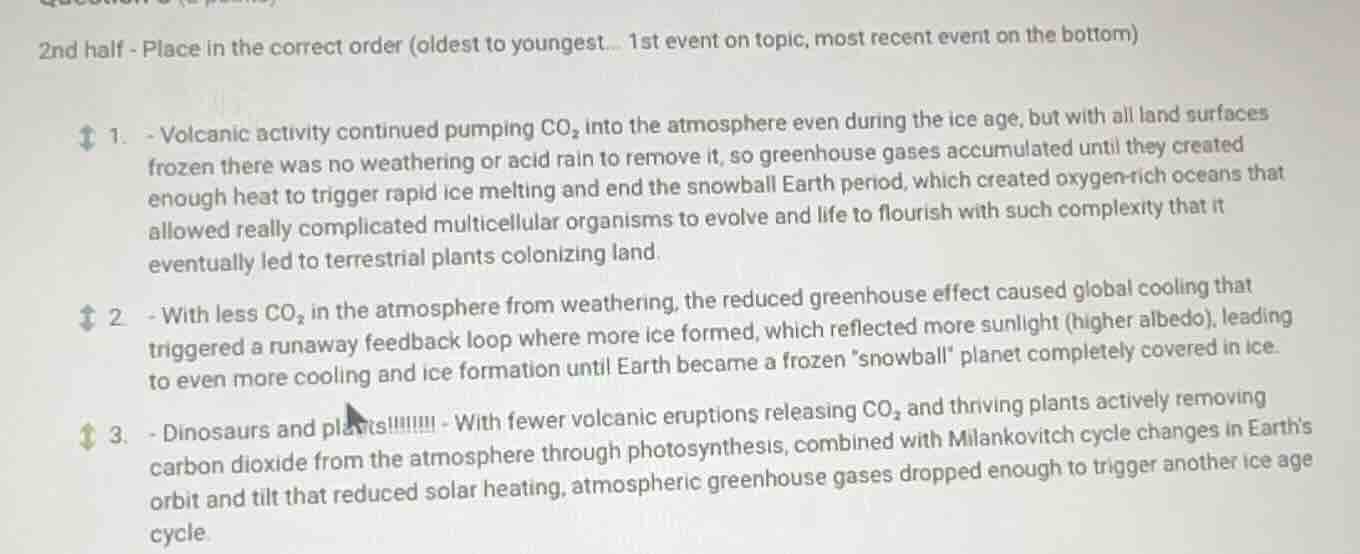
- - volcanic activity continued pumping co₂ into the atmosphere even during the ice age, but with all land surfaces frozen there was no weathering or acid rain to remove it, so greenhouse gases accumulated until they created enough heat to trigger rapid ice melting and end the snowball earth period, which created oxygen - rich oceans that allowed really complicated multicellular organisms to evolve and life to flourish with such complexity that it eventually led to terrestrial plants colonizing land.
- - with less co₂ in the atmosphere from weathering, the reduced greenhouse effect caused global cooling that triggered a runaway feedback loop where more ice formed, which reflected more sunlight (higher albedo), leading to even more cooling and ice formation until earth became a frozen snowball planet completely covered in ice.
- - dinosaurs and plants!!!!! - with fewer volcanic eruptions releasing co₂ and thriving plants actively removing carbon dioxide from the atmosphere through photosynthesis, combined with milankovitch cycle changes in earths orbit and tilt that reduced solar heating, atmospheric greenhouse gases dropped enough to trigger another ice age cycle.
Brief Explanations
- First, the scenario describes the formation of a snowball Earth: reduced CO₂ from weathering starts a cooling feedback loop that freezes the planet.
- Next, volcanic activity during the ice age builds up CO₂, melts the ice, creates oxygen-rich oceans, and allows complex life and terrestrial plants to evolve.
- Finally, reduced volcanic CO₂, plant photosynthesis removing CO₂, and Milankovitch cycle changes trigger another ice age after complex life (like dinosaurs and plants) has thrived.

Snap & solve any problem in the app
Get step-by-step solutions on Sovi AI
Photo-based solutions with guided steps
Explore more problems and detailed explanations
- - With less CO₂ in the atmosphere from weathering, the reduced greenhouse effect caused global cooling that triggered a runaway feedback loop where more ice formed, which reflected more sunlight (higher albedo), leading to even more cooling and ice formation until Earth became a frozen "snowball" planet completely covered in ice.
- - Volcanic activity continued pumping CO₂ into the atmosphere even during the ice age, but with all land surfaces frozen there was no weathering or acid rain to remove it, so greenhouse gases accumulated until they created enough heat to trigger rapid ice melting and end the snowball Earth period, which created oxygen-rich oceans that allowed really complicated multicellular organisms to evolve and life to flourish with such complexity that it eventually led to terrestrial plants colonizing land.
- - Dinosaurs and plants - With fewer volcanic eruptions releasing CO₂ and thriving plants actively removing carbon dioxide from the atmosphere through photosynthesis, combined with Milankovitch cycle changes in Earth's orbit and tilt that reduced solar heating, atmospheric greenhouse gases dropped enough to trigger another ice age cycle.