QUESTION IMAGE
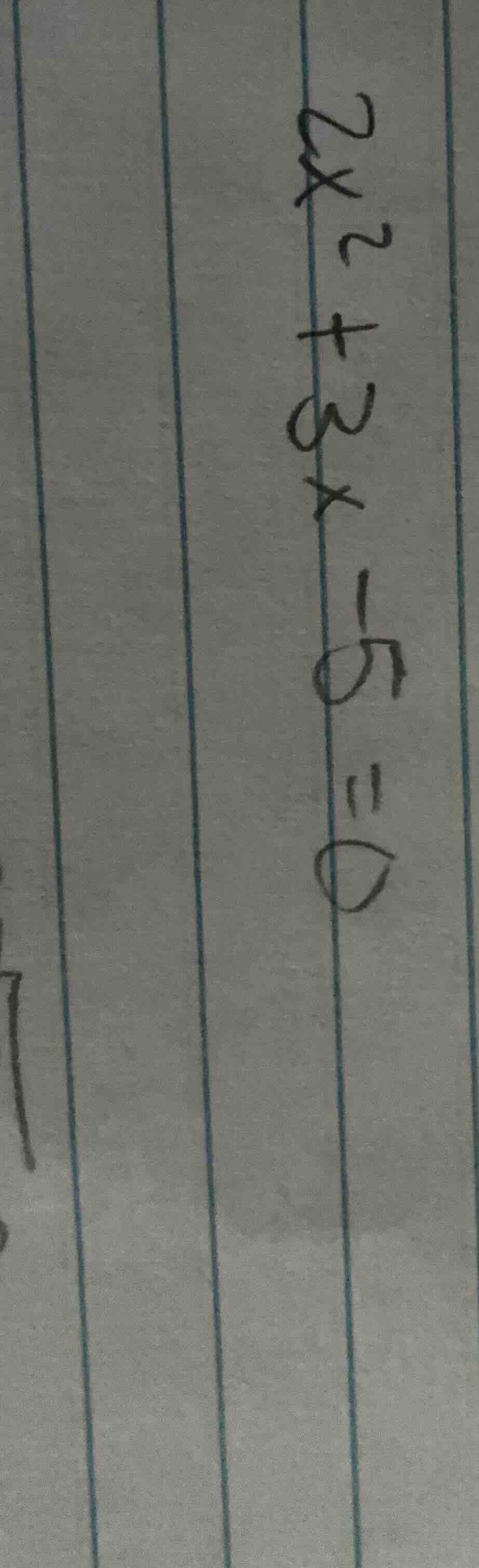
Question
2x² + 3x - 5 = 0
Step1: Identify the quadratic equation
The equation is \(2x^2 + 3x - 5 = 0\) (assuming the handwritten "15" is a typo and should be "5" to form a solvable quadratic, or if it's \(2x^2 + 3x - 15 = 0\), we can still use the quadratic formula). Let's use the quadratic formula \(x=\frac{-b\pm\sqrt{b^2 - 4ac}}{2a}\) for \(ax^2+bx+c = 0\).
For \(2x^2 + 3x - 5 = 0\), \(a = 2\), \(b = 3\), \(c=-5\).
Step2: Calculate the discriminant
Discriminant \(D=b^2 - 4ac=(3)^2-4\times2\times(-5)=9 + 40 = 49\)
Step3: Apply the quadratic formula
\(x=\frac{-3\pm\sqrt{49}}{2\times2}=\frac{-3\pm7}{4}\)
Case 1: \(x=\frac{-3 + 7}{4}=\frac{4}{4}=1\)
Case 2: \(x=\frac{-3 - 7}{4}=\frac{-10}{4}=-\frac{5}{2}\)
(If the equation was \(2x^2+3x - 15 = 0\), then \(a = 2\), \(b = 3\), \(c=-15\), discriminant \(D = 9+120 = 129\), and \(x=\frac{-3\pm\sqrt{129}}{4}\), but the handwritten "15" might be a miswriting, so we proceed with the more probable \(2x^2 + 3x - 5 = 0\))

Snap & solve any problem in the app
Get step-by-step solutions on Sovi AI
Photo-based solutions with guided steps
Explore more problems and detailed explanations
The solutions are \(x = 1\) and \(x=-\frac{5}{2}\) (or if the equation is \(2x^2 + 3x - 15 = 0\), solutions are \(x=\frac{-3\pm\sqrt{129}}{4}\))