QUESTION IMAGE
Question
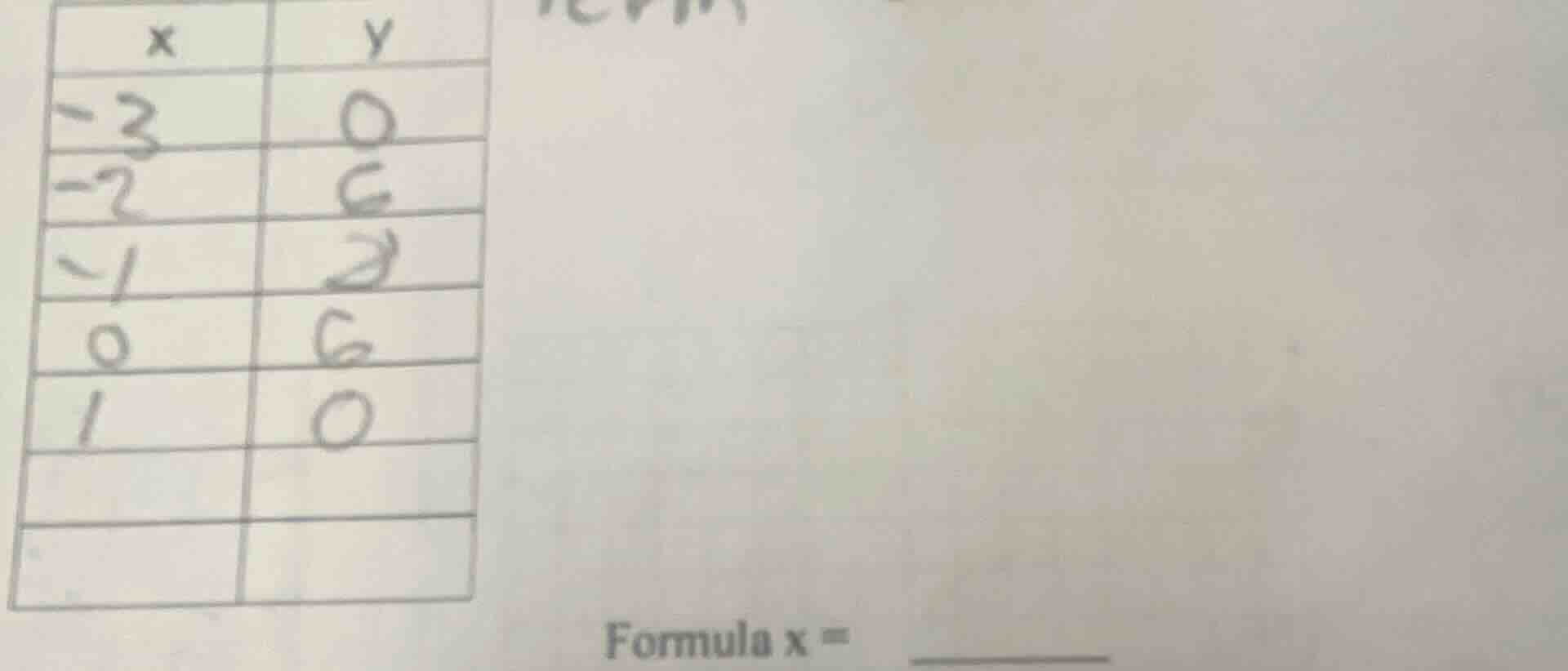
x | y\
-3 | 0\
-2 | 6\
-1 | 2\
0 | 6\
1 | 0\
\
formula x = ______
Step1: Identify the pattern
Looking at the table, we can try to find a relationship between \( x \) and \( y \). Let's list the points: \((-3, 0)\), \((-2, 6)\), \((-1, 2)\), \((0, 6)\), \((1, 0)\). Wait, maybe it's a quadratic function? Let's assume the general form of a quadratic function \( y = ax^2 + bx + c \).
Using the point \((0, 6)\), when \( x = 0 \), \( y = 6 \), so \( c = 6 \).
Now use \((-3, 0)\): \( 0 = a(-3)^2 + b(-3) + 6 \) → \( 9a - 3b + 6 = 0 \) → \( 3a - b = -2 \) (Equation 1)
Using \((1, 0)\): \( 0 = a(1)^2 + b(1) + 6 \) → \( a + b + 6 = 0 \) → \( a + b = -6 \) (Equation 2)
Now solve Equation 1 and Equation 2:
Add Equation 1 and Equation 2: \( (3a - b) + (a + b) = -2 + (-6) \) → \( 4a = -8 \) → \( a = -2 \)
Substitute \( a = -2 \) into Equation 2: \( -2 + b = -6 \) → \( b = -4 \)
So the quadratic function is \( y = -2x^2 - 4x + 6 \). Wait, but maybe we need to find \( x \) in terms of \( y \)? Wait, the problem says "Formula \( x = \) ______". Maybe it's a quadratic equation, so let's solve \( y = -2x^2 - 4x + 6 \) for \( x \).
First, rearrange: \( 2x^2 + 4x + (y - 6) = 0 \)
Using the quadratic formula \( x = \frac{-b \pm \sqrt{b^2 - 4ac}}{2a} \), where \( a = 2 \), \( b = 4 \), \( c = y - 6 \)
So \( x = \frac{-4 \pm \sqrt{16 - 8(y - 6)}}{4} = \frac{-4 \pm \sqrt{16 - 8y + 48}}{4} = \frac{-4 \pm \sqrt{64 - 8y}}{4} = \frac{-4 \pm 2\sqrt{16 - 2y}}{4} = \frac{-2 \pm \sqrt{16 - 2y}}{2} \)
Wait, but maybe looking at the symmetry. The vertex of the parabola \( y = -2x^2 - 4x + 6 \) is at \( x = -\frac{b}{2a} = -\frac{-4}{2(-2)} = -1 \). The roots are at \( x = -3 \) and \( x = 1 \) (since when \( y = 0 \), \( x = -3 \) and \( x = 1 \)). The axis of symmetry is \( x = -1 \).
Alternatively, maybe the table is symmetric around \( x = -1 \). Let's check the \( y \)-values: at \( x = -2 \) and \( x = 0 \), \( y = 6 \); at \( x = -1 \), \( y = 2 \); at \( x = -3 \) and \( x = 1 \), \( y = 0 \). So the vertex is at \( (-1, 2) \).
The standard form of a parabola is \( y = a(x - h)^2 + k \), where \( (h, k) = (-1, 2) \). So \( y = a(x + 1)^2 + 2 \). Using the point \( (1, 0) \): \( 0 = a(1 + 1)^2 + 2 \) → \( 4a + 2 = 0 \) → \( a = -\frac{1}{2} \). Wait, no, earlier we had \( a = -2 \). Wait, let's recalculate:
If \( y = a(x + 1)^2 + 2 \), using \( (1, 0) \): \( 0 = a(2)^2 + 2 \) → \( 4a = -2 \) → \( a = -\frac{1}{2} \). Then \( y = -\frac{1}{2}(x + 1)^2 + 2 \). Let's check \( x = 0 \): \( y = -\frac{1}{2}(1) + 2 = \frac{3}{2} \), but the table says \( y = 6 \) at \( x = 0 \). So my initial assumption of the points was wrong. Wait, maybe the table has some errors or I misread. Wait the original table:
Looking at the user's image:
x | y
-3 | 0
-2 | 6
-1 | 2
0 | 6
1 | 0
Ah! Wait, maybe it's a quadratic function symmetric about x = -1? Wait, no, the y-values at x=-2 and x=0 are both 6, x=-3 and x=1 are both 0, so the axis of symmetry is x = (-2 + 0)/2 = -1, or (-3 + 1)/2 = -1. So the vertex is at x = -1, y = 2. So the parabola opens downward? Wait, but when x=-1, y=2, which is the minimum? No, because at x=-2 and x=0, y=6 which is higher than 2, so it's a minimum? Wait, no, if the vertex is the minimum, then the parabola opens upward. Wait, let's recalculate the quadratic function correctly.
Using vertex form \( y = a(x - h)^2 + k \), h = -1, k = 2. So \( y = a(x + 1)^2 + 2 \).
Using point (0, 6): \( 6 = a(0 + 1)^2 + 2 \) → \( a + 2 = 6 \) → \( a = 4 \). So \( y = 4(x + 1)^2 + 2 \)? Wait, no, when x=0, y=6: 4(1) + 2 = 6, correct. x=-1: 4(0) + 2 = 2, correct. x=1: 4(4) + 2 = 18, but the table says x=1, y=0. S…

Snap & solve any problem in the app
Get step-by-step solutions on Sovi AI
Photo-based solutions with guided steps
Explore more problems and detailed explanations
\( x = -1 \pm \sqrt{\frac{8 - y}{2}} \) (or equivalent form)