QUESTION IMAGE
Question
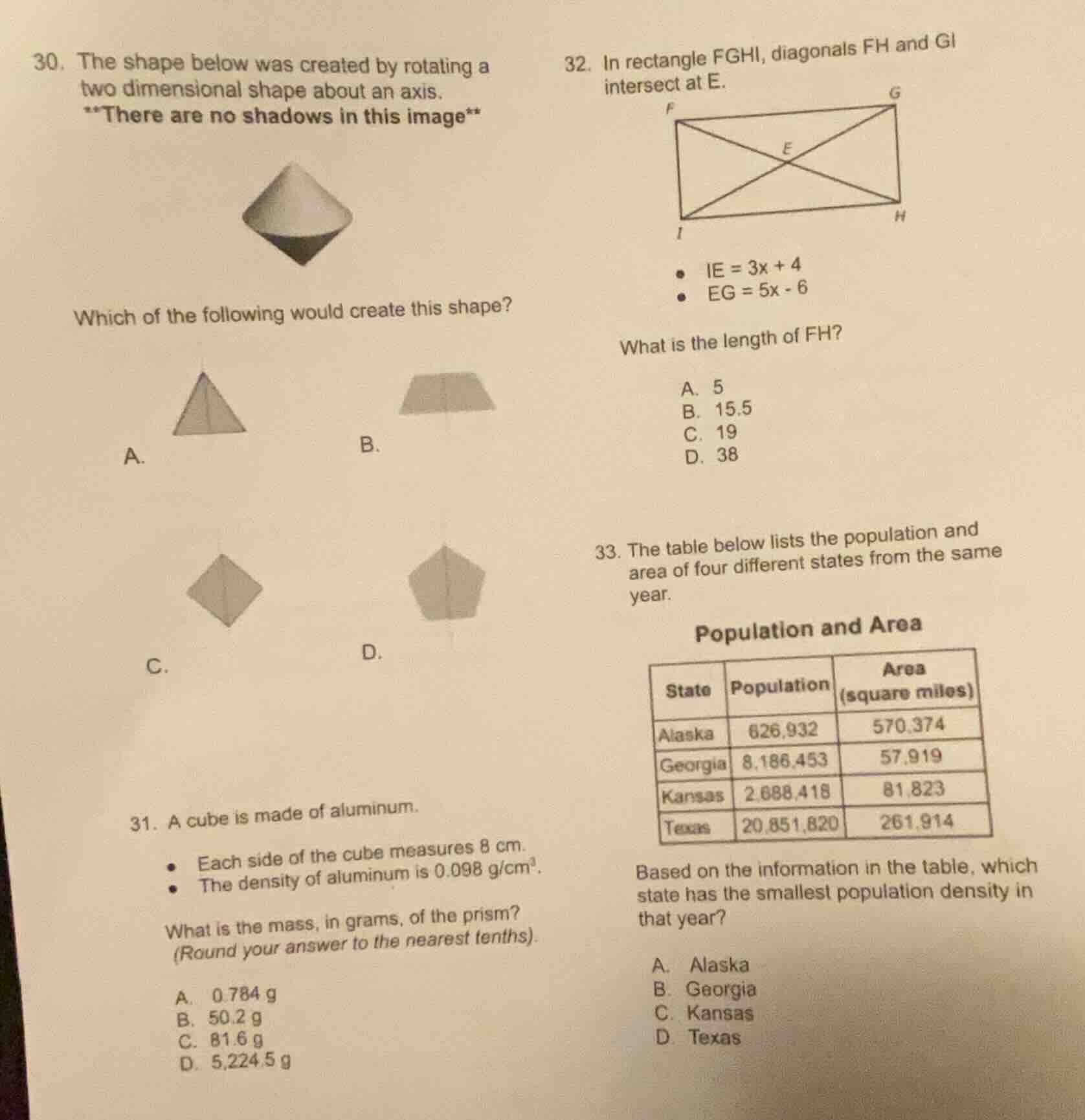
- the shape below was created by rotating a two dimensional shape about an axis. there are no shadows in this image
image of a 3d shape formed by two cones attached at their bases
which of the following would create this shape?
a. triangle, b. trapezoid, c. rhombus, d. pentagon
- a cube is made of aluminum.
- each side of the cube measures 8 cm.
- the density of aluminum is 0.098 g/cm³.
what is the mass, in grams, of the prism? (round your answer to the nearest tenths).
a. 0.784 g
b. 50.2 g
c. 81.6 g
d. 5,224.5 g
- in rectangle fghi, diagonals fh and gi intersect at e.
image of rectangle fghi with diagonals intersecting at e
- ie = 3x + 4
- eg = 5x - 6
what is the length of fh?
a. 5
b. 15.5
c. 19
d. 38
- the table below lists the population and area of four different states from the same year.
population and area
| state | population | area (square miles) |
|---|---|---|
| georgia | 8,186,453 | 57,919 |
| kansas | 2,888,418 | 81,823 |
| texas | 20,851,820 | 261,914 |
based on the information in the table, which state has the smallest population density in that year?
a. alaska
b. georgia
c. kansas
d. texas
Question 30
The 3D shape is two cones (one inverted) attached, formed by rotating a triangle (option A) about an axis. A triangle rotated around its altitude forms a cone; rotating a triangle (like in option A) about the axis of symmetry would create a double - cone (the given shape). Option B is a trapezoid (rotating it would form a frustum or other shape), option C is a rhombus (rotating it would form a different solid), option D is a pentagon (rotating it would form a pentagonal - based solid).
Step1: Calculate volume of cube
The volume \(V\) of a cube with side length \(s\) is given by \(V = s^{3}\). Given \(s = 8\space cm\), so \(V=8^{3}=512\space cm^{3}\).
Step2: Use density formula to find mass
Density \(
ho=\frac{m}{V}\), so \(m=
ho\times V\). Given \(
ho = 0.098\space g/cm^{3}\) and \(V = 512\space cm^{3}\), then \(m=0.098\times512 = 50.176\space g\).
Step3: Round to nearest tenths
Rounding \(50.176\) to the nearest tenths gives \(50.2\space g\).
Step1: Recall property of rectangle diagonals
In a rectangle, the diagonals are equal and bisect each other. So \(IE = EG\) (since diagonals bisect each other, \(E\) is the mid - point of \(GI\) and \(FH\)).
Step2: Solve for \(x\)
Set \(3x + 4=5x - 6\). Subtract \(3x\) from both sides: \(4 = 2x-6\). Add \(6\) to both sides: \(10 = 2x\). Divide by \(2\): \(x = 5\).
Step3: Find length of \(IE\) (or \(EG\))
Substitute \(x = 5\) into \(IE=3x + 4\), \(IE=3\times5 + 4=15 + 4 = 19\).
Step4: Find length of \(FH\)
Since diagonals in a rectangle are equal and \(FH = GI\), and \(GI=IE + EG=19 + 19 = 38\) (because \(IE = EG\)), so \(FH = 38\).

Snap & solve any problem in the app
Get step-by-step solutions on Sovi AI
Photo-based solutions with guided steps
Explore more problems and detailed explanations
A