QUESTION IMAGE
Question
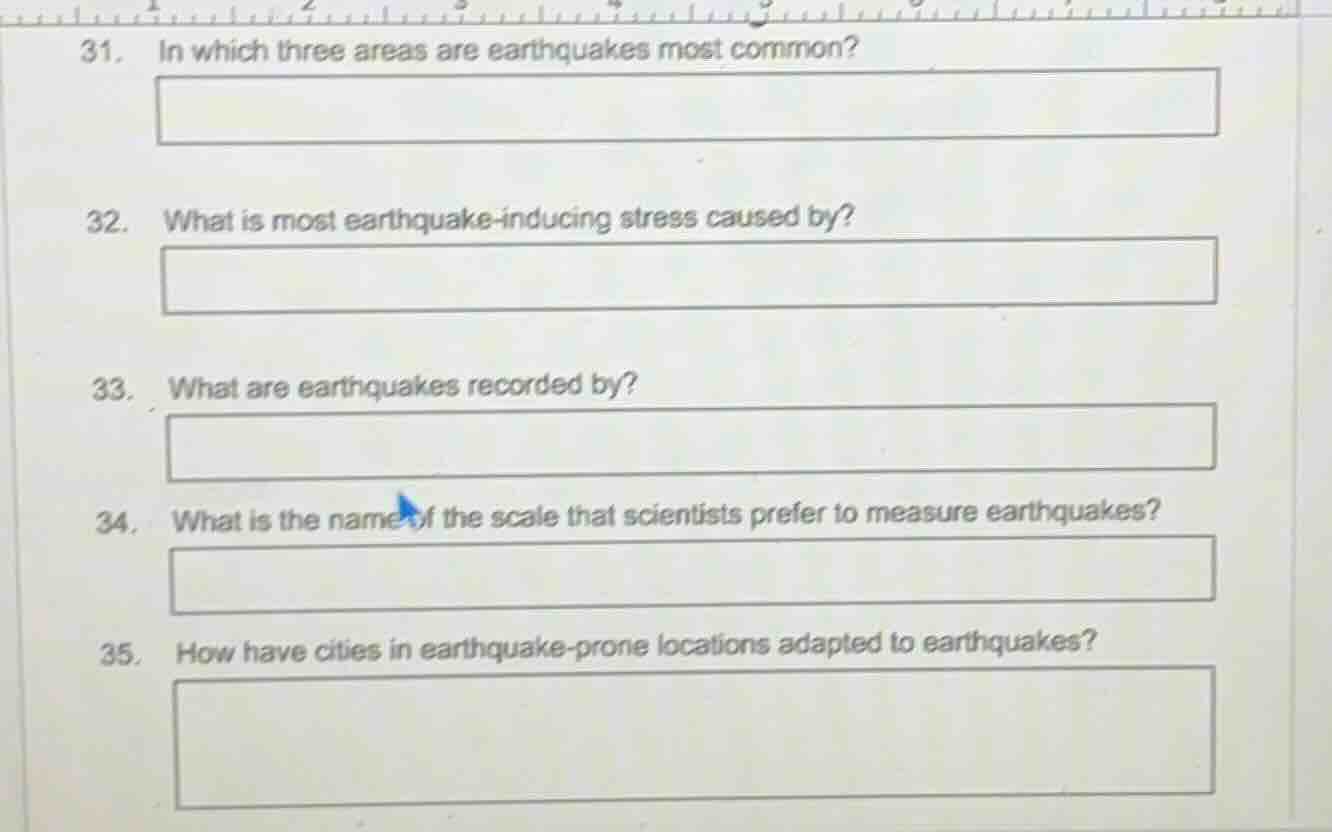
- in which three areas are earthquakes most common?
- what is most earthquake-inducing stress caused by?
- what are earthquakes recorded by?
- what is the name of the scale that scientists prefer to measure earthquakes?
- how have cities in earthquake-prone locations adapted to earthquakes?
Brief Explanations
- Earthquakes cluster at tectonic plate boundaries, where the three most active zones are the Pacific Ring of Fire, the Alpide Belt, and the Mid-Atlantic Ridge.
- The vast majority of earthquake-causing stress comes from the slow movement and interaction of Earth's tectonic plates, which build up friction and pressure along faults.
- Seismic instruments called seismometers (or seismographs, the full system including recording devices) detect and record the seismic waves produced by earthquakes.
- Scientists prefer the Moment Magnitude Scale because it accurately measures the total energy released by an earthquake, working for all quake sizes better than older scales.
- Cities in high-risk areas use earthquake-resistant building designs (like flexible foundations, reinforced materials), early warning systems, public preparedness drills, and land-use planning to avoid high-risk zones.

Snap & solve any problem in the app
Get step-by-step solutions on Sovi AI
Photo-based solutions with guided steps
Explore more problems and detailed explanations
- The Pacific Ring of Fire, the Alpide Belt, and the Mid-Atlantic Ridge
- The movement and interaction of Earth's tectonic plates
- Seismometers (or seismograph systems)
- Moment Magnitude Scale
- They use earthquake-resistant construction, early warning systems, public preparedness training, and careful land-use planning to reduce risk.