QUESTION IMAGE
Question
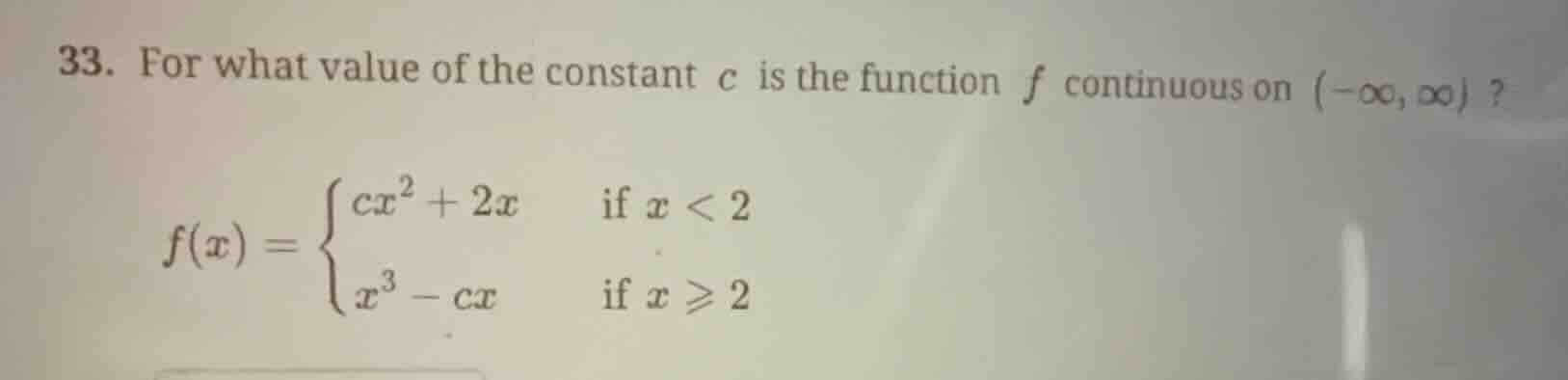
- for what value of the constant ( c ) is the function ( f ) continuous on ( (-infty, infty) ) ?
( f(x) = \begin{cases} cx^2 + 2x & \text{if } x < 2 \\ x^3 - cx & \text{if } x ge 2 end{cases} )
Step1: Recall the definition of continuity at a point
For a function \( f(x) \) to be continuous at \( x = a \), the following three conditions must hold:
- \( f(a) \) is defined.
- \( \lim_{x \to a^{-}} f(x) \) (left - hand limit) exists.
- \( \lim_{x \to a^{+}} f(x) \) (right - hand limit) exists.
- \( \lim_{x \to a^{-}} f(x)=\lim_{x \to a^{+}} f(x)=f(a) \)
In our case, the function is a piece - wise function and we need to check the continuity at \( x = 2 \) (since the function is composed of two polynomials, which are continuous everywhere in their respective domains, so the only possible point of discontinuity is at \( x = 2 \)).
Step2: Calculate the left - hand limit as \( x\to2^{-} \)
When \( x\to2^{-} \), we use the part of the function \( f(x)=cx^{2}+2x \) (because for \( x < 2 \), this is the definition of \( f(x) \)).
We calculate the limit: \( \lim_{x\to2^{-}}f(x)=\lim_{x\to2^{-}}(cx^{2}+2x) \)
Substitute \( x = 2 \) into \( cx^{2}+2x \) (since polynomials are continuous, we can use direct substitution):
\( \lim_{x\to2^{-}}(cx^{2}+2x)=c(2)^{2}+2(2)=4c + 4 \)
Step3: Calculate the right - hand limit as \( x\to2^{+} \)
When \( x\to2^{+} \), we use the part of the function \( f(x)=x^{3}-cx \) (because for \( x\geq2 \), this is the definition of \( f(x) \)).
We calculate the limit: \( \lim_{x\to2^{+}}f(x)=\lim_{x\to2^{+}}(x^{3}-cx) \)
Substitute \( x = 2 \) into \( x^{3}-cx \) (since polynomials are continuous, we can use direct substitution):
\( \lim_{x\to2^{+}}(x^{3}-cx)=2^{3}-c(2)=8 - 2c \)
Step4: Calculate \( f(2) \)
Since \( x = 2 \) is in the domain \( x\geq2 \), we use \( f(x)=x^{3}-cx \). So \( f(2)=2^{3}-c(2)=8 - 2c \)
Step5: Set the left - hand limit equal to the right - hand limit (and equal to \( f(2) \))
For the function to be continuous at \( x = 2 \), we need \( \lim_{x\to2^{-}}f(x)=\lim_{x\to2^{+}}f(x) \)
So, \( 4c + 4=8 - 2c \)
Add \( 2c \) to both sides of the equation:
\( 4c+2c + 4=8-2c + 2c \)
\( 6c+4 = 8 \)
Subtract 4 from both sides:
\( 6c+4 - 4=8 - 4 \)
\( 6c=4 \)
Divide both sides by 6:
\( c=\frac{4}{6}=\frac{2}{3} \)

Snap & solve any problem in the app
Get step-by-step solutions on Sovi AI
Photo-based solutions with guided steps
Explore more problems and detailed explanations
\( \frac{2}{3} \)