QUESTION IMAGE
Question
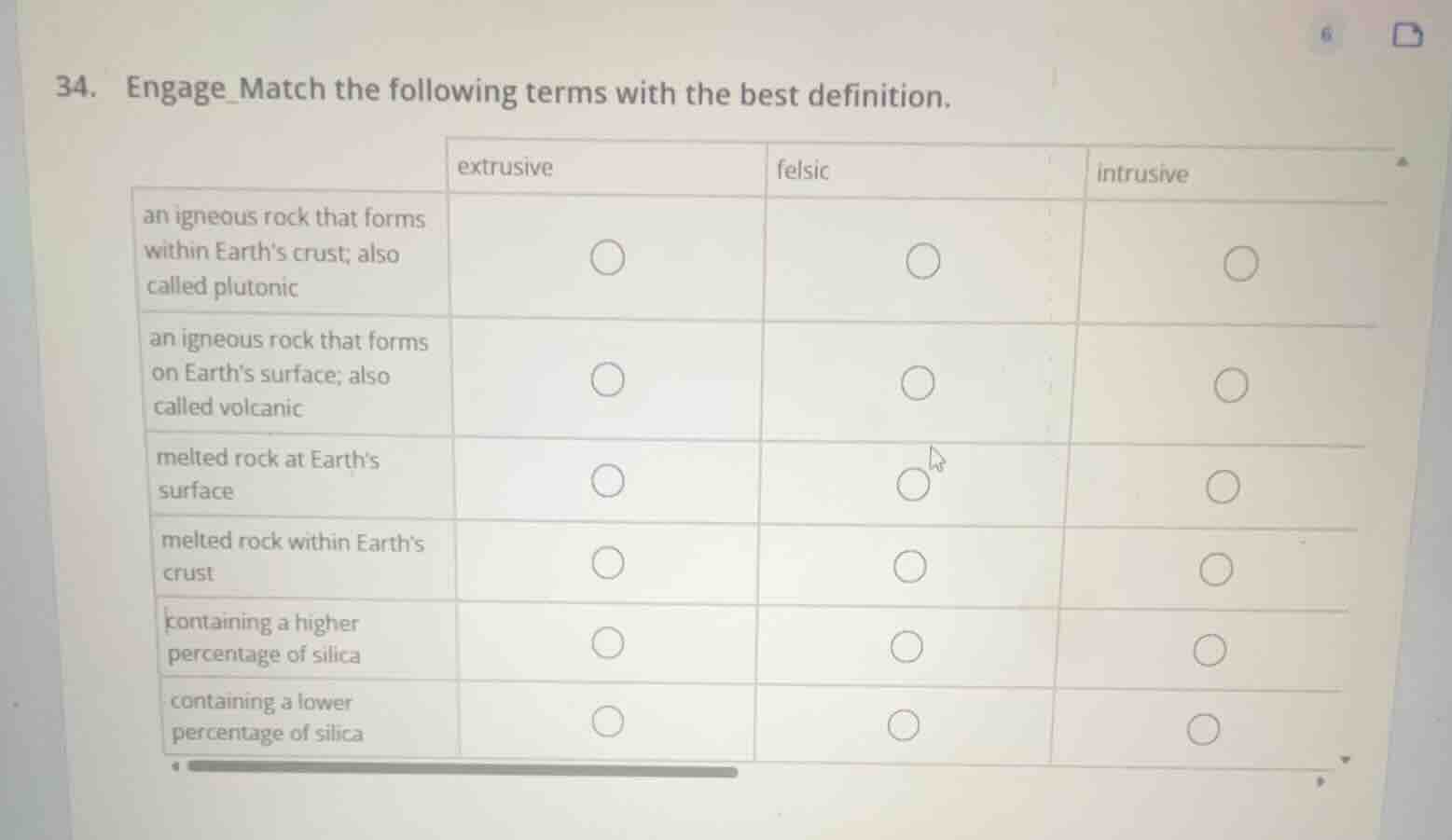
- engage_match the following terms with the best definition.
| extrusive | felsic | intrusive | |
|---|---|---|---|
| an igneous rock that forms on earth’s surface; also called volcanic | ○ | ○ | ○ |
| melted rock at earth’s surface | ○ | ○ | ○ |
| melted rock within earth’s crust | ○ | ○ | ○ |
| containing a higher percentage of silica | ○ | ○ | ○ |
| containing a lower percentage of silica | ○ | ○ | ○ |
Brief Explanations
- For "an igneous rock that forms within Earth’s crust; also called plutonic" → matches "intrusive" (intrusive rocks form inside the crust, plutonic is another term for intrusive).
- For "an igneous rock that forms on Earth’s surface; also called volcanic" → matches "extrusive" (extrusive rocks form on the surface, volcanic is another term for extrusive).
- For "melted rock at Earth’s surface" → this is "lava", but since the options are extrusive, felsic, intrusive, maybe a typo, but if we consider extrusive context (surface), but actually "melted rock at surface" is lava, but among the given terms, maybe extrusive? Wait, no—extrusive is the rock, not the melted. Wait, maybe the table has a mix. Wait, correct matches:
- intrusive: forms within crust (plutonic)
- extrusive: forms on surface (volcanic)
- felsic: containing higher silica (felsic rocks are silica - rich, like granite)
- Also, "melted rock at Earth’s surface" is lava (but not a term here), "melted rock within Earth’s crust" is magma (not a term here). Wait, the terms are extrusive, felsic, intrusive. So:
- "an igneous rock that forms within Earth’s crust; also called plutonic" → intrusive (circle intrusive column for this row)
- "an igneous rock that forms on Earth’s surface; also called volcanic" → extrusive (circle extrusive column for this row)
- "containing a higher percentage of silica" → felsic (circle felsic column for this row)
- The other rows: "melted rock at Earth’s surface" – maybe extrusive - related but not a rock term. "melted rock within Earth’s crust" – intrusive - related but not a rock term. But based on standard definitions:
- Intrusive: forms inside crust (plutonic)
- Extrusive: forms on surface (volcanic)
- Felsic: high silica
- (The other two rows about melted rock: "melted rock at surface" is lava (not a rock type term here), "melted rock within crust" is magma (not a rock type term here), so maybe the table has some mis - phrasing, but focusing on the rock type terms: extrusive (volcanic rock), intrusive (plutonic rock), felsic (silica - rich).

Snap & solve any problem in the app
Get step-by-step solutions on Sovi AI
Photo-based solutions with guided steps
Explore more problems and detailed explanations
- Row 1 ("an igneous rock that forms within Earth’s crust; also called plutonic"): intrusive (circle the option under "intrusive" for this row)
- Row 2 ("an igneous rock that forms on Earth’s surface; also called volcanic"): extrusive (circle the option under "extrusive" for this row)
- Row 5 ("containing a higher percentage of silica"): felsic (circle the option under "felsic" for this row)
(Note: For the rows about "melted rock", if we assume a mis - label, "melted rock at Earth’s surface" (lava) might be related to extrusive formation context, but since the terms are rock types (extrusive, felsic, intrusive), the main matches are as above. If forced to match the given terms:
- "melted rock at Earth’s surface" – no direct term, but maybe extrusive (but incorrect as extrusive is rock, not melted).
- "melted rock within Earth’s crust" – no direct term, but maybe intrusive (incorrect as intrusive is rock, not melted). But the key rock - type matches are the three above.)