QUESTION IMAGE
Question
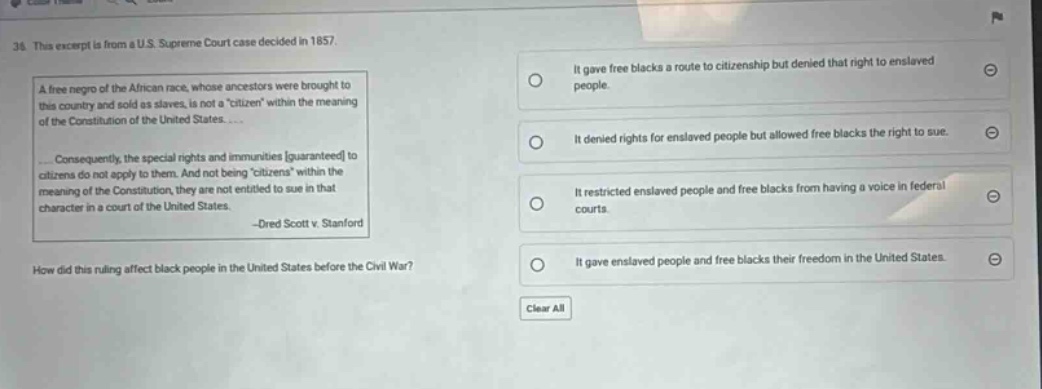
- this excerpt is from a u.s. supreme court case decided in 1857. a free negro of the african race, whose ancestors were brought to this country and sold as slaves, is not a \citizen\ within the meaning of the constitution of the united states.... consequently, the special rights and immunities guaranteed to citizens do not apply to them. and not being \citizens\ within the meaning of the constitution, they are not entitled to sue in that character in a court of the united states. --dred scott v. stanford how did this ruling affect black people in the united states before the civil war? it gave free blacks a route to citizenship but denied that right to enslaved people. it denied rights for enslaved people but allowed free blacks the right to sue. it restricted enslaved people and free blacks from having a voice in federal courts. it gave enslaved people and free blacks their freedom in the united states. clear all
Brief Explanations
El caso Dred Scott v. Stanford (1857) estableció que personas de raza africana (libres o esclavizadas) no eran ciudadanos de EE.UU. y, por tanto, no podían demandar en tribunales federales. Analicemos las opciones:
- Opción 1: El fallo no dio ruta a la ciudadanía a los negros libres (afirmó que no eran ciudadanos), así que esta está errada.
- Opción 2: El fallo denegó el derecho de los negros libres a demandar (dijo que no eran ciudadanos, así que no tenían ese derecho), así que esta está errada.
- Opción 3: Al afirmar que negros (libres o esclavizados) no eran ciudadanos, les negaba la capacidad de participar o ser parte de los tribunales federales (no podían demandar, ni tenían los derechos de ciudadanía que implicarían "voz" en esos tribunales), así que esta es correcta.
- Opción 4: El fallo no dio libertad a esclavizados o negros libres (tuvo el efecto opuesto, afirmando que la esclavitud era legal en territorios, etc.), así que esta está errada.

Snap & solve any problem in the app
Get step-by-step solutions on Sovi AI
Photo-based solutions with guided steps
Explore more problems and detailed explanations
C. It restricted enslaved people and free blacks from having a voice in federal courts