QUESTION IMAGE
Question
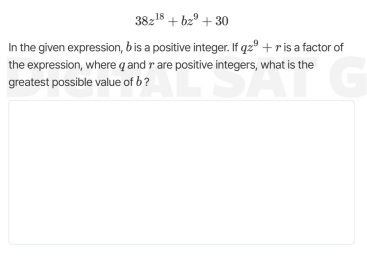
38z^{18}+b z^9 + 30
in the given expression, ( b ) is a positive integer. if ( q z^9 + r ) is a factor of
the expression, where ( q ) and ( r ) are positive integers, what is the
greatest possible value of ( b )?
z^{18}+r)+(bz^9 +30 -kr)$. For this to be divisible, $bz^9 +30 -kr=0$ for all $z$, which is impossible unless $b=0$, which is not positive. So $n$ must divide 9 or 18 such that the $z^9$ term is eliminated. The only possible $n$ is 9, because if $n$ divides 18 but not 9, i.e., $n=1,2,6$, then substituting $z=-r/q$ gives $38(r/q)^{18} -b(r/q)^9 +30=0$, which is same as $38y^2 -by +30=0$ where $y=(r/q)^9$. But $y=(r/q)^9$ would be $(r/q)^{n*(9/n)}$, so if $n=1$, $y=(r/q)^9$, which is rational. But the factor would be $qz +r$, which divides the polynomial only if $z=-r/q$ is a root, which gives the same equation. But the polynomial would factor as $(qz +r)(...)$, but the polynomial has only even powers of $z^9$, so it's a quadratic in $z^9$. So the only possible linear factors in $z^9$ are linear in $w=z^9$, so factors are $aw +b$, which correspond to $n=9$, $q=a$, $r=b$. So my initial mistake was considering $n
eq9$, but actually, since the polynomial is a quadratic in $w=z^9$, the only possible polynomial factors of the form $qz^n +r$ are linear in $w$, i.e., $n=9$, because any other $n$ would lead to a factor that is not linear in $w$, and the polynomial has no other terms. So correct approach: treat as quadratic in $w=z^9$: $38w^2 +bw +30$. Factors are $(mw +n)(pw +q)$ where $mp=38$, $nq=30$, $b=mq+np$, $m,n,p,q$ positive integers. Now find maximum $b$:
$mp=38$: pairs $(1,38),(2,19),(19,2),(38,1)$
$nq=30$: pairs $(1,30),(2,15),(3,10),(5,6),(6,5),(10,3),(15,2),(30,1)$
Calculate $b=mq+np$:
- $(1,38)$ with $(30,1)$: $1*1 +38*30=1+1140=1141$
- $(38,1)$ with $(1,30)$: $38*30 +1*1=1140+1=1141$
- $(2,19)$ with $(30,1)$: $2*1 +19*30=2+570=572$
- $(19,2)$ with $(1,30)$: $19*30 +2*1=570+2=572$
So the maximum $b$ is 1141. Wait but why did I get confused earlier? Because I forgot that $n$ must be 9, since the polynomial is quadratic in $z^9$, so factors must be linear in $z^9$, hence $n=9$. So the factor is $qz^9 +r$, which is linear in $w=z^9$, so $(q w + r)(s w + t)=38w^2 +bw +30$, so $qs=38$, $rt=30$, $b=qt + rs$. To maximize $b$, take the largest possible product terms: $q=1,s=38$, $r=30,t=1$: $b=1*1 +38*30=1141$, or $q=38,s=1$, $r=1,t=30$: $

Snap & solve any problem in the app
Get step-by-step solutions on Sovi AI
Photo-based solutions with guided steps
Explore more problems and detailed explanations
z^{18}+r)+(bz^9 +30 -kr)$. For this to be divisible, $bz^9 +30 -kr=0$ for all $z$, which is impossible unless $b=0$, which is not positive. So $n$ must divide 9 or 18 such that the $z^9$ term is eliminated. The only possible $n$ is 9, because if $n$ divides 18 but not 9, i.e., $n=1,2,6$, then substituting $z=-r/q$ gives $38(r/q)^{18} -b(r/q)^9 +30=0$, which is same as $38y^2 -by +30=0$ where $y=(r/q)^9$. But $y=(r/q)^9$ would be $(r/q)^{n*(9/n)}$, so if $n=1$, $y=(r/q)^9$, which is rational. But the factor would be $qz +r$, which divides the polynomial only if $z=-r/q$ is a root, which gives the same equation. But the polynomial would factor as $(qz +r)(...)$, but the polynomial has only even powers of $z^9$, so it's a quadratic in $z^9$. So the only possible linear factors in $z^9$ are linear in $w=z^9$, so factors are $aw +b$, which correspond to $n=9$, $q=a$, $r=b$. So my initial mistake was considering $n
eq9$, but actually, since the polynomial is a quadratic in $w=z^9$, the only possible polynomial factors of the form $qz^n +r$ are linear in $w$, i.e., $n=9$, because any other $n$ would lead to a factor that is not linear in $w$, and the polynomial has no other terms. So correct approach: treat as quadratic in $w=z^9$: $38w^2 +bw +30$. Factors are $(mw +n)(pw +q)$ where $mp=38$, $nq=30$, $b=mq+np$, $m,n,p,q$ positive integers. Now find maximum $b$:
$mp=38$: pairs $(1,38),(2,19),(19,2),(38,1)$
$nq=30$: pairs $(1,30),(2,15),(3,10),(5,6),(6,5),(10,3),(15,2),(30,1)$
Calculate $b=mq+np$:
- $(1,38)$ with $(30,1)$: $1*1 +38*30=1+1140=1141$
- $(38,1)$ with $(1,30)$: $38*30 +1*1=1140+1=1141$
- $(2,19)$ with $(30,1)$: $2*1 +19*30=2+570=572$
- $(19,2)$ with $(1,30)$: $19*30 +2*1=570+2=572$
So the maximum $b$ is 1141. Wait but why did I get confused earlier? Because I forgot that $n$ must be 9, since the polynomial is quadratic in $z^9$, so factors must be linear in $z^9$, hence $n=9$. So the factor is $qz^9 +r$, which is linear in $w=z^9$, so $(q w + r)(s w + t)=38w^2 +bw +30$, so $qs=38$, $rt=30$, $b=qt + rs$. To maximize $b$, take the largest possible product terms: $q=1,s=38$, $r=30,t=1$: $b=1*1 +38*30=1141$, or $q=38,s=1$, $r=1,t=30$: $