QUESTION IMAGE
Question
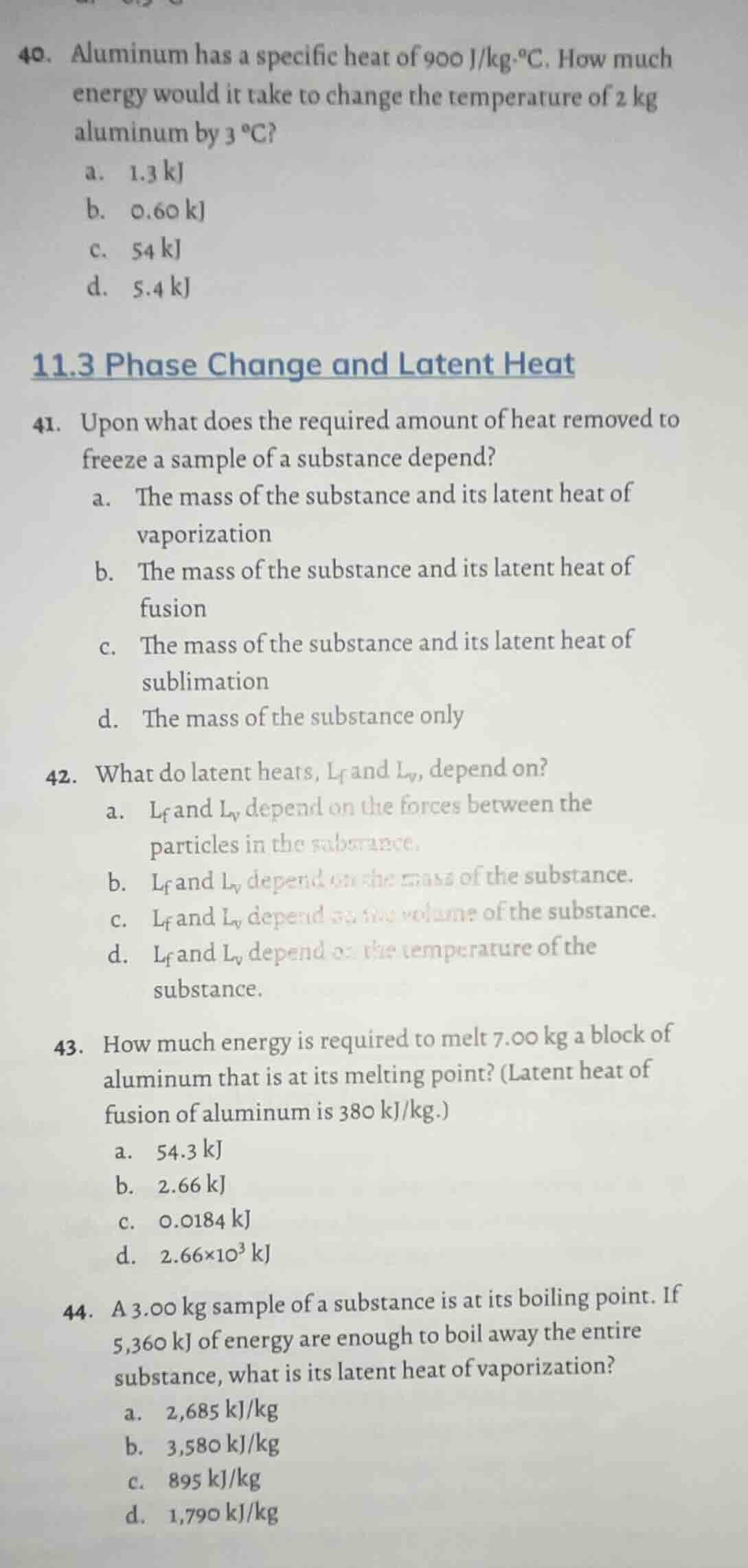
- aluminum has a specific heat of 900 j/kg·°c. how much energy would it take to change the temperature of 2 kg aluminum by 3 °c?
a. 1.3 kj
b. 0.60 kj
c. 54 kj
d. 5.4 kj
11.3 phase change and latent heat
- upon what does the required amount of heat removed to freeze a sample of a substance depend?
a. the mass of the substance and its latent heat of vaporization
b. the mass of the substance and its latent heat of fusion
c. the mass of the substance and its latent heat of sublimation
d. the mass of the substance only
- what do latent heats, ( l_f ) and ( l_v ), depend on?
a. ( l_f ) and ( l_v ) depend on the forces between the particles in the substance.
b. ( l_f ) and ( l_v ) depend on the mass of the substance.
c. ( l_f ) and ( l_v ) depend on the volume of the substance.
d. ( l_f ) and ( l_v ) depend on the temperature of the substance.
- how much energy is required to melt 7.00 kg a block of aluminum that is at its melting point? (latent heat of fusion of aluminum is 380 kj/kg.)
a. 54.3 kj
b. 2.66 kj
c. 0.0184 kj
d. ( 2.66 \times 10^3 ) kj
- a 3.00 kg sample of a substance is at its boiling point. if 5,360 kj of energy are enough to boil away the entire substance, what is its latent heat of vaporization?
a. 2,685 kj/kg
b. 3,580 kj/kg
c. 895 kj/kg
d. 1,790 kj/kg
Step1: Identify heat transfer formula
The energy required to change temperature is given by $Q = mc\Delta T$, where $m$ = mass, $c$ = specific heat, $\Delta T$ = temperature change.
Step2: Plug in given values
$m=2\ \text{kg}$, $c=900\ \text{J/kg}^\circ\text{C}$, $\Delta T=3^\circ\text{C}$
$Q = 2 \times 900 \times 3 = 5400\ \text{J}$
Step3: Convert to kilojoules
$\frac{5400}{1000} = 5.4\ \text{kJ}$
Freezing is a phase change from liquid to solid, which depends on the mass of the substance and the latent heat of fusion (the heat released when a substance freezes). Latent heat of vaporization applies to liquid-gas changes, sublimation to solid-gas changes, and mass alone is not sufficient.
Latent heats ($L_f$ for fusion, $L_v$ for vaporization) are properties of a substance that depend on the intermolecular forces between its particles. They do not depend on the mass, volume, or temperature of the sample (at the phase change temperature).
Step1: Identify latent heat formula
Energy to melt a substance at melting point is $Q = mL_f$, where $m$ = mass, $L_f$ = latent heat of fusion.
Step2: Plug in given values
$m=7.00\ \text{kg}$, $L_f=380\ \text{kJ/kg}$
$Q = 7.00 \times 380 = 2660\ \text{kJ}$
Step3: Rewrite in scientific notation
$2660 = 2.66 \times 10^3\ \text{kJ}$

Snap & solve any problem in the app
Get step-by-step solutions on Sovi AI
Photo-based solutions with guided steps
Explore more problems and detailed explanations
d. 5.4 kJ
---