QUESTION IMAGE
Question
- a cars velocity after each consecutive second of motion is 2 m/s, 4 m/s, 6 m/s, 8 m/s. this is evidence that the car is ______.
a. moving with a constant velocity
b. moving with a constant speed
c. moving with a constant acceleration
- a beryllium atom has 4 protons, 5 neutrons, and 4 electrons. when drawing the bohr model of beryllium, which of the following statements correctly describes the number and placement of electrons?
a. 4 electrons in the first ring
b. 2 electrons in the first ring and 2 electrons in the second ring
c. 5 electrons in the first ring
d. 2 electrons in the first ring and 3 electrons in the second ring
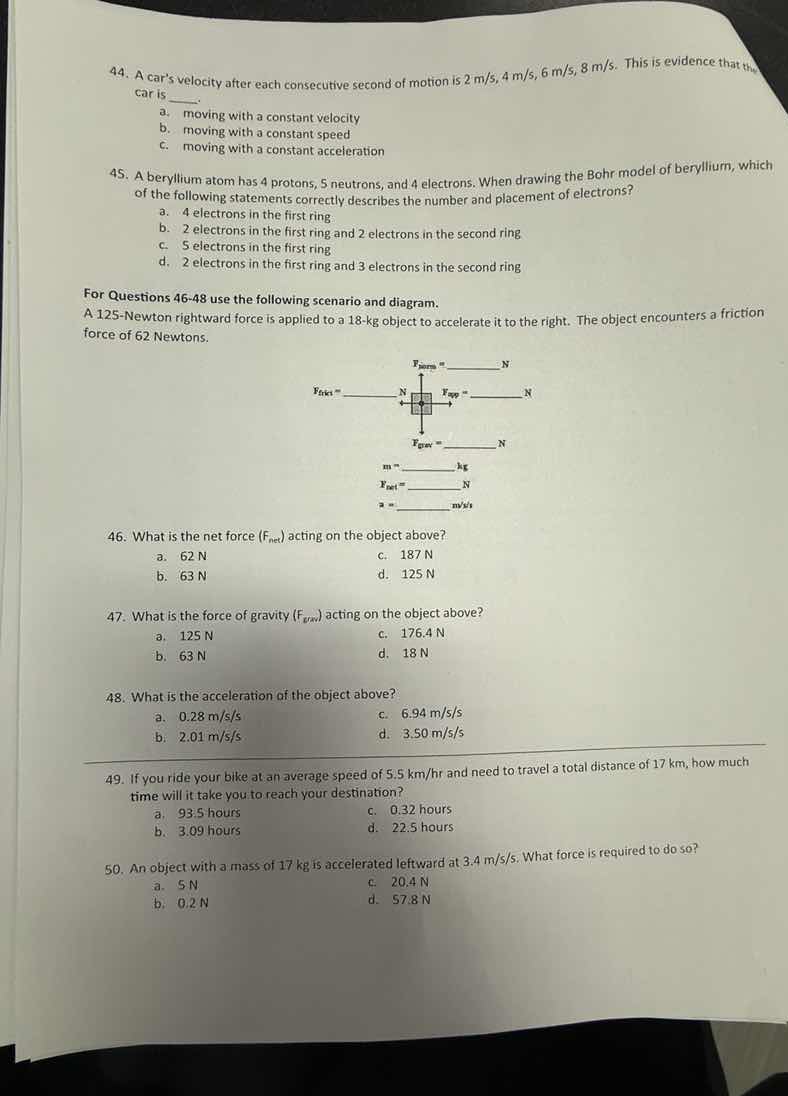
for questions 46 - 48 use the following scenario and diagram.
a 125 - newton rightward force is applied to a 18 - kg object to accelerate it to the right. the object encounters a friction force of 62 newtons.
diagram of a free - body diagram with labels for forces, mass, and acceleration
- what is the net force ($f_{net}$) acting on the object above?
a. 62 n
b. 63 n
c. 187 n
d. 125 n
- what is the force of gravity ($f_{grav}$) acting on the object above?
a. 125 n
b. 63 n
c. 176.4 n
d. 18 n
- what is the acceleration of the object above?
a. 0.28 m/s
b. 2.01 m/s²
c. 6.94 m/s²
d. 3.50 m/s²
- if you ride your bike at an average speed of 5.5 km/hr and need to travel a total distance of 17 km, how much time will it take you to reach your destination?
a. 93.5 hours
b. 3.09 hours
c. 0.32 hours
d. 22.5 hours
- an object with a mass of 17 kg is accelerated leftward at 3.4 m/s². what force is required to do so?
a. 5 n
b. 0.2 n
c. 20.4 n
d. 57.8 n
Question 44
To determine the car's motion, we analyze the velocity change. The velocity increases by 2 m/s each second (4 - 2 = 2, 6 - 4 = 2, 8 - 6 = 2). Acceleration is the rate of velocity change. A constant acceleration means velocity changes by a constant amount per unit time. Constant velocity would mean velocity doesn't change, and constant speed is about magnitude (but here direction isn't mentioned, but velocity is changing). So the car has constant acceleration.
In the Bohr model, the first electron shell (ring) can hold a maximum of 2 electrons, and the second shell can hold up to 8. Beryllium has 4 electrons. So 2 in the first ring and 2 in the second ring (2 + 2 = 4). Option a (4 in first) is wrong (first shell can't hold 4), option c (5 electrons) is wrong (beryllium has 4), option d (3 in second) would mean 2 + 3 = 5, which is wrong.
Step1: Identify forces
The applied force is 125 N rightward, friction is 62 N leftward. Net force is applied force minus friction (since they're in opposite directions).
Step2: Calculate net force
$F_{net} = F_{applied} - F_{friction} = 125 - 62 = 63$ N

Snap & solve any problem in the app
Get step-by-step solutions on Sovi AI
Photo-based solutions with guided steps
Explore more problems and detailed explanations
c. moving with a constant acceleration