QUESTION IMAGE
Question
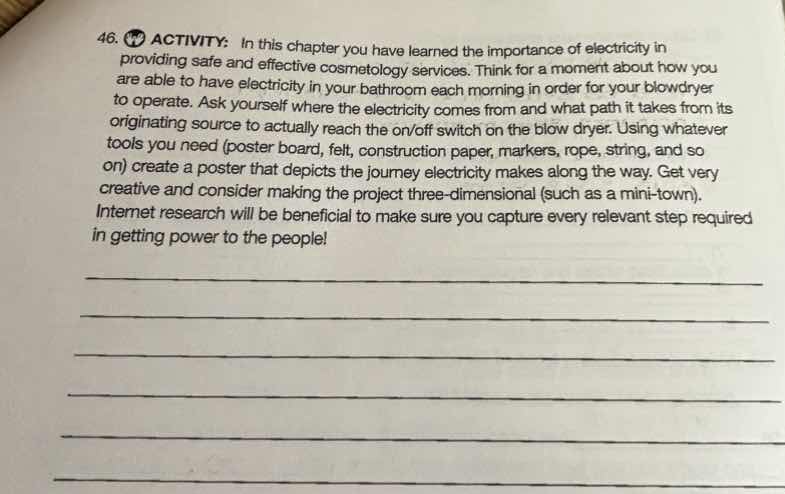
- activity: in this chapter you have learned the importance of electricity in providing safe and effective cosmetology services. think for a moment about how you are able to have electricity in your bathroom each morning in order for your blowdryer to operate. ask yourself where the electricity comes from and what path it takes from its originating source to actually reach the on/off switch on the blow dryer. using whatever tools you need (poster board, felt, construction paper, markers, rope, string, and so on) create a poster that depicts the journey electricity makes along the way. get very creative and consider making the project three - dimensional (such as a mini - town). internet research will be beneficial to make sure you capture every relevant step required in getting power to the people!
The problem here is an activity related to understanding the path of electricity for a blow - dryer in a bathroom. To solve this (in terms of planning the poster), we can follow these steps:
Step 1: Identify the power source
The electricity for a household blow - dryer typically comes from the power grid. This power is generated at a power plant (either a coal - fired, nuclear, hydroelectric, or other type of power plant) and then transmitted over high - voltage power lines to a local substation. At the substation, the voltage is stepped down for distribution to residential areas.
Step 2: Trace the path to the building
From the substation, the electricity is sent through distribution lines (usually underground or on utility poles) to the meter box of the building (in this case, the house or apartment where the bathroom is located). The meter measures the amount of electricity used.
Step 3: Path within the building
After the meter, the electricity enters the main electrical panel of the building. In the main panel, the power is distributed through circuit breakers to different circuits in the house. For a bathroom blow - dryer, it is likely connected to a dedicated circuit (often a 15 - or 20 - amp circuit, especially if it is a GFCI - protected circuit for safety in a wet environment like a bathroom). The electricity then travels through the electrical wiring within the walls of the building to the electrical outlet (or switch - outlet combination) in the bathroom.
Step 4: Path to the blow - dryer
When the blow - dryer is plugged into the outlet and the on/off switch on the blow - dryer is activated, the electricity flows from the outlet, through the power cord of the blow - dryer, and into the internal components of the blow - dryer (such as the heating element and the fan motor) to make it operate.
To create the poster, you can represent each of these steps visually:
- For the power plant and transmission lines, you can draw a simple power plant icon and some wavy lines (or straight lines with insulators) to represent the high - voltage transmission lines.
- For the substation, draw a small building - like structure with some transformer symbols.
- For the meter box, draw a rectangular box with a dial (to represent the meter).
- For the main electrical panel, draw a box with several small switches (representing circuit breakers).
- For the bathroom outlet, draw a typical electrical outlet symbol, and for the blow - dryer, draw a blow - dryer and its power cord connecting to the outlet.
You can use different colors or textures to distinguish between different parts of the path (e.g., use blue for the power lines, brown for the internal wiring in the building, etc.). If you want to make it 3 - dimensional, you can use materials like construction paper to create layered elements (e.g., a raised power plant, or a pop - up electrical panel).
If you are looking for a more scientific explanation of the electrical principles involved (such as how voltage, current, and resistance play a role in the blow - dryer's operation), we can also consider:
- The blow - dryer works on the principle of converting electrical energy into heat energy (in the heating element) and mechanical energy (in the fan). The heating element has a certain resistance, and according to Ohm's law ($I = \frac{V}{R}$, where $I$ is current, $V$ is voltage, and $R$ is resistance), when voltage is applied across the resistance of the heating element, current flows, and power ($P=VI = I^{2}R=\frac{V^{2}}{R}$) is dissipated as heat. The fan motor also ha…

Snap & solve any problem in the app
Get step-by-step solutions on Sovi AI
Photo-based solutions with guided steps
Explore more problems and detailed explanations
The problem here is an activity related to understanding the path of electricity for a blow - dryer in a bathroom. To solve this (in terms of planning the poster), we can follow these steps:
Step 1: Identify the power source
The electricity for a household blow - dryer typically comes from the power grid. This power is generated at a power plant (either a coal - fired, nuclear, hydroelectric, or other type of power plant) and then transmitted over high - voltage power lines to a local substation. At the substation, the voltage is stepped down for distribution to residential areas.
Step 2: Trace the path to the building
From the substation, the electricity is sent through distribution lines (usually underground or on utility poles) to the meter box of the building (in this case, the house or apartment where the bathroom is located). The meter measures the amount of electricity used.
Step 3: Path within the building
After the meter, the electricity enters the main electrical panel of the building. In the main panel, the power is distributed through circuit breakers to different circuits in the house. For a bathroom blow - dryer, it is likely connected to a dedicated circuit (often a 15 - or 20 - amp circuit, especially if it is a GFCI - protected circuit for safety in a wet environment like a bathroom). The electricity then travels through the electrical wiring within the walls of the building to the electrical outlet (or switch - outlet combination) in the bathroom.
Step 4: Path to the blow - dryer
When the blow - dryer is plugged into the outlet and the on/off switch on the blow - dryer is activated, the electricity flows from the outlet, through the power cord of the blow - dryer, and into the internal components of the blow - dryer (such as the heating element and the fan motor) to make it operate.
To create the poster, you can represent each of these steps visually:
- For the power plant and transmission lines, you can draw a simple power plant icon and some wavy lines (or straight lines with insulators) to represent the high - voltage transmission lines.
- For the substation, draw a small building - like structure with some transformer symbols.
- For the meter box, draw a rectangular box with a dial (to represent the meter).
- For the main electrical panel, draw a box with several small switches (representing circuit breakers).
- For the bathroom outlet, draw a typical electrical outlet symbol, and for the blow - dryer, draw a blow - dryer and its power cord connecting to the outlet.
You can use different colors or textures to distinguish between different parts of the path (e.g., use blue for the power lines, brown for the internal wiring in the building, etc.). If you want to make it 3 - dimensional, you can use materials like construction paper to create layered elements (e.g., a raised power plant, or a pop - up electrical panel).
If you are looking for a more scientific explanation of the electrical principles involved (such as how voltage, current, and resistance play a role in the blow - dryer's operation), we can also consider:
- The blow - dryer works on the principle of converting electrical energy into heat energy (in the heating element) and mechanical energy (in the fan). The heating element has a certain resistance, and according to Ohm's law ($I = \frac{V}{R}$, where $I$ is current, $V$ is voltage, and $R$ is resistance), when voltage is applied across the resistance of the heating element, current flows, and power ($P=VI = I^{2}R=\frac{V^{2}}{R}$) is dissipated as heat. The fan motor also has a resistance, and the electrical energy is converted into mechanical energy to rotate the fan blades.
In terms of the poster, you can also add labels to each part of the diagram to explain what is happening at each stage. For example, label the power plant as "Power Generation", the transmission lines as "High - Voltage Transmission", the substation as "Voltage Step - Down", etc.
If you are asked to calculate something related to the electricity in the blow - dryer (for example, the power consumption), and we know that the power ($P$) of an electrical device is given by $P = VI$, where $V$ is the voltage (usually 120 V in the US for household appliances) and $I$ is the current. If a blow - dryer has a power rating of, say, 1800 W, we can calculate the current drawn as $I=\frac{P}{V}=\frac{1800\ W}{120\ V} = 15\ A$. But since the problem is mainly about creating a poster to depict the path, the main focus is on the visual and descriptive steps above.
If we assume that we are just planning the content of the poster (not doing a calculation - based answer), the key is to clearly show the flow of electricity from the power source to the blow - dryer.
So, to summarize the steps for the poster:
- Research and identify each stage of the electricity's path (power plant, transmission, substation, meter, main panel, bathroom wiring, outlet, blow - dryer).
- Decide on the visual elements (drawings, symbols) to represent each stage.
- Arrange the elements in a sequential order (from the power plant to the blow - dryer) on the poster.
- Add labels and brief explanations for each stage to make the poster informative.