QUESTION IMAGE
Question
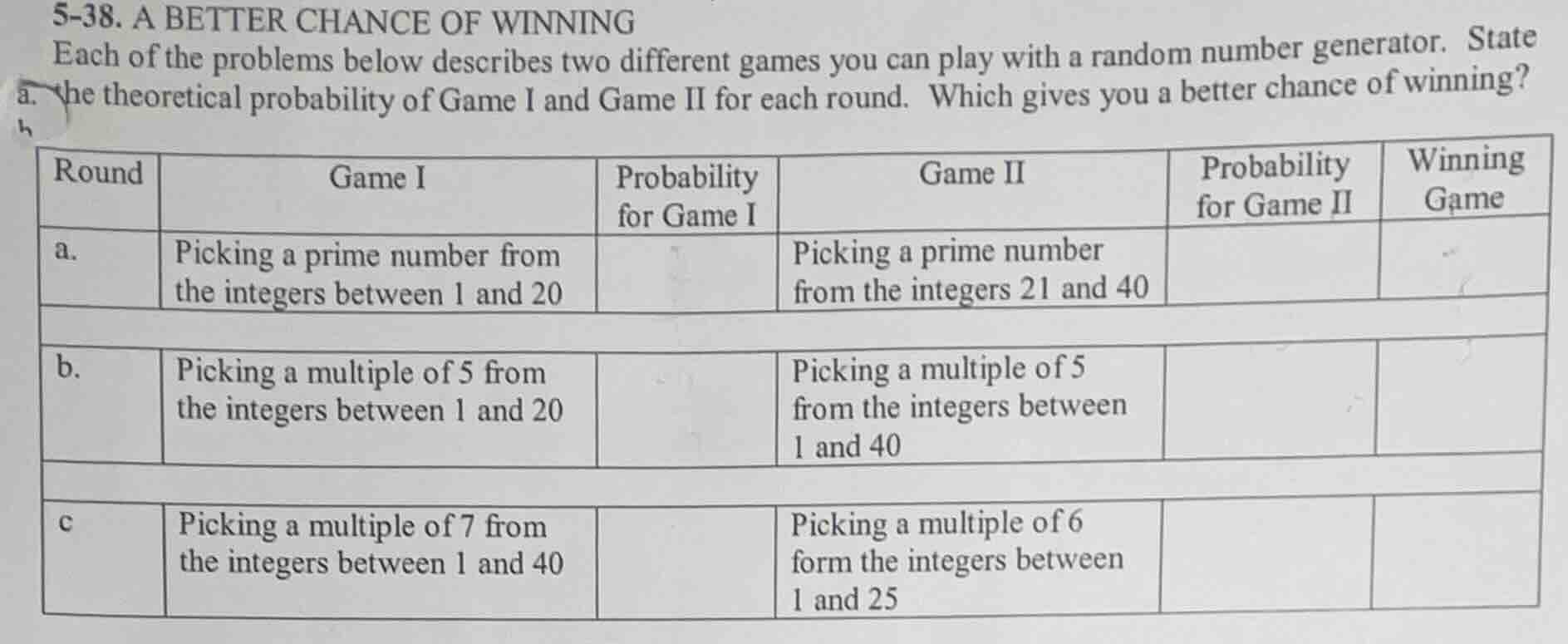
5-38. a better chance of winning
each of the problems below describes two different games you can play with a random number generator. state
the theoretical probability of game i and game ii for each round. which gives you a better chance of winning?
a.
b.
| round | game i | probability for game i | game ii | probability for game ii | winning game |
|---|---|---|---|---|---|
| b. | picking a multiple of 5 from the integers between 1 and 20 | picking a multiple of 5 from the integers between 1 and 40 | |||
| c | picking a multiple of 7 from the integers between 1 and 40 | picking a multiple of 6 form the integers between 1 and 25 |
Part a
Step1: Count primes 1-20
Primes 1-20: 2,3,5,7,11,13,17,19 (8 total).
Probability: $\frac{8}{20} = \frac{2}{5}$
Step2: Count primes 21-40
Primes 21-40: 23,29,31,37 (4 total).
Probability: $\frac{4}{20} = \frac{1}{5}$
Step3: Compare probabilities
$\frac{2}{5} > \frac{1}{5}$, so Game I wins.
Part b
Step1: Count multiples 5 (1-20)
Multiples of 5 1-20: 5,10,15,20 (4 total).
Probability: $\frac{4}{20} = \frac{1}{5}$
Step2: Count multiples 5 (1-40)
Multiples of 5 1-40: 8 total.
Probability: $\frac{8}{40} = \frac{1}{5}$
Step3: Compare probabilities
$\frac{1}{5} = \frac{1}{5}$, so no better game.
Part c
Step1: Count multiples 7 (1-40)
Multiples of 7 1-40: 7,14,21,28,35 (5 total).
Probability: $\frac{5}{40} = \frac{1}{8}$
Step2: Count multiples 6 (1-25)
Multiples of 6 1-25: 6,12,18,24 (4 total).
Probability: $\frac{4}{25}$
Step3: Compare probabilities
$\frac{1}{8}=0.125$, $\frac{4}{25}=0.16$, so $\frac{4}{25} > \frac{1}{8}$, Game II wins.

Snap & solve any problem in the app
Get step-by-step solutions on Sovi AI
Photo-based solutions with guided steps
Explore more problems and detailed explanations
| Round | Probability for Game I | Probability for Game II | Winning Game |
|---|---|---|---|
| b. | $\frac{1}{5}$ | $\frac{1}{5}$ | Neither (equal chance) |
| c. | $\frac{1}{8}$ | $\frac{4}{25}$ | Game II |