QUESTION IMAGE
Question
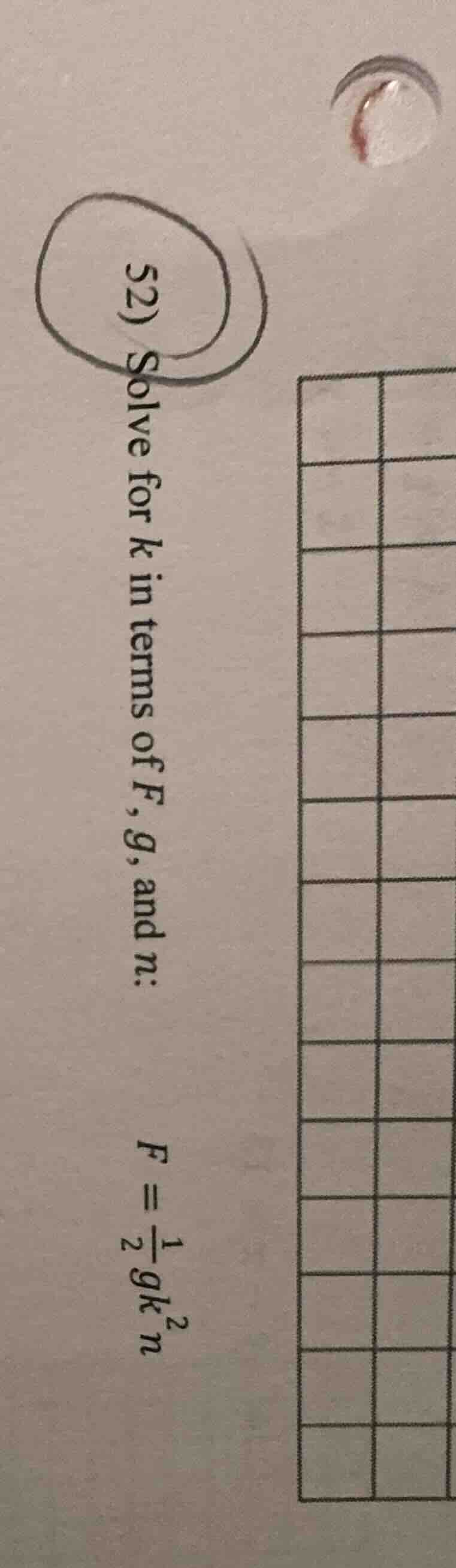
- solve for k in terms of f, g, and n:
$f = \frac{1}{2} g k^2 n$
Step1: Multiply both sides by 2
To eliminate the fraction, we multiply both sides of the equation \( F=\frac{1}{2}g k^{2}n \) by 2. This gives us \( 2F = g k^{2}n \).
Step2: Divide both sides by \( gn \)
We want to isolate \( k^{2} \), so we divide both sides of the equation \( 2F = g k^{2}n \) by \( gn \). This results in \( \frac{2F}{gn}=k^{2} \).
Step3: Take the square root of both sides
To solve for \( k \), we take the square root of both sides of the equation \( k^{2}=\frac{2F}{gn} \). Remembering that when we take the square root, we consider both the positive and negative roots, so \( k = \pm\sqrt{\frac{2F}{gn}} \). We can also rationalize the denominator or rewrite it as \( k=\pm\frac{\sqrt{2Fgn}}{gn} \) (by multiplying numerator and denominator inside the square root by \( gn \) and then simplifying), but the form \( \pm\sqrt{\frac{2F}{gn}} \) is also correct.

Snap & solve any problem in the app
Get step-by-step solutions on Sovi AI
Photo-based solutions with guided steps
Explore more problems and detailed explanations
\( k = \pm\sqrt{\frac{2F}{gn}} \) (or equivalently \( k=\pm\frac{\sqrt{2Fgn}}{gn} \))