QUESTION IMAGE
Question
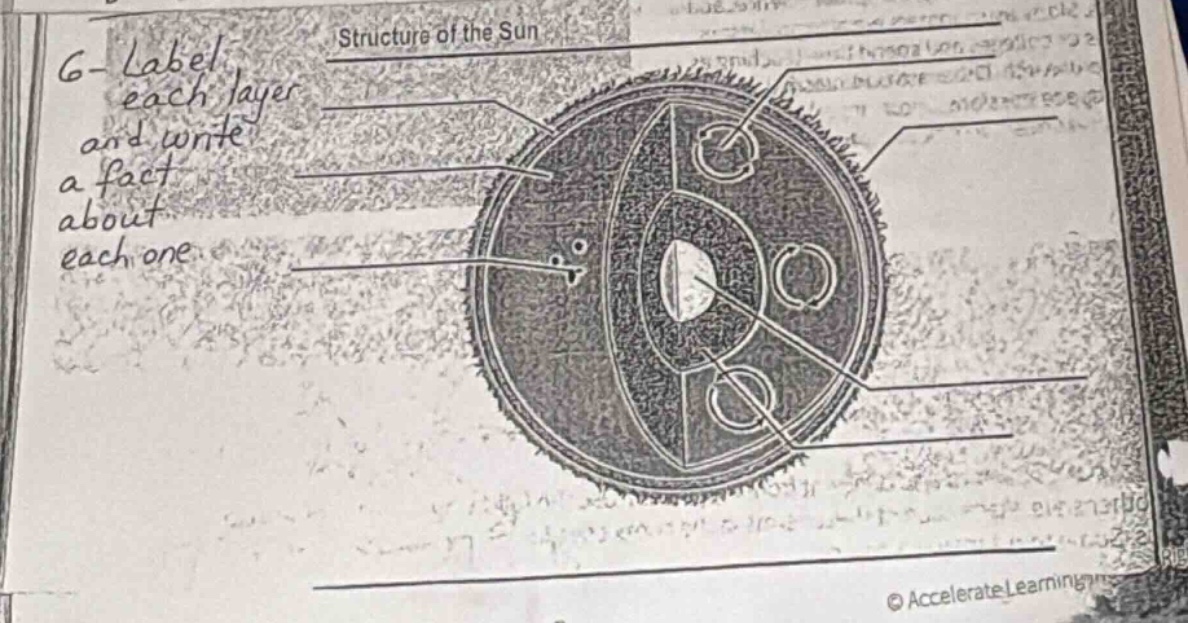
6- label each layer and write a fact about each one. structure of the sun
To solve this problem about labeling the Sun's layers and providing facts, we analyze the Sun's structure:
1. Core
- Label: Core (center of the Sun).
- Fact: The core is where nuclear fusion occurs (hydrogen fuses into helium), producing the Sun’s energy. Temperatures here reach ~15 million °C.
2. Radiative Zone
- Label: Radiative Zone (surrounds the core).
- Fact: Energy from the core travels outward as electromagnetic radiation (photons) through this zone. It can take millions of years for energy to pass through due to frequent photon absorption and re - emission.
3. Convective Zone
- Label: Convective Zone (outside the radiative zone).
- Fact: Energy is transferred here by convection currents (hot plasma rises, cools, and sinks). This motion creates granulation on the Sun’s surface.
4. Photosphere
- Label: Photosphere (visible “surface” of the Sun).
- Fact: It has a temperature of ~5,500 °C and is where sunspots (cooler, darker regions) form. We observe the photosphere as the Sun’s bright disk.
5. Chromosphere
- Label: Chromosphere (layer above the photosphere).
- Fact: It is visible during solar eclipses as a reddish glow. Temperatures here increase with height, reaching ~20,000 °C.
6. Corona
- Label: Corona (outermost layer, extends into space).
- Fact: It is extremely hot (millions of °C) and visible during eclipses as a faint, white halo. The corona is the source of solar wind (charged particles streaming into space).
To label the diagram, match each layer to its position (core at the center, then radiative, convective, photosphere, chromosphere, corona outward) and include the corresponding fact.

Snap & solve any problem in the app
Get step-by-step solutions on Sovi AI
Photo-based solutions with guided steps
Explore more problems and detailed explanations
To solve this problem about labeling the Sun's layers and providing facts, we analyze the Sun's structure:
1. Core
- Label: Core (center of the Sun).
- Fact: The core is where nuclear fusion occurs (hydrogen fuses into helium), producing the Sun’s energy. Temperatures here reach ~15 million °C.
2. Radiative Zone
- Label: Radiative Zone (surrounds the core).
- Fact: Energy from the core travels outward as electromagnetic radiation (photons) through this zone. It can take millions of years for energy to pass through due to frequent photon absorption and re - emission.
3. Convective Zone
- Label: Convective Zone (outside the radiative zone).
- Fact: Energy is transferred here by convection currents (hot plasma rises, cools, and sinks). This motion creates granulation on the Sun’s surface.
4. Photosphere
- Label: Photosphere (visible “surface” of the Sun).
- Fact: It has a temperature of ~5,500 °C and is where sunspots (cooler, darker regions) form. We observe the photosphere as the Sun’s bright disk.
5. Chromosphere
- Label: Chromosphere (layer above the photosphere).
- Fact: It is visible during solar eclipses as a reddish glow. Temperatures here increase with height, reaching ~20,000 °C.
6. Corona
- Label: Corona (outermost layer, extends into space).
- Fact: It is extremely hot (millions of °C) and visible during eclipses as a faint, white halo. The corona is the source of solar wind (charged particles streaming into space).
To label the diagram, match each layer to its position (core at the center, then radiative, convective, photosphere, chromosphere, corona outward) and include the corresponding fact.