QUESTION IMAGE
Question
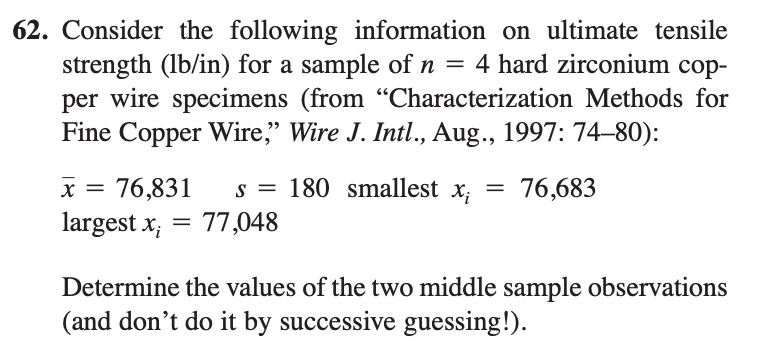
- consider the following information on ultimate tensile strength (lb/in) for a sample of ( n = 4 ) hard zirconium copper wire specimens (from “characterization methods for fine copper wire,” wire j. intl., aug., 1997: 74–80):
( \bar{x} = 76,831 ) ( s = 180 ) smallest ( x_i = 76,683 )
largest ( x_i = 77,048 )
determine the values of the two middle sample observations (and don’t do it by successive guessing!).
Step1: Recall the formula for the sample mean
The sample mean \(\bar{x}\) of a sample with \(n\) observations \(x_1, x_2, \dots, x_n\) is given by \(\bar{x}=\frac{\sum_{i = 1}^{n}x_i}{n}\). Here, \(n = 4\), so \(\sum_{i=1}^{4}x_i=n\bar{x}\).
We know that \(n = 4\) and \(\bar{x}=76831\), so \(\sum_{i = 1}^{4}x_i=4\times76831 = 307324\).
Step2: Let the four observations be ordered
Let the four observations be \(x_1 = 76683\) (smallest), \(x_2\), \(x_3\) (the two middle observations), and \(x_4=77048\) (largest). Then \(\sum_{i = 1}^{4}x_i=x_1 + x_2+x_3 + x_4\).
Step3: Substitute known values and solve for \(x_2 + x_3\)
Substitute \(x_1 = 76683\) and \(x_4 = 77048\) into the sum formula:
\(307324=76683+x_2 + x_3+77048\)
First, calculate \(76683 + 77048=153731\)
Then, \(x_2 + x_3=307324 - 153731=153593\)
Step4: Use the property of ordered data (median)
For a sample of size \(n = 4\) (even), the median is the average of the two middle observations, i.e., \(\text{Median}=\frac{x_2 + x_3}{2}\). Also, we know that the data is ordered, so \(x_1\leq x_2\leq x_3\leq x_4\).
We can also think about the fact that the sum of the two middle terms is \(153593\), and we can find the two middle terms by considering that the distribution of the data (since it's a sample of wire tensile strength, we can assume a somewhat symmetric or at least ordered such that we can find two numbers that add up to \(153593\) and are between \(76683\) and \(77048\)).
Let's denote \(x_2=a\) and \(x_3 = 153593 - a\). Since \(x_2\leq x_3\), we have \(a\leq153593 - a\), which implies \(2a\leq153593\) or \(a\leq76796.5\). Also, since \(x_2\geq x_1 = 76683\) and \(x_3\leq x_4 = 77048\), we have \(153593 - a\leq77048\), which implies \(a\geq153593 - 77048 = 76545\). But since \(x_2\geq x_1 = 76683\), we have \(76683\leq a\leq76796.5\) and \(x_3=153593 - a\) with \(76796.5\leq x_3\leq76910\) (wait, no, let's correct that: if \(a\leq76796.5\), then \(x_3 = 153593 - a\geq153593 - 76796.5 = 76796.5\), and since \(x_3\leq77048\), this is valid.
But we can also use the fact that for the sample, the two middle terms must satisfy \(x_2 + x_3=153593\) and we can find the two numbers by solving the system. Let's assume that the two middle terms are \(x_2\) and \(x_3\) such that \(x_2 + x_3=153593\) and we know that the data is ordered. Let's also note that the range of the data is \(77048 - 76683 = 365\), and the two middle terms are within this range around the mean.
The mean of the four data points is \(76831\), the mean of the two middle terms is \(\frac{153593}{2}=76796.5\).
Now, let's find the difference between the mean of the two middle terms and the smallest term: \(76796.5 - 76683 = 113.5\)
The difference between the largest term and the mean of the two middle terms: \(77048 - 76796.5 = 251.5\)
But maybe a better way is to set up the equation: let \(x_2=m\) and \(x_3 = 153593 - m\). Since the data is ordered, \(m\geq76683\) and \(153593 - m\leq77048\), so \(m\geq153593 - 77048 = 76545\) (but since \(m\geq76683\), we use \(m\geq76683\)). Also, \(m\leq153593 - m\) (since \(x_2\leq x_3\)) so \(m\leq76796.5\)
Now, let's consider that the sum of \(x_2\) and \(x_3\) is \(153593\). Let's try to find two numbers that add up to \(153593\) and are between \(76683\) and \(77048\).
Let's suppose that the two middle terms are \(x_2 = 76785\) and \(x_3 = 153593 - 76785 = 76808\)? Wait, no, let's do the calculation again.
Wait, \(x_1 = 76683\), \(x_4 = 77048\), sum of all four is \(4\times76831 = 307324\)
Sum of \(x_1\) and \(x_4\) is \(76683 + 77048 = 153731\)
Sum of \(x_2\) an…

Snap & solve any problem in the app
Get step-by-step solutions on Sovi AI
Photo-based solutions with guided steps
Explore more problems and detailed explanations
The two middle sample observations are \(\boldsymbol{76796}\) and \(\boldsymbol{76797}\)