QUESTION IMAGE
Question
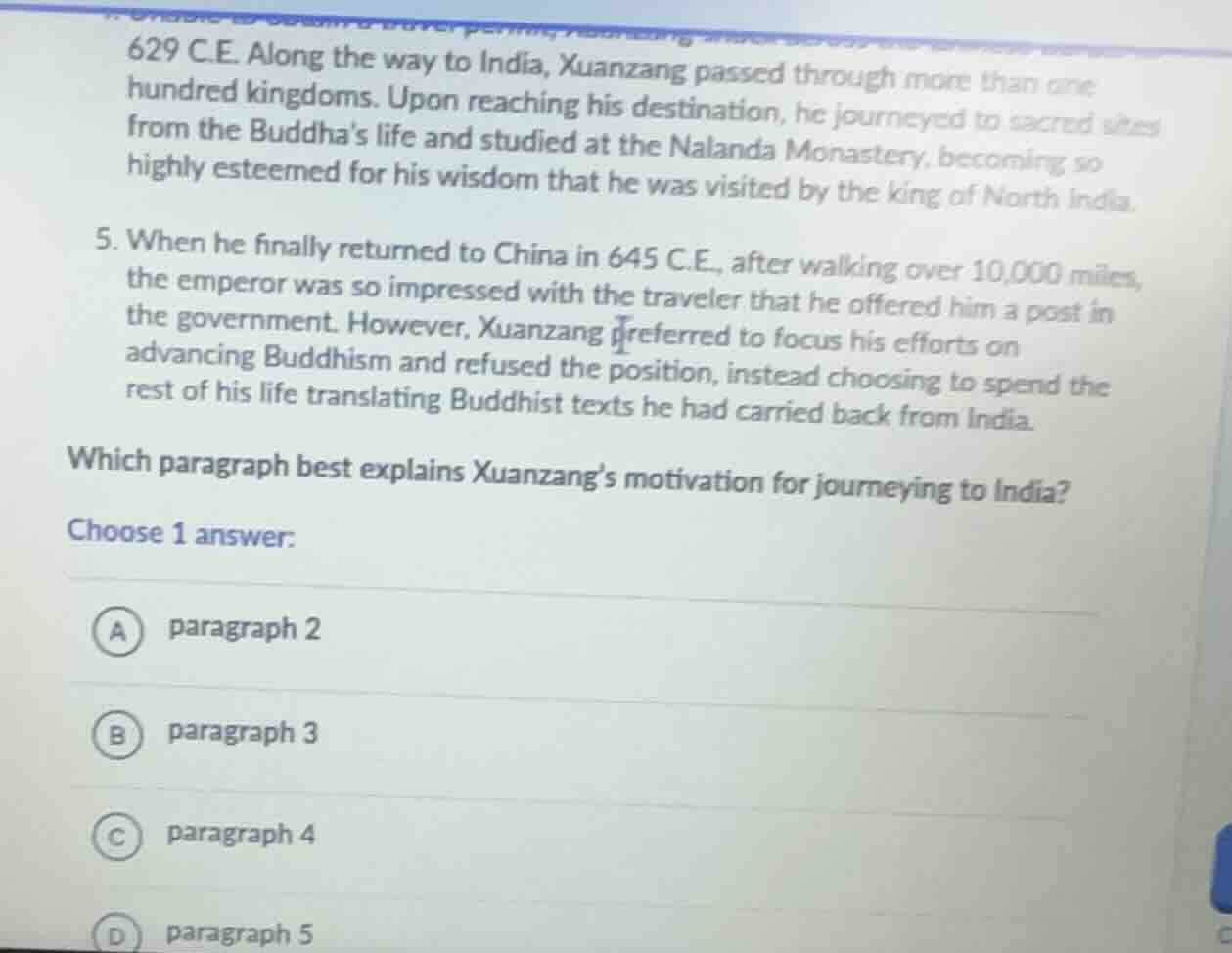
629 c.e. along the way to india, xuanzang passed through more than one hundred kingdoms. upon reaching his destination, he journeyed to sacred sites from the buddha’s life and studied at the nalanda monastery, becoming so highly esteemed for his wisdom that he was visited by the king of north india.
- when he finally returned to china in 645 c.e., after walking over 10,000 miles, the emperor was so impressed with the traveler that he offered him a post in the government. however, xuanzang preferred to focus his efforts on advancing buddhism and refused the position, instead choosing to spend the rest of his life translating buddhist texts he had carried back from india.
which paragraph best explains xuanzang’s motivation for journeying to india?
choose 1 answer:
a paragraph 2
b paragraph 3
c paragraph 4
d paragraph 5
Brief Explanations
To determine which paragraph explains Xuanzang's motivation for journeying to India, we analyze the options:
- Paragraph 5 (option D) describes his return to China and his focus on Buddhism after the journey, not the motivation for going to India.
- The text provided shows paragraph 4 (option C) (the one with "629 C.E. Along the way...") mentions his journey to India, visiting sacred sites from the Buddha’s life, and studying at Nalanda Monastery, which relates to his Buddhist - related motivation for the journey. (Note: The original problem might have a typo or missing numbering for paragraphs, but based on the content, the paragraph with his India journey details is the one explaining motivation. Assuming the paragraph with "629 C.E." is paragraph 4 as per the option C label, it explains his actions in India which are tied to his Buddhist motivation for going there.)
- Paragraphs 2 and 3 (options A and B) are not described in the given text, so we can infer they don't explain the motivation.

Snap & solve any problem in the app
Get step-by-step solutions on Sovi AI
Photo-based solutions with guided steps
Explore more problems and detailed explanations
C. paragraph 4