QUESTION IMAGE
Question
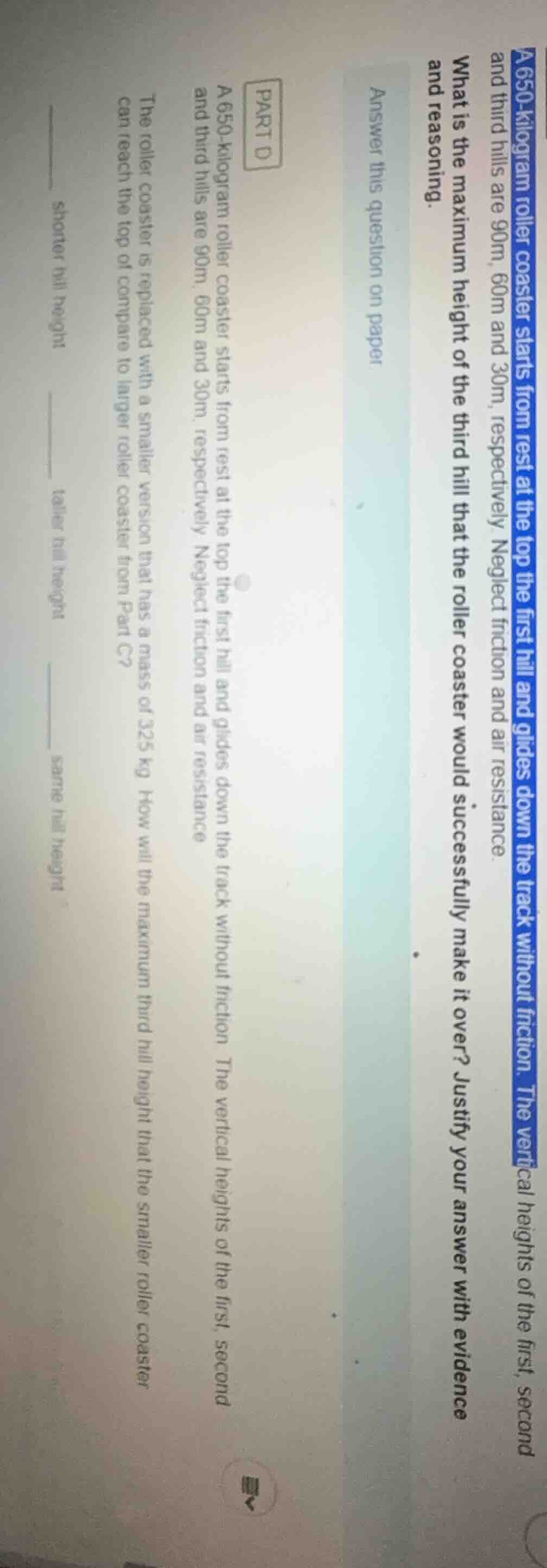
a 650-kilogram roller coaster starts from rest at the top the first hill and glides down the track without friction. the vertical heights of the first, second and third hills are 90m, 60m and 30m, respectively. neglect friction and air resistance.
what is the maximum height of the third hill that the roller coaster would successfully make it over? justify your answer with evidence and reasoning.
answer this question on paper
part d
a 650-kilogram roller coaster starts from rest at the top the first hill and glides down the track without friction. the vertical heights of the first, second and third hills are 90m, 60m and 30m, respectively. neglect friction and air resistance
the roller coaster is replaced with a smaller version that has a mass of 325 kg. how will the maximum third hill height that the smaller roller coaster can reach the top of compare to larger roller coaster from part c?
____ shorter hill height __ taller hill height ____ same hill height
Step1: Apply energy conservation (no friction)
The roller coaster starts from rest, so initial kinetic energy $KE_i = 0$. Initial gravitational potential energy is $PE_i = mgh_1$, where $m$ is mass, $g$ is acceleration due to gravity, $h_1=90\,\text{m}$. At the top of the third hill, the coaster can have minimal kinetic energy ($KE_f \geq 0$) to just clear it, so final energy is $PE_f + KE_f = mgh_3 + KE_f$. By conservation of mechanical energy:
$$PE_i = PE_f + KE_f$$
$$mgh_1 = mgh_3 + KE_f$$
Step2: Solve for maximum $h_3$
To find the maximum possible $h_3$, set $KE_f=0$ (coaster just reaches the top with no speed left). The mass $m$ cancels out:
$$gh_1 = gh_3$$
$$h_3 = h_1$$
Substitute $h_1=90\,\text{m}$:
$$h_3 = 90\,\text{m}$$
Step3: Analyze smaller coaster case
For the 325 kg coaster, repeat the energy conservation:
$$m'sgh_1 = m'sgh_3' + KE_f'$$
Mass $m'$ cancels out, so $h_3' = h_1=90\,\text{m}$ when $KE_f'=0$. Mass does not affect the maximum hill height.

Snap & solve any problem in the app
Get step-by-step solutions on Sovi AI
Photo-based solutions with guided steps
Explore more problems and detailed explanations
- The maximum height of the third hill the roller coaster can successfully climb is $\boldsymbol{90\,\text{m}}$. This comes from conservation of mechanical energy: since there is no friction, all initial gravitational potential energy ($mgh_1$) can convert back to potential energy at the third hill (with zero kinetic energy at the peak), and mass cancels out in the energy equation, so the maximum height equals the starting height of 90m.
- The smaller roller coaster can reach the same hill height (90m) as the larger coaster. Gravitational potential energy and kinetic energy both depend linearly on mass, so mass cancels out in the energy conservation equation, meaning the maximum hill height is independent of the coaster's mass.