QUESTION IMAGE
Question
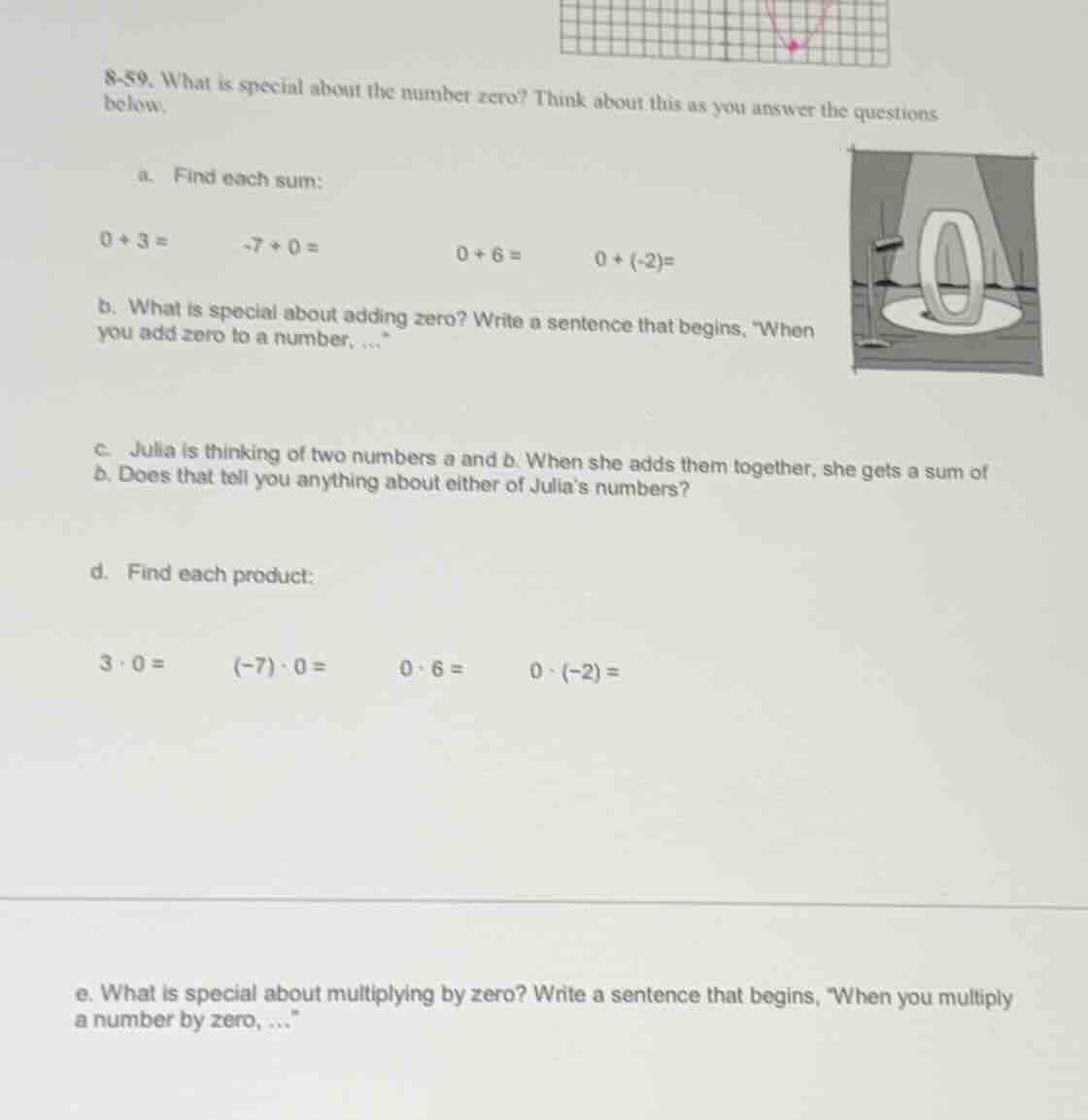
8-59. what is special about the number zero? think about this as you answer the questions below.
a. find each sum:
$0 + 3 =$ $-7 + 0 =$ $0 + 6 =$ $0 + (-2)=$
b. what is special about adding zero? write a sentence that begins, \when you add zero to a number, ...\
c. julia is thinking of two numbers $a$ and $b$. when she adds them together, she gets a sum of $b$. does that tell you anything about either of julia’s numbers?
d. find each product:
$3 \cdot 0 =$ $(-7) \cdot 0 =$ $0 \cdot 6 =$ $0 \cdot (-2) =$
e. what is special about multiplying by zero? write a sentence that begins, \when you multiply a number by zero, ...\
Step1: Calculate sums for part a
$0+3=3$
$-7+0=-7$
$0+6=6$
$0+(-2)=-2$
Step2: Explain zero addition property (part b)
When you add zero to a number, the sum is the original number.
Step3: Deduce number value (part c)
Given $a + b = b$, subtract $b$ from both sides:
$a + b - b = b - b$
$a = 0$
Step4: Calculate products for part d
$3 \cdot 0=0$
$(-7) \cdot 0=0$
$0 \cdot 6=0$
$0 \cdot (-2)=0$
Step5: Explain zero multiplication property (part e)
When you multiply a number by zero, the product is always zero.

Snap & solve any problem in the app
Get step-by-step solutions on Sovi AI
Photo-based solutions with guided steps
Explore more problems and detailed explanations
a. $0+3=3$; $-7+0=-7$; $0+6=6$; $0+(-2)=-2$
b. When you add zero to a number, the sum is that number.
c. Yes, it tells us that the number $a$ must be 0.
d. $3 \cdot 0=0$; $(-7) \cdot 0=0$; $0 \cdot 6=0$; $0 \cdot (-2)=0$
e. When you multiply a number by zero, the product is 0.