QUESTION IMAGE
Question
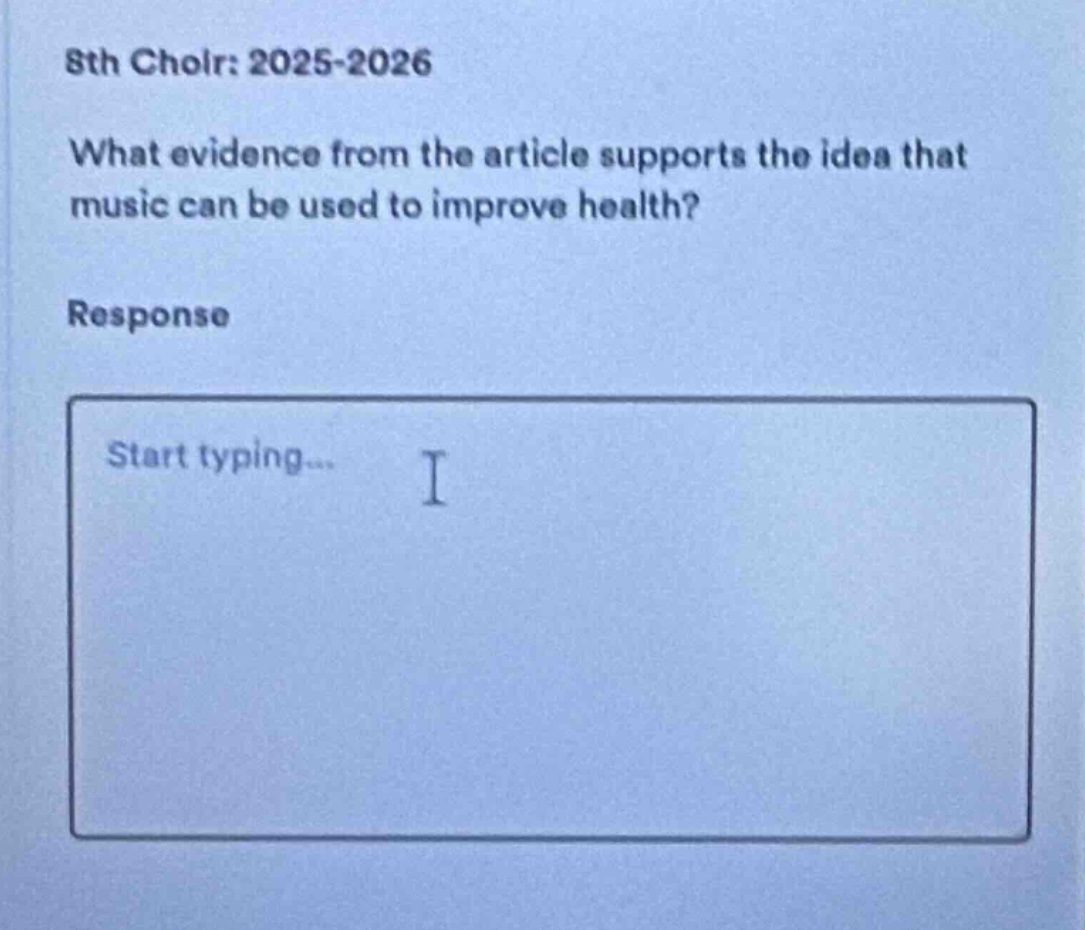
8th choir: 2025 - 2026
what evidence from the article supports the idea that music can be used to improve health?
response
start typing...
To answer this, we need the article's content (which isn't provided here). However, typical evidence from an article about music and health might include:
- Studies showing reduced stress hormones (like cortisol) in people listening to music.
- Research on improved mood (e.g., less depression/anxiety) with music therapy.
- Clinical trials where patients' pain perception decreased with music intervention.
- Evidence of better sleep quality in individuals using music as a sleep aid.
- Improvements in cognitive function (e.g., memory, attention) in older adults or patients with neurological conditions through music engagement.
Since the article isn't provided, a general response framework is: "To determine evidence, we analyze the article for empirical data (studies, trials), anecdotes, or expert claims linking music to health improvements (e.g., reduced stress, better pain management, improved mood/sleep/cognition). For example, if the article cites a study where cancer patients had lower anxiety during treatment with music, that supports the idea."
If we assume a common article on this topic (e.g., music therapy in hospitals), a sample response could be: "If the article includes research like 'A study found that hospitalized patients who listened to calming music had lower blood pressure and reported less pain,' this supports music improving health by reducing physiological stress and pain perception. Additionally, claims about music therapy reducing symptoms of depression or aiding in stroke recovery (via neuroplasticity from music engagement) would also be evidence."
But without the actual article, we can only outline how to identify such evidence.

Snap & solve any problem in the app
Get step-by-step solutions on Sovi AI
Photo-based solutions with guided steps
Explore more problems and detailed explanations
To answer this, we need the article's content (which isn't provided here). However, typical evidence from an article about music and health might include:
- Studies showing reduced stress hormones (like cortisol) in people listening to music.
- Research on improved mood (e.g., less depression/anxiety) with music therapy.
- Clinical trials where patients' pain perception decreased with music intervention.
- Evidence of better sleep quality in individuals using music as a sleep aid.
- Improvements in cognitive function (e.g., memory, attention) in older adults or patients with neurological conditions through music engagement.
Since the article isn't provided, a general response framework is: "To determine evidence, we analyze the article for empirical data (studies, trials), anecdotes, or expert claims linking music to health improvements (e.g., reduced stress, better pain management, improved mood/sleep/cognition). For example, if the article cites a study where cancer patients had lower anxiety during treatment with music, that supports the idea."
If we assume a common article on this topic (e.g., music therapy in hospitals), a sample response could be: "If the article includes research like 'A study found that hospitalized patients who listened to calming music had lower blood pressure and reported less pain,' this supports music improving health by reducing physiological stress and pain perception. Additionally, claims about music therapy reducing symptoms of depression or aiding in stroke recovery (via neuroplasticity from music engagement) would also be evidence."
But without the actual article, we can only outline how to identify such evidence.