QUESTION IMAGE
Question
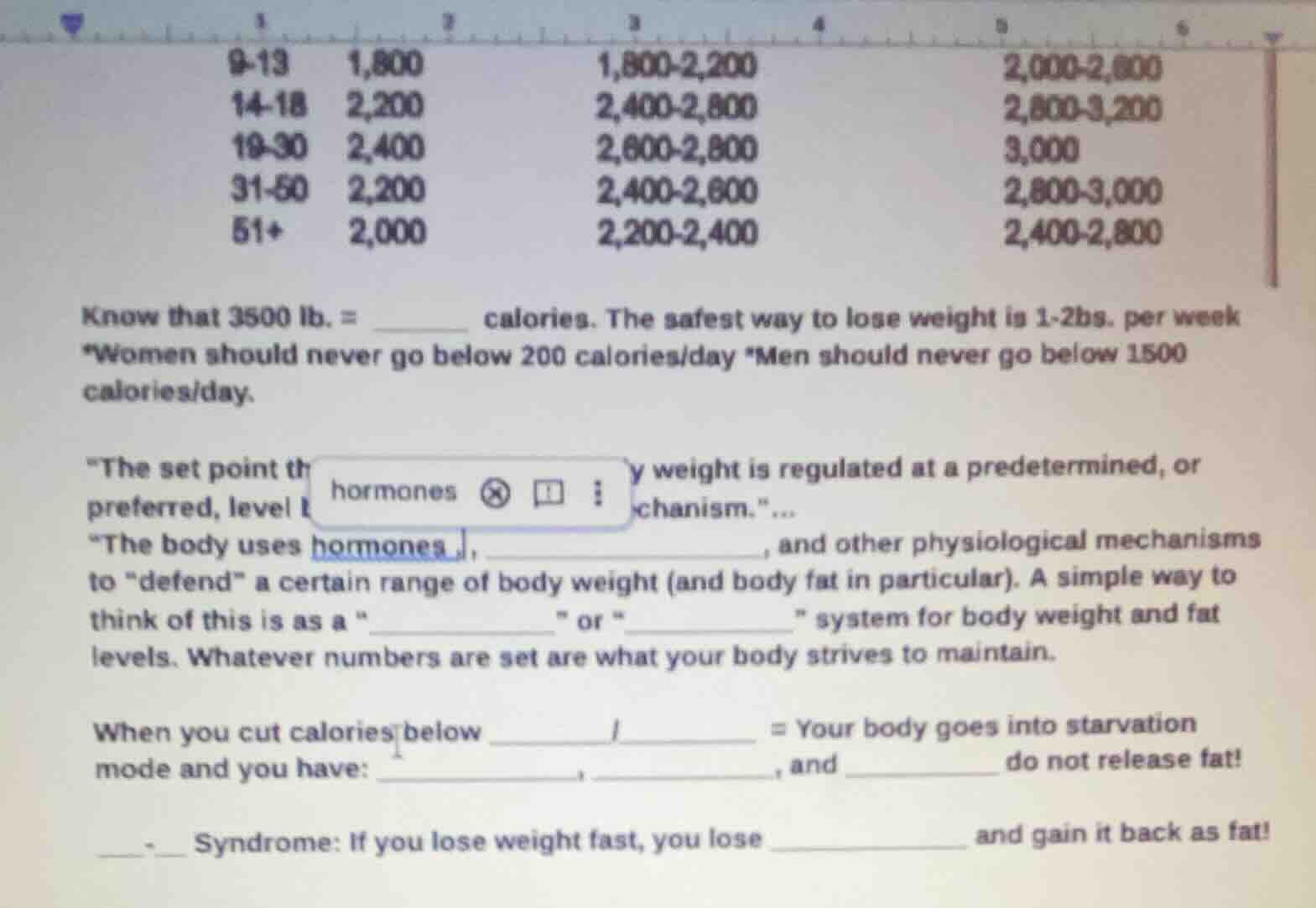
9-13 1,800
14-18 2,200
19-30 2,400
31-50 2,200
51+ 2,000
1,800-2,200
2,400-2,800
2,600-2,800
2,400-2,600
2,200-2,400
2,000-2,800
2,800-3,200
3,000
2,800-3,000
2,400-2,800
know that 3500 lb. = ______ calories. the safest way to lose weight is 1-2bs. per week
women should never go below 200 calories/day men should never go below 1500 calories/day.
\the set point th____ y weight is regulated at a predetermined, or preferred, level l____ chanism.\...
\the body uses hormones, ____, and other physiological mechanisms to \defend\ a certain range of body weight (and body fat in particular). a simple way to think of this is as a \__\ or \____\ system for body weight and fat levels. whatever numbers are set are what your body strives to maintain.
when you cut calories below ____/__ = your body goes into starvation mode and you have: __, __, and ____ do not release fat!
__- syndrome: if you lose weight fast, you lose ____ and gain it back as fat!
- The standard calorie equivalent for 1 pound of body weight is 3500, so 3500 lb. (likely a typo for 1 lb.) equals 3500 calories.
- The set point theory states body weight is regulated via physiological mechanisms, including hormones, metabolism, and acts like a "thermostat" or "feedback" system to maintain a preferred weight.
- Eating below your basal metabolic rate (BMR, the calorie needs at rest) triggers starvation mode, slowing metabolism, reducing energy, and causing the body to hold onto fat stores.
- The Yo-Yo Syndrome (weight cycling) occurs when rapid weight loss leads to losing muscle mass, which is later regained as fat.
- The minimum daily calorie guidelines are 1200 for women (corrected from the likely typo 200) and 1500 for men.

Snap & solve any problem in the app
Get step-by-step solutions on Sovi AI
Photo-based solutions with guided steps
Explore more problems and detailed explanations
- 3500
- theory; metabolism; thermostat; feedback
- your basal metabolic rate (BMR); slowed metabolism; reduced energy levels; fat cells
- Yo-Yo; muscle mass