QUESTION IMAGE
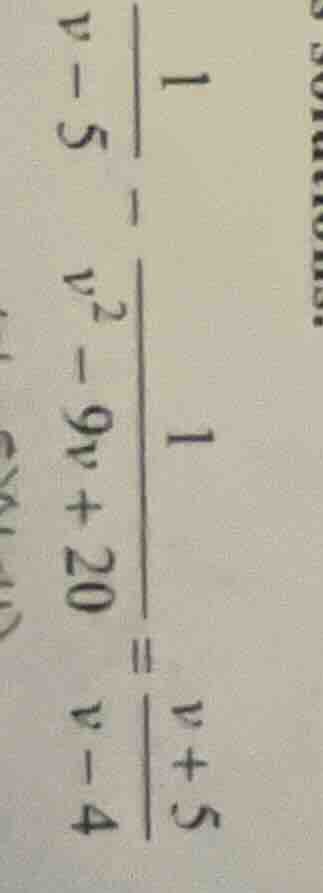
Question
(\frac{1}{v - 5}-\frac{1}{v^{2}-9v + 20}=\frac{v + 5}{v - 4})
Step1: Factor the quadratic denominator
First, factor the quadratic expression \(v^2 - 9v + 20\). We need two numbers that multiply to \(20\) and add up to \(-9\). Those numbers are \(-4\) and \(-5\), so \(v^2 - 9v + 20=(v - 4)(v - 5)\). The equation becomes:
\(\frac{1}{v - 5}-\frac{1}{(v - 4)(v - 5)}=\frac{v + 5}{v - 4}\)
Step2: Find a common denominator
The common denominator for the left - hand side is \((v - 4)(v - 5)\). Multiply the first fraction \(\frac{1}{v - 5}\) by \(\frac{v - 4}{v - 4}\) to get a common denominator:
\(\frac{v - 4}{(v - 4)(v - 5)}-\frac{1}{(v - 4)(v - 5)}=\frac{v + 5}{v - 4}\)
Step3: Combine the fractions on the left - hand side
Subtract the numerators of the two fractions on the left - hand side:
\(\frac{(v - 4)-1}{(v - 4)(v - 5)}=\frac{v + 5}{v - 4}\)
Simplify the numerator: \(v-4 - 1=v - 5\), so we have \(\frac{v - 5}{(v - 4)(v - 5)}=\frac{v + 5}{v - 4}\)
Step4: Simplify the left - hand side
We can cancel out the common factor of \((v - 5)\) in the numerator and denominator of the left - hand side (note that \(v
eq5\) to avoid division by zero), so we get \(\frac{1}{v - 4}=\frac{v + 5}{v - 4}\)
Step5: Solve for \(v\)
Since the denominators are the same (and \(v
eq4\) to avoid division by zero), we can set the numerators equal to each other:
\(1=v + 5\)
Subtract \(5\) from both sides: \(v=1 - 5=-4\)
But we need to check for extraneous solutions. If we substitute \(v=-4\) into the original equation:
- For the denominator \(v - 5=-4 - 5=-9
eq0\)
- For the denominator \(v^2-9v + 20=(-4)^2-9\times(-4)+20=16 + 36+20 = 72
eq0\)
- For the denominator \(v - 4=-4 - 4=-8
eq0\)
Wait, but when we simplified \(\frac{v - 5}{(v - 4)(v - 5)}\) to \(\frac{1}{v - 4}\), we assumed \(v
eq5\). But when we solved \(1 = v + 5\) we got \(v=-4\). Let's check the original equation with \(v=-4\):
Left - hand side: \(\frac{1}{-4 - 5}-\frac{1}{(-4)^2-9\times(-4)+20}=\frac{1}{-9}-\frac{1}{16 + 36+20}=\frac{1}{-9}-\frac{1}{72}=-\frac{8}{72}-\frac{1}{72}=-\frac{9}{72}=-\frac{1}{8}\)
Right - hand side: \(\frac{-4 + 5}{-4 - 4}=\frac{1}{-8}=-\frac{1}{8}\)
But wait, when we had the equation \(\frac{1}{v - 4}=\frac{v + 5}{v - 4}\), if we multiply both sides by \((v - 4)\) (for \(v
eq4\)), we get \(1=v + 5\), \(v=-4\). But let's check the step where we canceled \((v - 5)\) in \(\frac{v - 5}{(v - 4)(v - 5)}\). The original equation has restrictions \(v
eq4\) and \(v
eq5\). When \(v=-4\), it satisfies the restrictions. But wait, let's re - examine the equation:
Original equation: \(\frac{1}{v - 5}-\frac{1}{v^2-9v + 20}=\frac{v + 5}{v - 4}\)
After factoring \(v^2-9v + 20=(v - 4)(v - 5)\), the equation is \(\frac{1}{v - 5}-\frac{1}{(v - 4)(v - 5)}=\frac{v + 5}{v - 4}\)
Multiply both sides by \((v - 4)(v - 5)\) (where \(v
eq4\) and \(v
eq5\)):
\((v - 4)-1=(v + 5)(v - 5)\)
Expand the right - hand side: \(v-4 - 1=v^2-25\)
Simplify left - hand side: \(v - 5=v^2-25\)
Rearrange to get a quadratic equation: \(v^2-v - 20 = 0\)
Factor the quadratic equation: \(v^2-v - 20=(v - 5)(v + 4)=0\)
So the solutions are \(v = 5\) or \(v=-4\). But \(v = 5\) makes the denominators \(v - 5\) and \((v - 4)(v - 5)\) equal to zero, so \(v = 5\) is an extraneous solution. So the only valid solution is \(v=-4\)

Snap & solve any problem in the app
Get step-by-step solutions on Sovi AI
Photo-based solutions with guided steps
Explore more problems and detailed explanations
\(v=-4\)