QUESTION IMAGE
Question
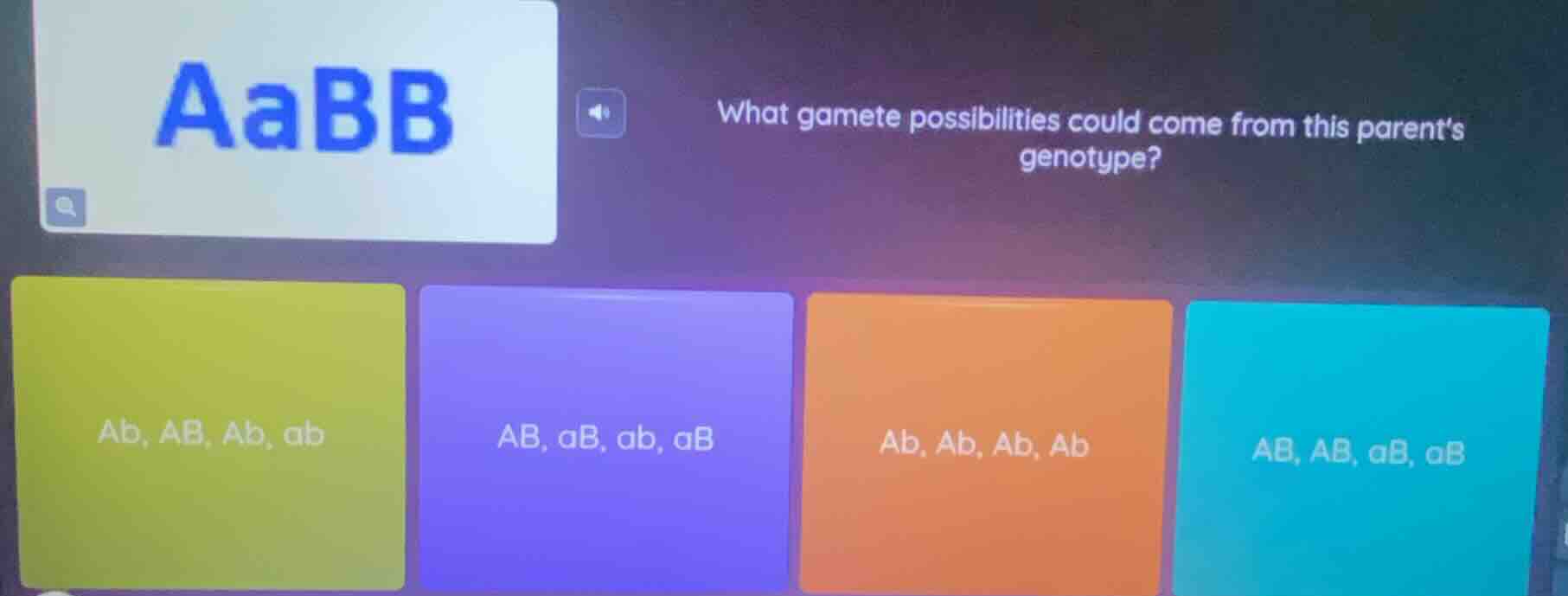
aabb what gamete possibilities could come from this parents genotype? ab, ab, ab, ab; ab, ab, ab, ab; ab, ab, ab, ab; ab, ab, ab, ab
Step1: Analyze the genotype
The parent's genotype is AaBB. For the A/a gene pair, since it's heterozygous (Aa), it can produce two types of alleles: A and a. For the B/B gene pair, since it's homozygous (BB), it can only produce one type of allele: B.
Step2: Determine gamete combinations
Using the principle of independent assortment (or simply combining the possible alleles from each gene pair), the possible gametes are formed by combining one allele from the A/a pair and one allele from the B/B pair. So from A/a (A or a) and B/B (only B), the possible gametes are AB (A from A/a and B from B/B) and aB (a from A/a and B from B/B). Since the B gene is homozygous, every gamete will have B, and the A/a gene gives either A or a. So the gametes are AB, AB, aB, aB (because for each of the two possibilities from A/a, we have two gametes? Wait, no, actually, the number of gametes: for Aa (2 options) and BB (1 option), the number of unique gametes is 2, but when considering the possible production (like in a Punnett square for gametes), since BB can only give B, and Aa can give A or a, so the gametes are AB (when A is chosen) and aB (when a is chosen). But since the parent has Aa (so can produce A and a in equal proportion) and BB (only B), the gametes produced would be AB, AB, aB, aB (because for each of the two A/a alleles, paired with B, and since there are two copies? Wait, maybe better to think: the genotype is AaBB, so the alleles are A, a, B, B. When forming gametes, we take one allele from each gene locus. So for the first locus (A/a), we can take A or a, and for the second locus (B/B), we can only take B. So the possible gametes are A with B (AB) and a with B (aB). Now, since the parent has two B alleles, but when forming gametes, each gamete gets one from each locus. Wait, maybe the key is that for Aa (heterozygous), the two alleles (A and a) will segregate, and for BB (homozygous), the two B alleles are identical, so they don't segregate into different types. So the possible gametes are AB (A from Aa, B from BB) and aB (a from Aa, B from BB). Now, how many of each? Since Aa can produce A and a in equal numbers, and BB can only produce B, the gametes will be AB, AB, aB, aB (because for each of the two A/a alleles, paired with B, and since there are two Bs, but actually, the ratio is 1:1 for A and a, so the gametes are 50% AB and 50% aB. So in a set of four gametes (to represent the possible production, like in a meiosis where two divisions occur, producing four gametes), we would have two AB and two aB, which is AB, AB, aB, aB.
Step3: Match with the options
Looking at the options, the fourth option (the cyan one) is AB, AB, aB, aB, which matches our calculation.

Snap & solve any problem in the app
Get step-by-step solutions on Sovi AI
Photo-based solutions with guided steps
Explore more problems and detailed explanations
D. AB, AB, aB, aB (assuming the fourth option is D; if the options are labeled as the four colored boxes, the cyan box with AB, AB, aB, aB)