QUESTION IMAGE
Question
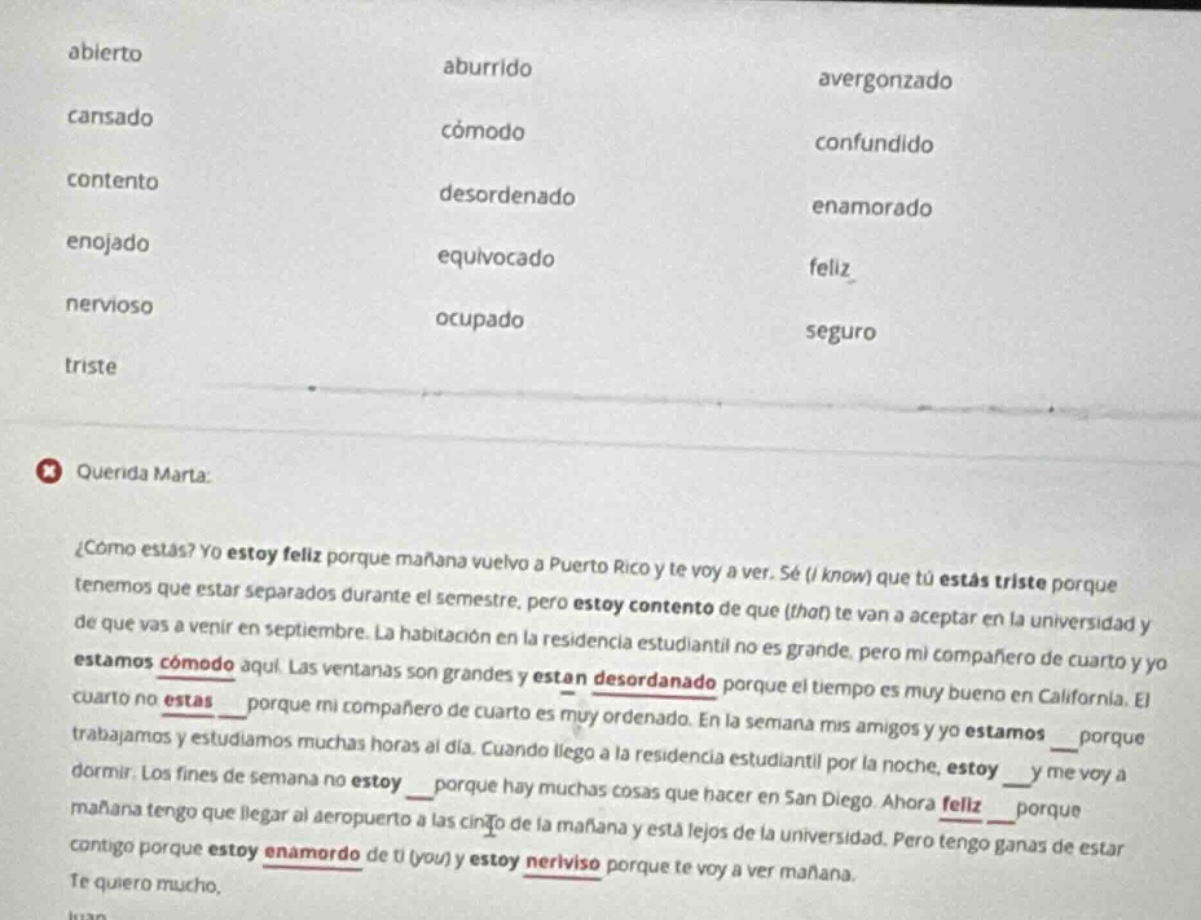
abierto
aburrido
avergonzado
cansado
cómodo
confundido
contento
desordenado
enamorado
enojado
equivocado
feliz
nervioso
ocupado
seguro
triste
querida marta:
¿cómo estás? yo estoy feliz porque mañana vuelvo a puerto rico y te voy a ver. sé (i know) que tú estás triste porque tenemos que estar separados durante el semestre, pero estoy contento de que (that) te van a aceptar en la universidad y de que vas a venir en septiembre. la habitación en la residencia estudiantil no es grande, pero mi compañero de cuarto y yo estamos cómodo aquí. las ventanas son grandes y están desordenado porque el tiempo es muy bueno en california. el cuarto no estas _ porque mi compañero de cuarto es muy ordenado. en la semana mis amigos y yo estamos _ porque trabajamos y estudiamos muchas horas al día. cuando llego a la residencia estudiantil por la noche, estoy _ y me voy a dormir. los fines de semana no estoy _ porque hay muchas cosas que hacer en san diego. ahora feliz ___ porque mañana tengo que llegar al aeropuerto a las cinco de la mañana y está lejos de la universidad. pero tengo ganas de estar contigo porque estoy enamordo de ti (you) y estoy nervioso porque te voy a ver mañana.
te quiero mucho,
To solve this fill - in - the - blank problem in Spanish (related to the Arts subfield of Languages, as it involves Spanish vocabulary and grammar), we analyze the context and the given adjectives:
1. First blank: “El cuarto no ____ porque mi compañero de cuarto es muy ordenado.”
The subject here is “el cuarto” (the room), which is a singular masculine noun. In Spanish, the verb “estar” (to be) for a singular masculine subject in the present tense is “está”. And from the context (the roommate is very orderly), the adjective should be the opposite of “desordenado” (messy), so it's “ordenado”. But wait, the structure is “no + verb + adjective”. Wait, no, the correct structure is “el cuarto no está desordenado” (the room is not messy) because the roommate is orderly. Wait, the original sentence: “El cuarto no __ porque mi compañero de cuarto es muy ordenado.” So the verb “estar” for “el cuarto” (third - person singular) is “está”, and the adjective should be “desordenado” in the negative. Wait, let's re - examine. The subject is “el cuarto” (singular, masculine), so “estar” is “está”. And since the roommate is orderly, the room is not messy. So the first blank: “está desordenado” – no, wait, the blank is after “no ”. Wait, the original text: “El cuarto no __ porque mi compañero de cuarto es muy ordenado.” So the correct form is “está desordenado” in negative? Wait, no, the correct sentence is “El cuarto no está desordenado porque mi compañero de cuarto es muy ordenado.” So the first blank: “está desordenado” (but wait, the given adjectives include “desordenado”, but let's check the verb. The subject “el cuarto” is third - person singular, so “estar” is “está”.
2. Second blank: “En la semana mis amigos y yo estamos ____ porque trabajamos y estudiamos muchas horas al día.”
The subject is “mis amigos y yo” (we), so the verb “estar” is “estamos”. The context is that we work and study many hours a day, so we are “ocupado” (but for “we”, it's “ocupados”). Wait, the given adjectives have “ocupado”, and for the first - person plural, the adjective should be plural: “ocupados”. But let's check the list of adjectives. The list has “ocupado” (singular), but in context, with “nosotros” (we), it should be “ocupados”. But maybe the problem expects the singular form as a typo or just the adjective. Wait, the original sentence: “estamos ____”. So the adjective should be “ocupado” (but grammatically, it should be “ocupados”, but maybe in the problem's context, they use the singular. Alternatively, maybe “aburrido”? No, because we work and study, so we are busy (ocupado).
3. Third blank: “Cuando llego a la residencia estudiantil por la noche, estoy ____ y me voy a dormir.”
After a long day of working and studying, at night, I am “cansado” (tired). The subject is “yo” (I), so “estoy cansado”.
4. Fourth blank: “Los fines de semana no estoy ____ porque hay muchas cosas que hacer en San Diego.”
The context is that on weekends, there are many things to do, so I am not “aburrido” (bored). The subject is “yo”, so “estoy aburrido” in negative: “no estoy aburrido”.
5. Fifth blank: “Ahora ____ porque mañana tengo que llegar al aeropuerto a las cinco de la mañana y está lejos de la universidad.”
The context is that I have to go to the airport early and it's far, so I am “nervioso” (nervous) or “equivocado”? No, “nervioso” makes sense. The subject is “yo”, so “estoy nervioso”. But wait, the original text has some words already filled, but let's correct the blanks with the given adjectives:
- First blank: “está desordenado” – no, wa…

Snap & solve any problem in the app
Get step-by-step solutions on Sovi AI
Photo-based solutions with guided steps
Explore more problems and detailed explanations
To solve this fill - in - the - blank problem in Spanish (related to the Arts subfield of Languages, as it involves Spanish vocabulary and grammar), we analyze the context and the given adjectives:
1. First blank: “El cuarto no ____ porque mi compañero de cuarto es muy ordenado.”
The subject here is “el cuarto” (the room), which is a singular masculine noun. In Spanish, the verb “estar” (to be) for a singular masculine subject in the present tense is “está”. And from the context (the roommate is very orderly), the adjective should be the opposite of “desordenado” (messy), so it's “ordenado”. But wait, the structure is “no + verb + adjective”. Wait, no, the correct structure is “el cuarto no está desordenado” (the room is not messy) because the roommate is orderly. Wait, the original sentence: “El cuarto no __ porque mi compañero de cuarto es muy ordenado.” So the verb “estar” for “el cuarto” (third - person singular) is “está”, and the adjective should be “desordenado” in the negative. Wait, let's re - examine. The subject is “el cuarto” (singular, masculine), so “estar” is “está”. And since the roommate is orderly, the room is not messy. So the first blank: “está desordenado” – no, wait, the blank is after “no ”. Wait, the original text: “El cuarto no __ porque mi compañero de cuarto es muy ordenado.” So the correct form is “está desordenado” in negative? Wait, no, the correct sentence is “El cuarto no está desordenado porque mi compañero de cuarto es muy ordenado.” So the first blank: “está desordenado” (but wait, the given adjectives include “desordenado”, but let's check the verb. The subject “el cuarto” is third - person singular, so “estar” is “está”.
2. Second blank: “En la semana mis amigos y yo estamos ____ porque trabajamos y estudiamos muchas horas al día.”
The subject is “mis amigos y yo” (we), so the verb “estar” is “estamos”. The context is that we work and study many hours a day, so we are “ocupado” (but for “we”, it's “ocupados”). Wait, the given adjectives have “ocupado”, and for the first - person plural, the adjective should be plural: “ocupados”. But let's check the list of adjectives. The list has “ocupado” (singular), but in context, with “nosotros” (we), it should be “ocupados”. But maybe the problem expects the singular form as a typo or just the adjective. Wait, the original sentence: “estamos ____”. So the adjective should be “ocupado” (but grammatically, it should be “ocupados”, but maybe in the problem's context, they use the singular. Alternatively, maybe “aburrido”? No, because we work and study, so we are busy (ocupado).
3. Third blank: “Cuando llego a la residencia estudiantil por la noche, estoy ____ y me voy a dormir.”
After a long day of working and studying, at night, I am “cansado” (tired). The subject is “yo” (I), so “estoy cansado”.
4. Fourth blank: “Los fines de semana no estoy ____ porque hay muchas cosas que hacer en San Diego.”
The context is that on weekends, there are many things to do, so I am not “aburrido” (bored). The subject is “yo”, so “estoy aburrido” in negative: “no estoy aburrido”.
5. Fifth blank: “Ahora ____ porque mañana tengo que llegar al aeropuerto a las cinco de la mañana y está lejos de la universidad.”
The context is that I have to go to the airport early and it's far, so I am “nervioso” (nervous) or “equivocado”? No, “nervioso” makes sense. The subject is “yo”, so “estoy nervioso”. But wait, the original text has some words already filled, but let's correct the blanks with the given adjectives:
- First blank: “está desordenado” – no, wait, the sentence is “El cuarto no ____ porque mi compañero de cuarto es muy ordenado.” So the correct verb - adjective combination: “está desordenado” is wrong. Wait, the correct logic: if the roommate is orderly, the room is not messy. So “El cuarto no está desordenado” (the room is not messy). So the blank is “está desordenado” (but the verb is “está” and adjective “desordenado”).
- Second blank: “estamos ocupados” (but the list has “ocupado”, maybe the problem expects “ocupado” as a typo, so “ocupado”).
- Third blank: “estoy cansado” (from the list, “cansado” is available).
- Fourth blank: “estoy aburrido” (in negative: “no estoy aburrido”, so the blank is “aburrido”).
- Fifth blank: “estoy nervioso” (from the list, “nervioso” is available).
Final Answers (filling the blanks with the correct verb - adjective combinations, focusing on the adjectives from the list):
- First blank: está desordenado (but the main adjective is “desordenado”, verb “está”)
- Second blank: ocupado (with “estamos”, grammatically “ocupados”, but using the given adjective form)
- Third blank: cansado
- Fourth blank: aburrido
- Fifth blank: nervioso
Wait, but let's re - check the original text's blanks:
- “El cuarto no estás __” – Wait, no, the subject is “el cuarto” (third - person singular), so the verb should be “está”, not “estás” (which is second - person singular). Maybe it's a typo in the text, and it should be “está”. So correcting the verb:
- “El cuarto no está desordenado” (because the roommate is orderly)
- “En la semana mis amigos y yo estamos ocupados” (but the list has “ocupado”, maybe the problem uses singular, so “ocupado”)
- “Cuando llego a la residencia estudiantil por la noche, estoy cansado”
- “Los fines de semana no estoy aburrido”
- “Ahora estoy nervioso” (but the blank is after “Ahora feliz ” – wait, the original text: “Ahora feliz porque mañana tengo que llegar al aeropuerto...”. Wait, maybe the text has a typo. Let's re - examine the original text:
Original text blanks:
- “El cuarto no estás __” – This is a mistake, should be “está”.
- “En la semana mis amigos y yo estamos __”
- “Cuando llego a la residencia estudiantil por la noche, estoy __ y me voy a dormir.”
- “Los fines de semana no estoy __”
- “Ahora feliz __ porque mañana tengo que llegar al aeropuerto...”
Given the list of adjectives: abierto, aburrido, avergonzado, cansado, cómodo, confundido, contento, desordenado, enamorado, enojado, equivocado, feliz, nervioso, ocupado, seguro, triste.
- “El cuarto no está __” (roommate is orderly, so not desordenado) → desordenado (with verb “está”)
- “estamos __” (work and study many hours, so ocupado) → ocupado
- “estoy __” (tired at night) → cansado
- “no estoy __” (weekends have many things to do, so not aburrido) → aburrido
- “Ahora __” (nervous about early airport trip) → nervioso
So the filled blanks (adjectives) are:
- desordenado (with verb “está”)
- ocupado
- cansado
- aburrido
- nervioso