QUESTION IMAGE
Question
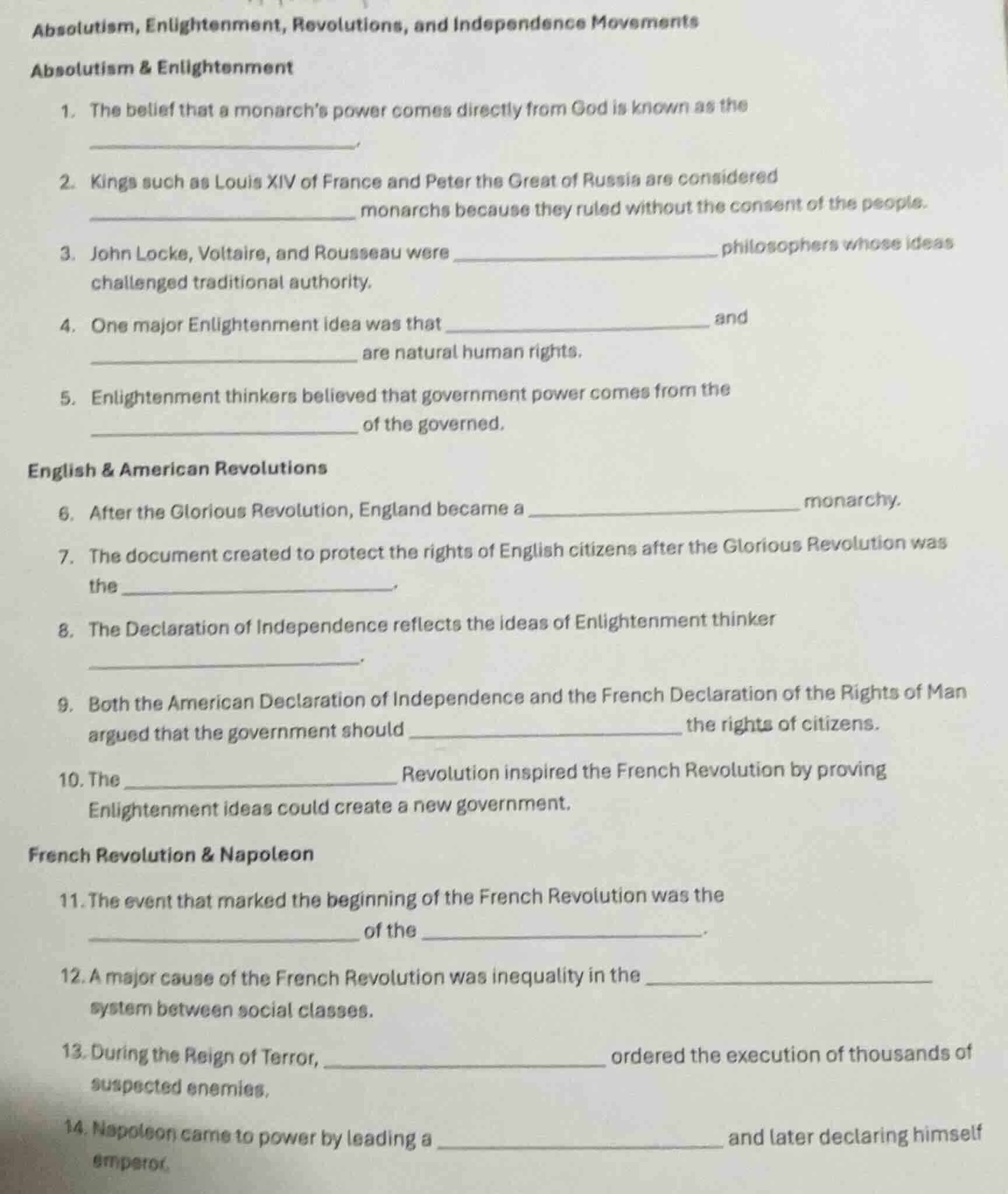
absolutism, enlightenment, revolutions, and independence movements
absolutism & enlightenment
- the belief that a monarch’s power comes directly from god is known as the
______________________.
- kings such as louis xiv of france and peter the great of russia are considered
__________________________ monarchs because they ruled without the consent of the people.
- john locke, voltaire, and rousseau were ________________________ philosophers whose ideas
challenged traditional authority.
- one major enlightenment idea was that _________________________ and
_________________________ are natural human rights.
- enlightenment thinkers believed that government power comes from the
__________________________ of the governed.
english & american revolutions
- after the glorious revolution, england became a __________________________ monarchy.
- the document created to protect the rights of english citizens after the glorious revolution was
the __________________________.
- the declaration of independence reflects the ideas of enlightenment thinker
__________________________.
- both the american declaration of independence and the french declaration of the rights of man
argued that the government should __________________________ the rights of citizens.
- the __________________________ revolution inspired the french revolution by proving
enlightenment ideas could create a new government.
french revolution & napoleon
- the event that marked the beginning of the french revolution was the
________________________ of the ________________________.
- a major cause of the french revolution was inequality in the __________________________
system between social classes.
- during the reign of terror, __________________________ ordered the execution of thousands of
suspected enemies.
- napoleon came to power by leading a __________________________ and later declaring himself
emperor.
- Identifies the core doctrine of absolute monarchies linking royal power to God.
- Labels rulers with unrestricted, unaccountable authority.
- Names the intellectual movement these philosophers led.
- Cites foundational natural rights from Enlightenment thought.
- States the Enlightenment's core principle of popular political legitimacy.
- Describes the limited form of monarchy established in post-1688 England.
- Identifies the key post-Glorious Revolution rights document.
- Links the Declaration of Independence to its primary Enlightenment influence.
- Notes the shared core demand of these revolutionary rights documents.
- Identifies the revolution that demonstrated Enlightenment principles could be put into practice.
- Names the iconic event that initiated the French Revolution.
- Points to the unfair social hierarchy that fueled the French Revolution.
- Identifies the leader of the radical, violent phase of the French Revolution.
- Describes Napoleon's path to power through military and political means.

Snap & solve any problem in the app
Get step-by-step solutions on Sovi AI
Photo-based solutions with guided steps
Explore more problems and detailed explanations
- Divine Right of Kings
- absolute
- Enlightenment
- life; liberty (or property)
- consent
- constitutional (limited)
- English Bill of Rights
- John Locke
- protect
- American
- Storming; Bastille
- Estates
- Maximilien Robespierre (or the Committee of Public Safety)
- coup d'état