QUESTION IMAGE
Question
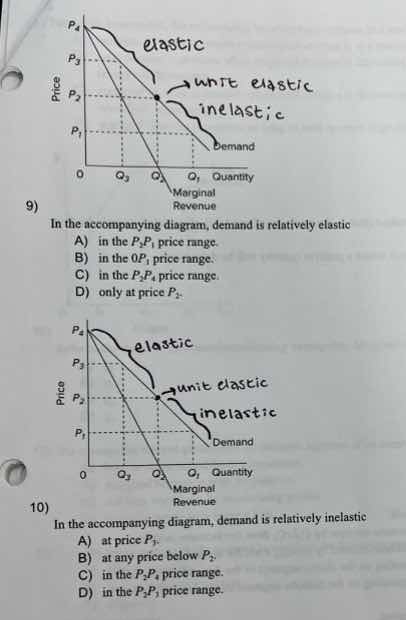
- in the accompanying diagram, demand is relatively elastic a) in the $p_{4}p_{1}$ price range. b) in the $0p_{1}$ price range. c) in the $p_{3}p_{4}$ price range. d) only at price $p_{2}$. 10) in the accompanying diagram, demand is relatively inelastic a) at price $p_{3}$. b) at any price below $p_{2}$. c) in the $p_{4}p_{1}$ price range. d) in the $p_{2}p_{1}$ price range.
Response
Question 9
Step1: Recall elasticity rules
For a linear demand curve, demand is elastic above the midpoint (unit elastic point), unit elastic at the midpoint, and inelastic below the midpoint. The midpoint here is at price $P_2$.
Step2: Match to options
The $P_3P_4$ range is above the unit elastic point ($P_2$), so demand is elastic here.
Step1: Recall elasticity rules
For a linear demand curve, demand is inelastic below the midpoint (unit elastic point at $P_2$).
Step2: Match to options
The $P_1P_2$ range is below the unit elastic point ($P_2$), so demand is inelastic here.

Snap & solve any problem in the app
Get step-by-step solutions on Sovi AI
Photo-based solutions with guided steps
Explore more problems and detailed explanations
C) in the $P_3P_4$ price range.
---