QUESTION IMAGE
Question
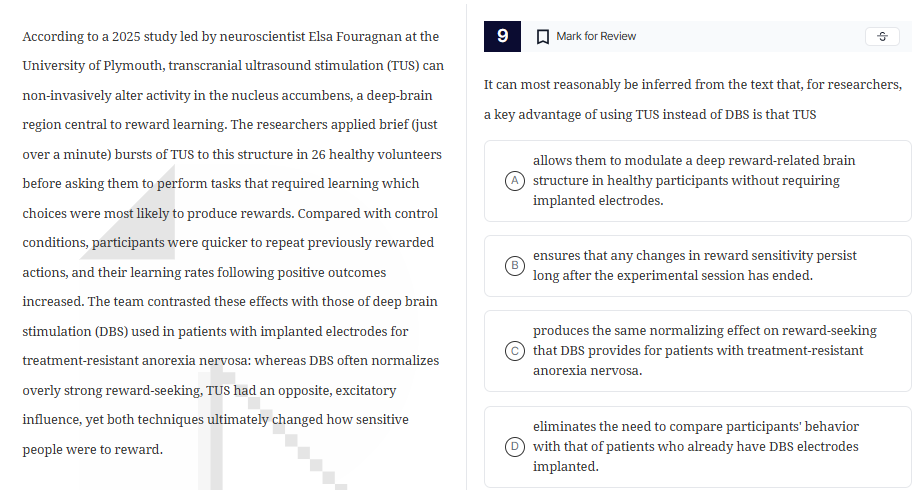
according to a 2025 study led by neuroscientist elsa fouragnan at the university of plymouth, transcranial ultrasound stimulation (tus) can non - invasively alter activity in the nucleus accumbens, a deep - brain region central to reward learning. the researchers applied brief (just over a minute) bursts of tus to this structure in 26 healthy volunteers before asking them to perform tasks that required learning which choices were most likely to produce rewards. compared with control conditions, participants were quicker to repeat previously rewarded actions, and their learning rates following positive outcomes increased. the team contrasted these effects with those of deep brain stimulation (dbs) used in patients with implanted electrodes for treatment - resistant anorexia nervosa; whereas dbs often normalizes overly strong reward - seeking, tus had an opposite, excitatory influence, yet both techniques ultimately changed how sensitive people were to reward.
9 mark for review
it can most reasonably be inferred from the text that, for researchers, a key advantage of using tus instead of dbs is that tus
a allows them to modulate a deep reward - related brain structure in healthy participants without requiring implanted electrodes.
b ensures that any changes in reward sensitivity persist long after the experimental session has ended.
c produces the same normalizing effect on reward - seeking that dbs provides for patients with treatment - resistant anorexia nervosa.
d eliminates the need to compare participants behavior with that of patients who already have dbs electrodes implanted.
To solve this, we analyze each option:
- Option A: The text says TUS is non - invasive and used on healthy volunteers, while DBS uses implanted electrodes. So TUS can modulate the brain structure in healthy participants without implanted electrodes. This matches the info.
- Option B: The text has no info about TUS effects persisting long after the session. Eliminate.
- Option C: TUS had an opposite effect to DBS on reward - seeking, so it doesn't produce the same normalizing effect. Eliminate.
- Option D: The study compared TUS effects with DBS effects, so it doesn't eliminate the need to compare with DBS - implanted patients. Eliminate.

Snap & solve any problem in the app
Get step-by-step solutions on Sovi AI
Photo-based solutions with guided steps
Explore more problems and detailed explanations
A. allows them to modulate a deep reward - related brain structure in healthy participants without requiring implanted electrodes.