QUESTION IMAGE
Question
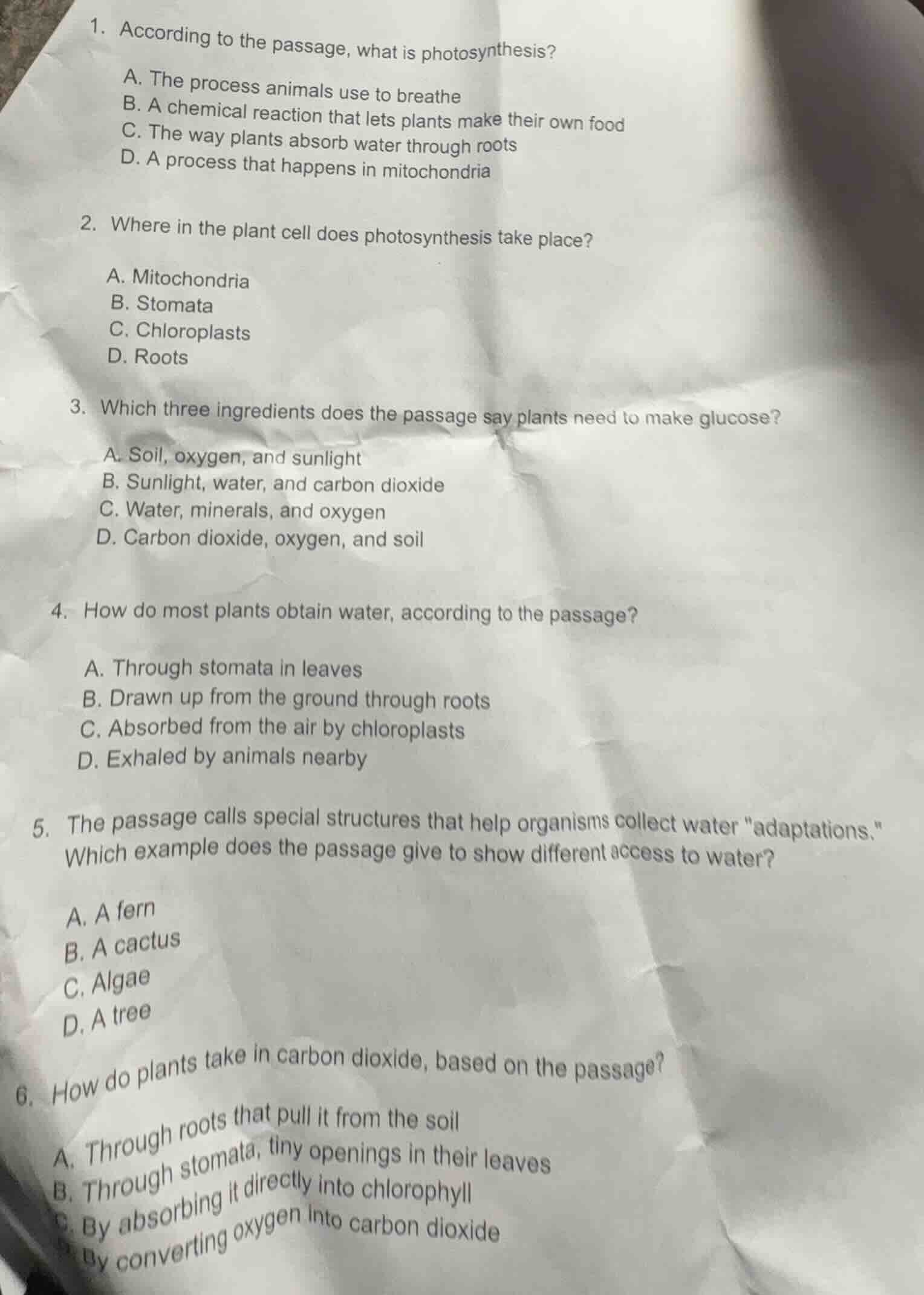
- according to the passage, what is photosynthesis?a. the process animals use to breatheb. a chemical reaction that lets plants make their own foodc. the way plants absorb water through rootsd. a process that happens in mitochondria2. where in the plant cell does photosynthesis take place?a. mitochondriab. stomatac. chloroplastsd. roots3. which three ingredients does the passage say plants need to make glucose?a. soil, oxygen, and sunlightb. sunlight, water, and carbon dioxidec. water, minerals, and oxygend. carbon dioxide, oxygen, and soil4. how do most plants obtain water, according to the passage?a. through stomata in leavesb. drawn up from the ground through rootsc. absorbed from the air by chloroplastsd. exhaled by animals nearby5. the passage calls special structures that help organisms collect water \adaptations.\ which example does the passage give to show different access to water?a. a fernb. a cactusc. algaed. a tree6. how do plants take in carbon dioxide, based on the passage?a. through roots that pull it from the soilb. through stomata, tiny openings in their leavesc. by absorbing it directly into chlorophylld. by converting oxygen into carbon dioxide
Brief Explanations
- Photosynthesis is the process where plants produce their own food via a chemical reaction.
- Photosynthesis occurs in chloroplasts, organelles in plant cells.
- The reactants for glucose production in photosynthesis are sunlight, water, and carbon dioxide.
- Most plants take in water from the ground through their root systems.
- Cacti are adapted to arid environments with specialized water-collecting/conserving structures, demonstrating unique water access.
- Plants absorb carbon dioxide through small leaf openings called stomata.

Snap & solve any problem in the app
Get step-by-step solutions on Sovi AI
Photo-based solutions with guided steps
Explore more problems and detailed explanations
- B. A chemical reaction that lets plants make their own food
- C. Chloroplasts
- B. Sunlight, water, and carbon dioxide
- B. Drawn up from the ground through roots
- B. A cactus
- B. Through stomata, tiny openings in their leaves