QUESTION IMAGE
Question
4.
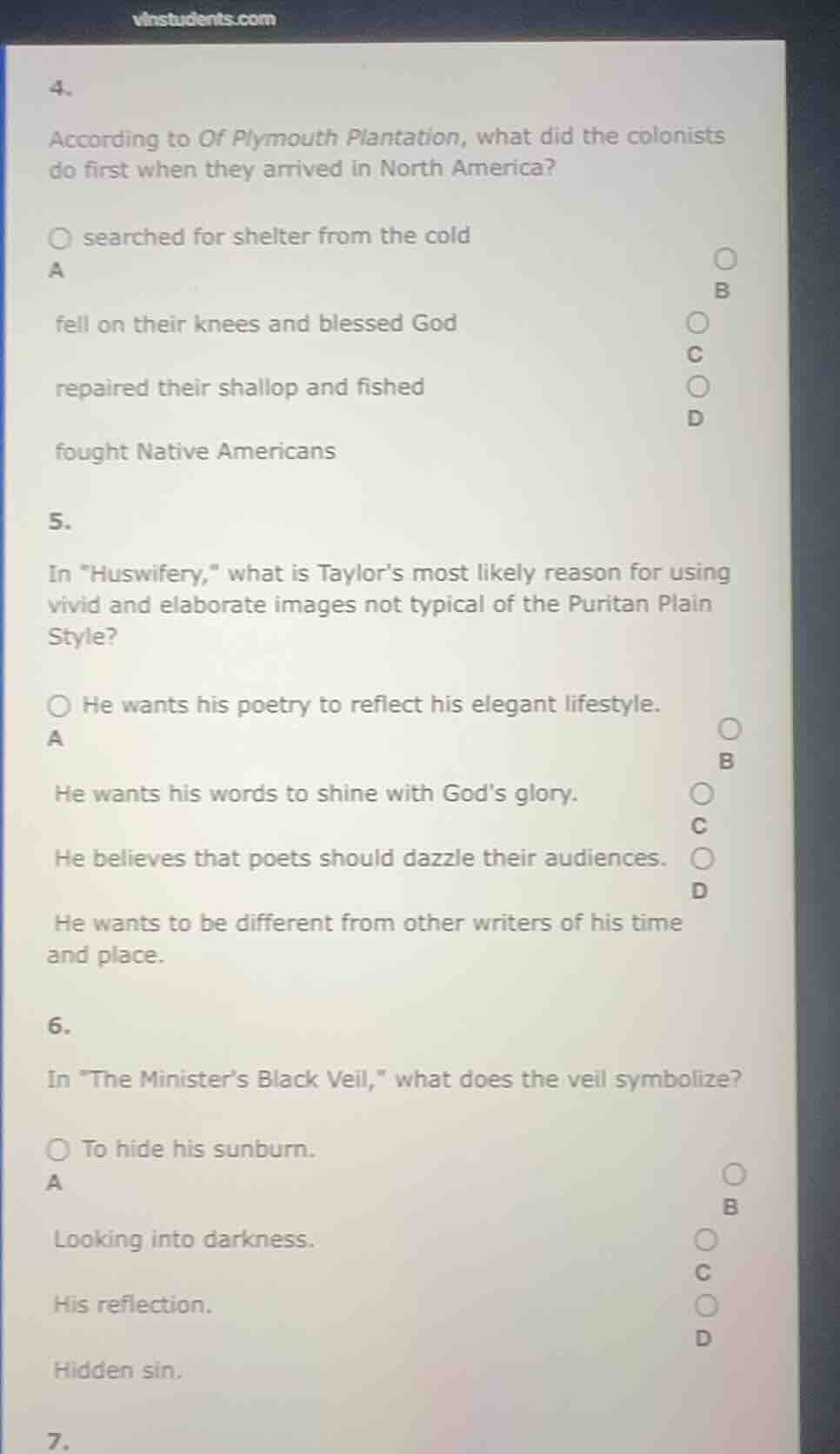
according to of plymouth plantation, what did the colonists
do first when they arrived in north america?
○ searched for shelter from the cold
a
○ b
fell on their knees and blessed god
○ c
repaired their shallop and fished
○ d
fought native americans
5.
in \huswifery,\ what is taylor’s most likely reason for using
vivid and elaborate images not typical of the puritan plain
style?
○ he wants his poetry to reflect his elegant lifestyle.
a
○ b
he wants his words to shine with god’s glory.
○ c
he believes that poets should dazzle their audiences.
○ d
he wants to be different from other writers of his time
and place.
6.
in \the minister’s black veil,\ what does the veil symbolize?
○ to hide his sunburn.
a
○ b
looking into darkness.
○ c
his reflection.
○ d
hidden sin.
7.
Question 4:
Of Plymouth Plantation records that upon arriving, the colonists first gave thanks to God by kneeling and blessing Him, as their survival of the voyage was attributed to divine grace.
Question 5:
Edward Taylor, a Puritan poet, used vivid imagery in "Huswifery" to tie domestic tasks to divine glory, framing his work as a way to honor and reflect God's greatness, not for personal or stylistic vanity.
Question 6:
In Hawthorne's The Minister's Black Veil, the veil is a central symbol of the hidden sin that every person carries, which the minister chooses to outwardly represent to confront others about their own unacknowledged transgressions.

Snap & solve any problem in the app
Get step-by-step solutions on Sovi AI
Photo-based solutions with guided steps
Explore more problems and detailed explanations
- B. fell on their knees and blessed God
- B. He wants his words to shine with God's glory.
- D. Hidden sin.