QUESTION IMAGE
Question
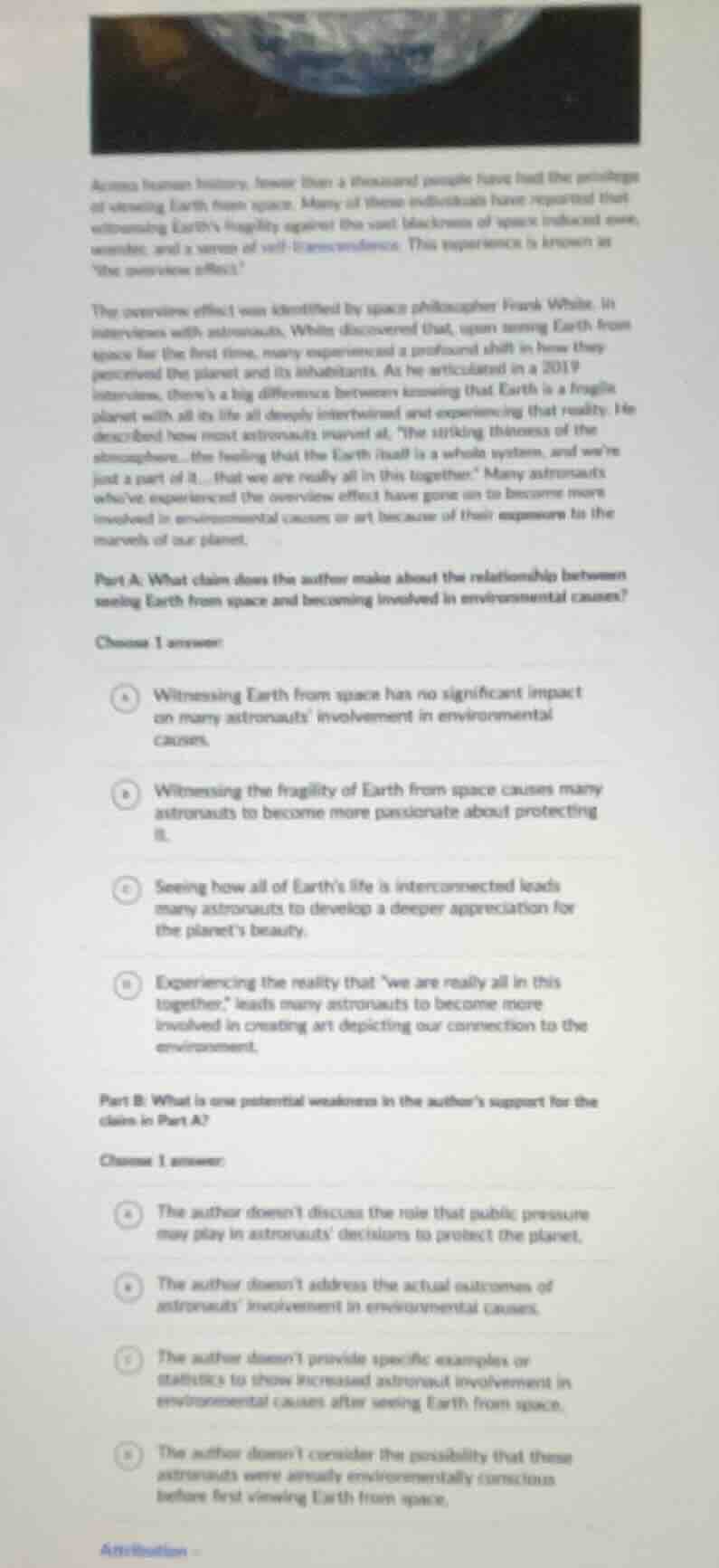
across human history, fewer than a thousand people have had the privilege of seeing earth from space. many of these individuals have reported that witnessing earth’s fragility against the vast blackness of space induced awe, wonder, and a sense of self - transcendence. this experience is known as ‘the overview effect.’
the overview effect was identified by space philosopher frank white. in interviews with astronauts, white discovered that, upon seeing earth from space for the first time, many experienced a profound shift in how they perceived the planet and its inhabitants. as he articulated in a 2019 interview, there’s a big difference between knowing that earth is a fragile planet with all its life all deeply intertwined and experiencing that reality. he described how most astronauts marvel at ‘the striking thinness of the atmosphere... the feeling that the earth itself is a whole system, and we’re just a part of it... that we are really all in this together.’ many astronauts who’ve experienced the overview effect have gone on to become more involved in environmental causes or art because of their exposure to the marvels of our planet.
part a. what claim does the author make about the relationship between seeing earth from space and becoming involved in environmental causes?
choose 1 answer:
a witnessing earth from space has no significant impact on many astronauts’ involvement in environmental causes.
b witnessing the fragility of earth from space causes many astronauts to become more passionate about protecting it.
c seeing how all of earth’s life is interconnected leads many astronauts to develop a deeper appreciation for the planet’s beauty.
d experiencing the reality that ‘we are really all in this together,’ leads many astronauts to become more involved in creating art depicting our connection to the environment.
part b: what is one potential weakness in the author’s support for the claim in part a?
choose 1 answer:
a the author doesn’t discuss the role that public pressure may play in astronauts’ decisions to protect the planet.
b the author doesn’t address the actual outcomes of astronauts’ involvement in environmental causes.
c the author doesn’t provide specific examples or statistics to show increased astronaut involvement in environmental causes after seeing earth from space.
d the author doesn’t consider the possibility that these astronauts were already environmentally conscious before first viewing earth from space.
Part A
- Option A: The passage says many astronauts became more involved in environmental causes, so A is wrong.
- Option B: The text states that seeing Earth's fragility from space (via the overview effect) made many astronauts more passionate about protecting it (involved in environmental causes), which matches the claim.
- Option C: The focus is on environmental involvement, not appreciation for beauty, so C is incorrect.
- Option D: The passage is about environmental causes, not art creation, so D is wrong.
- Option A: Public pressure isn't relevant to the claim about the effect of seeing Earth from space on environmental involvement, so not a weakness.
- Option B: The claim is about the cause (seeing Earth) leading to involvement, not the outcomes of that involvement, so B is not a weakness.
- Option C: The author claims many astronauts became involved but doesn't give specific examples or stats to support the increase, which is a potential weakness in the support.
- Option D: The claim is about the effect of seeing Earth from space, not pre - existing concern, so D is not a relevant weakness.

Snap & solve any problem in the app
Get step-by-step solutions on Sovi AI
Photo-based solutions with guided steps
Explore more problems and detailed explanations
B. Witnessing the fragility of Earth from space causes many astronauts to become more passionate about protecting it.