QUESTION IMAGE
Question
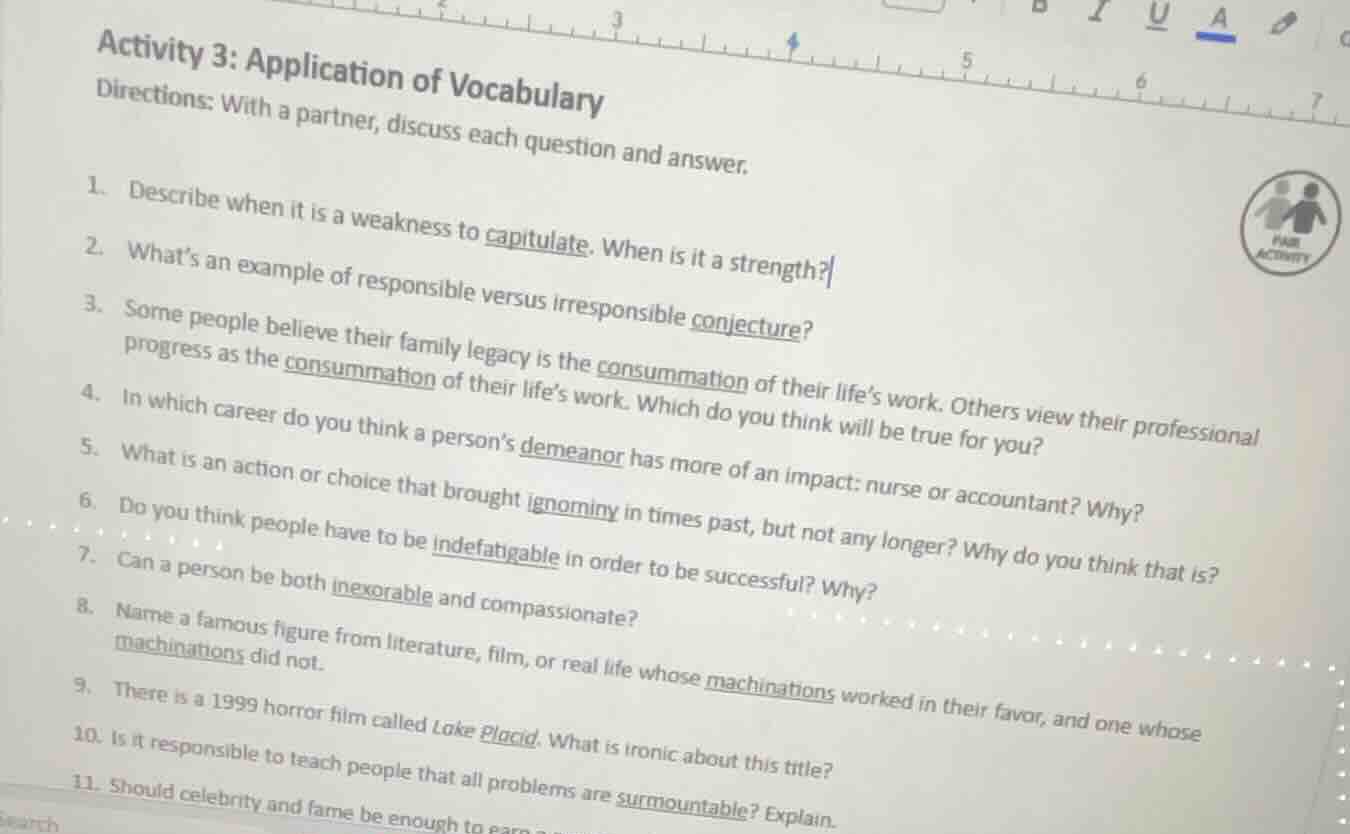
activity 3: application of vocabulary
directions: with a partner, discuss each question and answer.
- describe when it is a weakness to capitulate. when is it a strength?
- what’s an example of responsible versus irresponsible conjecture?
- some people believe their family legacy is the consummation of their life’s work. others view their professional progress as the consummation of their life’s work. which do you think will be true for you?
- in which career do you think a person’s demeanor has more of an impact: nurse or accountant? why?
- what is an action or choice that brought ignominy in times past, but not any longer? why do you think that is?
- do you think people have to be indefatigable in order to be successful? why?
- can a person be both inexorable and compassionate?
- name a famous figure from literature, film, or real life whose machinations worked in their favor, and one whose machinations did not.
- there is a 1999 horror film called lake placid. what is ironic about this title?
- is it responsible to teach people that all problems are surmountable? explain.
- should celebrity and fame be enough to earn
Brief Explanations
- Capitulate weakness/strength: Capitulating is a weakness when it means surrendering core values or letting others exploit you (e.g., giving in to a bully's demands to avoid conflict). It is a strength when it prevents unnecessary harm (e.g., surrendering in a hopeless battle to save lives) or de-escalates a dangerous situation.
- Responsible vs. irresponsible conjecture: A responsible conjecture is an educated guess backed by evidence, like a scientist hypothesizing a new treatment based on preliminary data. An irresponsible conjecture is an unsubstantiated claim, like spreading a rumor that a coworker is quitting with no proof.
- Family legacy vs. professional progress: This is a personal preference. For some, building a strong, supportive family legacy (passing down values, care, and stability) feels like the ultimate life work. For others, achieving professional milestones (innovating in a field, building a successful career) feels like the true summation of their efforts.
- Demeanor impact (nurse vs. accountant): A nurse's demeanor has a bigger impact. Nurses interact directly with vulnerable, stressed patients; a calm, kind demeanor can ease anxiety and improve patient outcomes. Accountants focus more on data, so while professionalism matters, their demeanor has less direct impact on others' well-being.
- Ignominy action/choice: An example is a person who lied to get a promotion. At the time, they may have faced shame (ignominy) from colleagues, but as workplace norms around accountability have shifted, that same action might now result in termination, making the past ignominy milder by comparison.
- Indefatigable for success: It depends. For high-stakes, demanding fields like surgery or startup entrepreneurship, indefatigable (unwearying) drive is often necessary to overcome long hours and setbacks. But for many roles, balanced, sustainable effort (not constant overwork) can lead to success without being indefatigable.
- Inexorable and compassionate: Yes. A judge can be inexorable (firm, unyielding) about upholding the law while showing compassion, like sentencing a first-time offender to community service instead of jail to help them rebuild their life.
- Machinations examples: A successful machinator is Iago from Othello, whose manipulative schemes (turning Othello against Desdemona) work in his favor until the end. An unsuccessful machinator is Lord Voldemort from the Harry Potter series, whose endless plots to kill Harry and seize power ultimately lead to his own death.
- Lake Placid irony: The word "placid" means calm, peaceful, and undisturbed. The irony is that the film is a horror movie centered on a violent, man-eating crocodile terrorizing the lake, which is the opposite of placid.
- Teaching all problems are surmountable: It is generally responsible. Teaching this fosters resilience and a growth mindset, encouraging people to face challenges instead of giving up. However, it is important to acknowledge that some problems are extremely difficult, to avoid dismissing genuine struggle.
- Celebrity/fame as sufficient reward: No. Celebrity and fame are often fleeting and do not equate to meaningful contribution or personal fulfillment. True success should be tied to effort, impact, and personal values, not just public attention.

Snap & solve any problem in the app
Get step-by-step solutions on Sovi AI
Photo-based solutions with guided steps
Explore more problems and detailed explanations
- Weakness: Surrendering core values to exploiters. Strength: Surrendering to save lives.
- Responsible: Evidence-backed hypothesis. Irresponsible: Unsubstantiated rumor.
- Personal preference; either family legacy or professional progress is valid based on individual values.
- Nurse; their demeanor directly impacts vulnerable patients' well-being.
- Example: Lying for a promotion; past ignominy was milder than modern professional consequences.
- No; sustainable effort works for many roles, though it helps in high-stakes fields.
- Yes; e.g., a judge upholding law while showing mercy to first offenders.
- Successful: Iago (Othello). Unsuccessful: Lord Voldemort (Harry Potter).
- "Placid" means calm, but the lake hosts a violent, man-eating crocodile.
- Yes; it builds resilience, but should acknowledge some struggles are very hard.
- No; fame is fleeting, success needs meaningful impact/effort.