QUESTION IMAGE
Question
activity
student handout
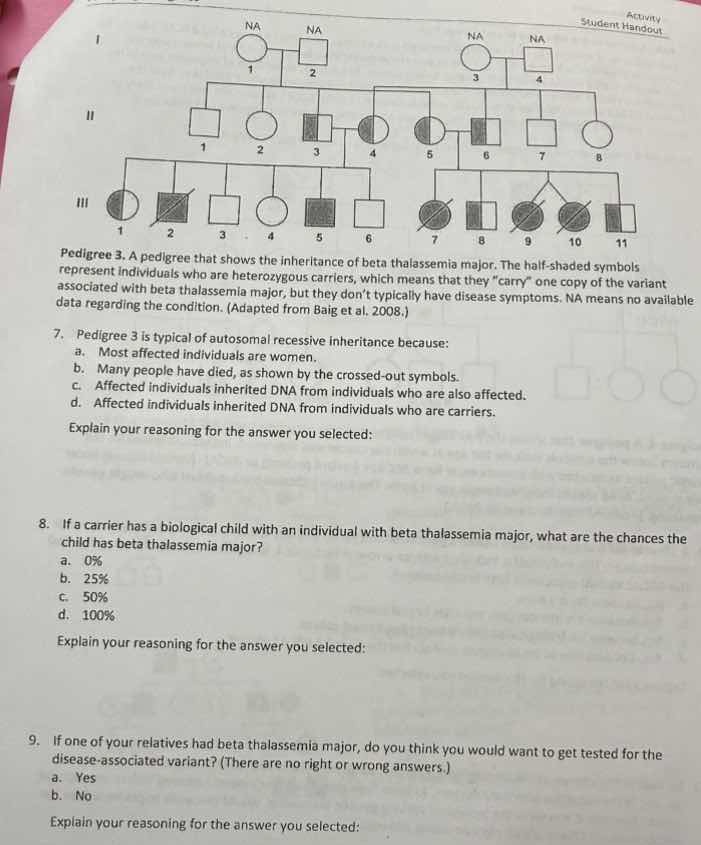
pedigree 3. a pedigree that shows the inheritance of beta thalassemia major. the half-shaded symbols represent individuals who are heterozygous carriers, which means that they \carry\ one copy of the variant associated with beta thalassemia major, but they dont typically have disease symptoms. na means no available data regarding the condition. (adapted from baig et al. 2008.)
- pedigree 3 is typical of autosomal recessive inheritance because:
a. most affected individuals are women.
b. many people have died, as shown by the crossed-out symbols.
c. affected individuals inherited dna from individuals who are also affected.
d. affected individuals inherited dna from individuals who are carriers.
explain your reasoning for the answer you selected:
- if a carrier has a biological child with an individual with beta thalassemia major, what are the chances the child has beta thalassemia major?
a. 0%
b. 25%
c. 50%
d. 100%
explain your reasoning for the answer you selected:
- if one of your relatives had beta thalassemia major, do you think you would want to get tested for the disease-associated variant? (there are no right or wrong answers.)
a. yes
b. no
explain your reasoning for the answer you selected:
Question 7
Autosomal recessive inheritance requires two copies of the defective allele (one from each carrier parent). In this pedigree, affected individuals (solid symbols) have parents who are either carriers (half-shaded) or affected, meaning they inherited the variant from carrier/affected parents. Option a is wrong as affected individuals are evenly split by sex. Option b is irrelevant to inheritance type. Option c is incorrect because affected individuals can inherit from carriers (not just affected individuals).
Step1: Define genotypes
Let the normal allele be $A$, the thalassemia allele be $a$. Carrier genotype: $Aa$; Beta thalassemia major genotype: $aa$.
Step2: Set up Punnett square
Cross $Aa \times aa$:
Step3: Calculate probability
2 out of 4 offspring have $aa$ (thalassemia major). Probability = $\frac{2}{4} = 50\%$.
Beta thalassemia major is autosomal recessive, requiring two defective alleles ($aa$). A carrier ($Aa$) will pass either $A$ or $a$ (50% chance each), while an affected individual ($aa$) can only pass $a$. 50% of offspring will inherit two defective alleles ($aa$), resulting in the disease.
---
Question 9

Snap & solve any problem in the app
Get step-by-step solutions on Sovi AI
Photo-based solutions with guided steps
Explore more problems and detailed explanations
d. Affected individuals inherited DNA from individuals who are carriers.
---