QUESTION IMAGE
Question
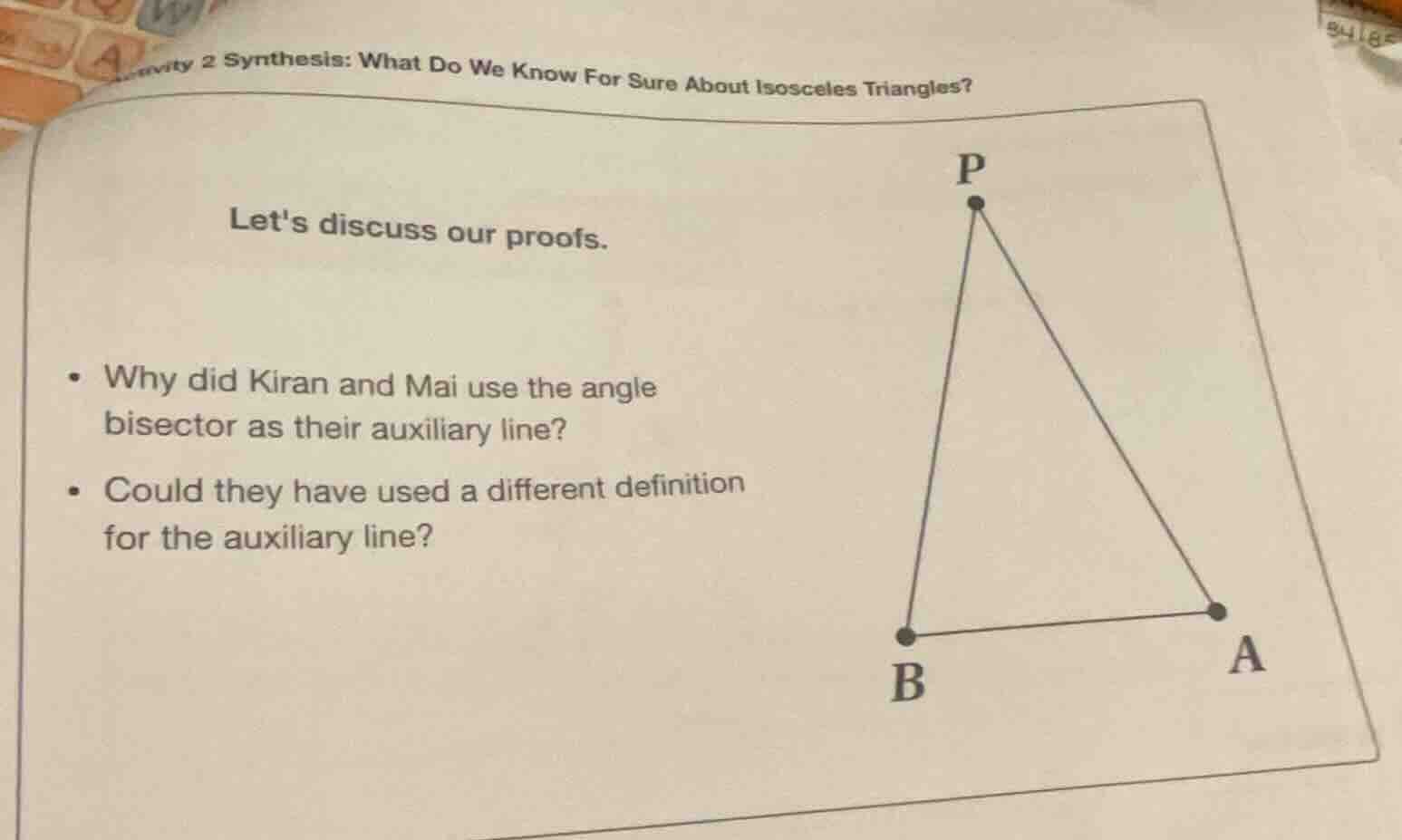
activity 2 synthesis: what do we know for sure about isosceles triangles?
lets discuss our proofs.
- why did kiran and mai use the angle bisector as their auxiliary line?
- could they have used a different definition for the auxiliary line?
Brief Explanations
- For the first question: The angle bisector of the vertex angle ∠BPA splits the isosceles triangle into two congruent smaller triangles. This lets them use congruence criteria (like SAS, since the two equal sides of the isosceles triangle, the shared bisector, and the split equal angles match) to prove properties of the isosceles triangle, such as base angles being equal or the bisector also being the median/altitude.
- For the second question: Yes, they could use other auxiliary lines. A common alternative is the perpendicular bisector of the base BA from point P, or the median from P to the midpoint of BA. Both of these lines also divide the isosceles triangle into two congruent right triangles, which can be used to prove the triangle's properties via congruence (like HL for right triangles).

Snap & solve any problem in the app
Get step-by-step solutions on Sovi AI
Photo-based solutions with guided steps
Explore more problems and detailed explanations
- Kiran and Mai used the angle bisector because it splits the isosceles triangle into two congruent triangles, enabling proof via triangle congruence criteria.
- Yes, they could use a different auxiliary line. Examples include the perpendicular bisector of the base or the median from the vertex to the base.