QUESTION IMAGE
Question
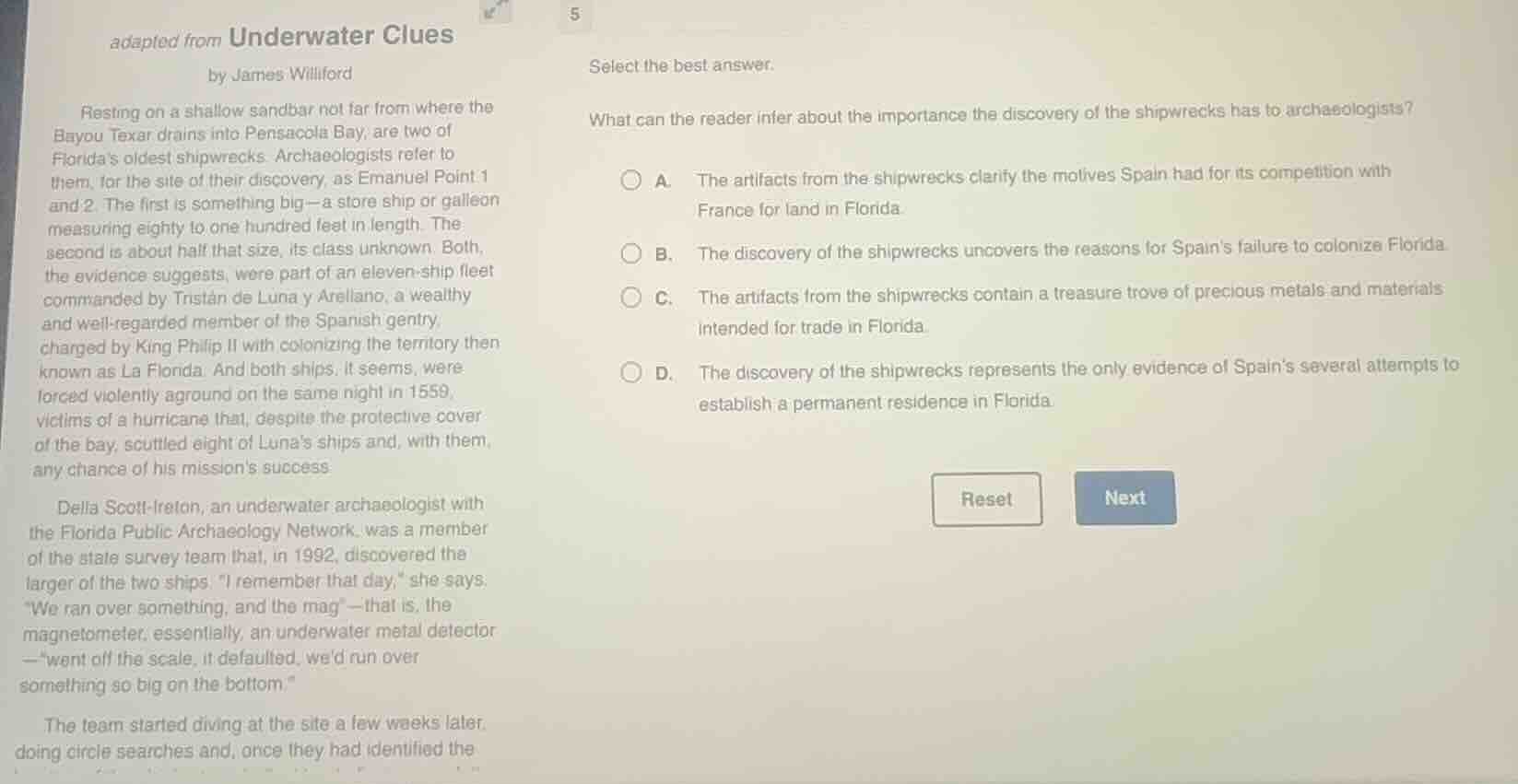
adapted from underwater clues by james williford resting on a shallow sandbar not far from where the bayou texar drains into pensacola bay, are two of florida’s oldest shipwrecks. archaeologists refer to them, for the site of their discovery, as emanuel point 1 and 2. the first is something big—a store ship or galleon measuring eighty to one hundred feet in length. the second is about half that size, its class unknown. both, the evidence suggests, were part of an eleven - ship fleet commanded by tristán de luna y arellano, a wealthy and well - regarded member of the spanish gentry, charged by king philip ii with colonizing the territory then known as la florida. and both ships, it seems, were forced violently aground on the same night in 1559, victims of a hurricane that, despite the protective cover of the bay, scuttled eight of luna’s ships and, with them, any chance of his mission’s success. delia scott - irelton, an underwater archaeologist with the florida public archaeology network, was a member of the state survey team that, in 1992, discovered the larger of the two ships. “i remember that day,” she says. “we ran over something, and the mag”—that is, the magnetometer, essentially, an underwater metal detector—“went off the scale. it defaulted, we’d run over something so big on the bottom.” the team started diving at the site a few weeks later, doing circle searches and, once they had identified the 5 select the best answer. what can the reader infer about the importance the discovery of the shipwrecks has to archaeologists? a. the artifacts from the shipwrecks clarify the motives spain had for its competition with france for land in florida. b. the discovery of the shipwrecks uncovers the reasons for spain’s failure to colonize florida. c. the artifacts from the shipwrecks contain a treasure trove of precious metals and materials intended for trade in florida. d. the discovery of the shipwrecks represents the only evidence of spain’s several attempts to establish a permanent residence in florida.
The passage states the ships were part of Tristán de Luna's fleet tasked with colonizing La Florida, and the hurricane destroyed most of the fleet, ending the mission's chance of success. This means the shipwrecks provide evidence explaining why Spain's colonization attempt failed. Option A is incorrect because the text does not mention motives for competing with France. Option C is incorrect as there is no reference to precious metals for trade. Option D is wrong because the text does not state this is the only evidence of Spain's colonization attempts.

Snap & solve any problem in the app
Get step-by-step solutions on Sovi AI
Photo-based solutions with guided steps
Explore more problems and detailed explanations
B. The discovery of the shipwrecks uncovers the reasons for Spain's failure to colonize Florida.