QUESTION IMAGE
Question
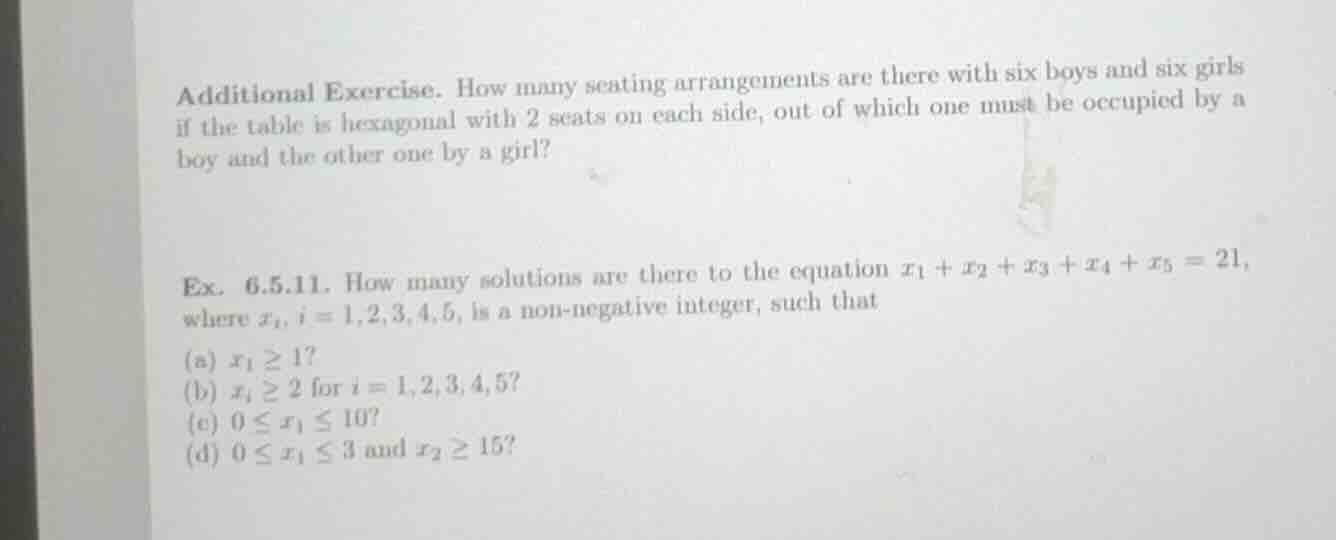
additional exercise. how many seating arrangements are there with six boys and six girls if the table is hexagonal with 2 seats on each side, out of which one must be occupied by a boy and the other one by a girl?
ex. 6.5.11. how many solutions are there to the equation $x_1 + x_2 + x_3 + x_4 + x_5 = 21$, where $x_i, i=1,2,3,4,5$, is a non-negative integer, such that
(a) $x_1 \geq 1?$
(b) $x_i \geq 2$ for $i=1,2,3,4,5?$
(c) $0 \leq x_1 \leq 10?$
(d) $0 \leq x_1 \leq 3$ and $x_2 \geq 15?$
First Problem: Seating Arrangements
Step1: Fix boy-girl pairs per side
Each of the 6 sides has 1 boy + 1 girl. First, arrange 6 boys around the hexagonal table. For circular permutations of \(n\) distinct objects, the number is \((n-1)!\).
Expression: \((6-1)! = 5!\)
Step2: Assign girls to each side
For each boy's seat, we can place a girl in the paired seat, and the 6 girls are distinct. We permute the 6 girls across the 6 sides.
Expression: \(6!\)
Step3: Account for side seat order
On each side, the boy and girl can swap seats (boy in left/girl in right, or vice versa). There are 6 sides, each with 2 possibilities.
Expression: \(2^6\)
Step4: Calculate total arrangements
Multiply the three components together.
Expression: \(5! \times 6! \times 2^6\)
---
Part (a): \(x_1 \geq 1\)
Step1: Substitute \(x_1'=x_1-1\)
Convert to non-negative variable: \(x_1' \geq 0\). The equation becomes \(x_1'+1+x_2+x_3+x_4+x_5=21\), so \(x_1'+x_2+x_3+x_4+x_5=20\).
Expression: \(\binom{20+5-1}{5-1}\)
Step2: Compute combination
Calculate the binomial coefficient.
Expression: \(\binom{24}{4}\)
---
Part (b): \(x_i \geq 2\) for all \(i\)
Step1: Substitute \(x_i'=x_i-2\)
All \(x_i' \geq 0\). The equation becomes \((x_1'+2)+(x_2'+2)+...+(x_5'+2)=21\), so \(x_1'+x_2'+x_3'+x_4'+x_5'=21-10=11\).
Expression: \(\binom{11+5-1}{5-1}\)
Step2: Compute combination
Expression: \(\binom{15}{4}\)
---
Part (c): \(0 \leq x_1 \leq 10\)
Step1: Total solutions without restriction
Calculate all non-negative solutions to \(x_1+x_2+x_3+x_4+x_5=21\).
Expression: \(\binom{21+5-1}{5-1}=\binom{25}{4}\)
Step2: Subtract invalid solutions (\(x_1 \geq 11\))
Substitute \(x_1'=x_1-11\), equation becomes \(x_1'+x_2+x_3+x_4+x_5=21-11=10\). Number of invalid solutions: \(\binom{10+5-1}{5-1}=\binom{14}{4}\)
Step3: Compute valid solutions
Expression: \(\binom{25}{4}-\binom{14}{4}\)
---
Part (d): \(0 \leq x_1 \leq 3\) and \(x_2 \geq 15\)
Step1: Substitute \(x_2'=x_2-15\)
\(x_2' \geq 0\), equation becomes \(x_1+x_2'+15+x_3+x_4+x_5=21\), so \(x_1+x_2'+x_3+x_4+x_5=6\), with \(0 \leq x_1 \leq 3\).
Step2: Calculate valid solutions
Sum solutions for \(x_1=0,1,2,3\): for each \(x_1=k\), solve \(x_2'+x_3+x_4+x_5=6-k\), number of solutions is \(\binom{(6-k)+4-1}{4-1}=\binom{9-k}{3}\).
Expression: \(\binom{9}{3}+\binom{8}{3}+\binom{7}{3}+\binom{6}{3}\)

Snap & solve any problem in the app
Get step-by-step solutions on Sovi AI
Photo-based solutions with guided steps
Explore more problems and detailed explanations
\(120 \times 720 \times 64 = 5,529,600\)
---
Second Problem: Integer Solutions to \(x_1+x_2+x_3+x_4+x_5=21\)
We use the stars and bars formula: the number of non-negative integer solutions to \(y_1+y_2+...+y_k=n\) is \(\binom{n+k-1}{k-1}\).