QUESTION IMAGE
Question
adolf hitler and nazi germany:
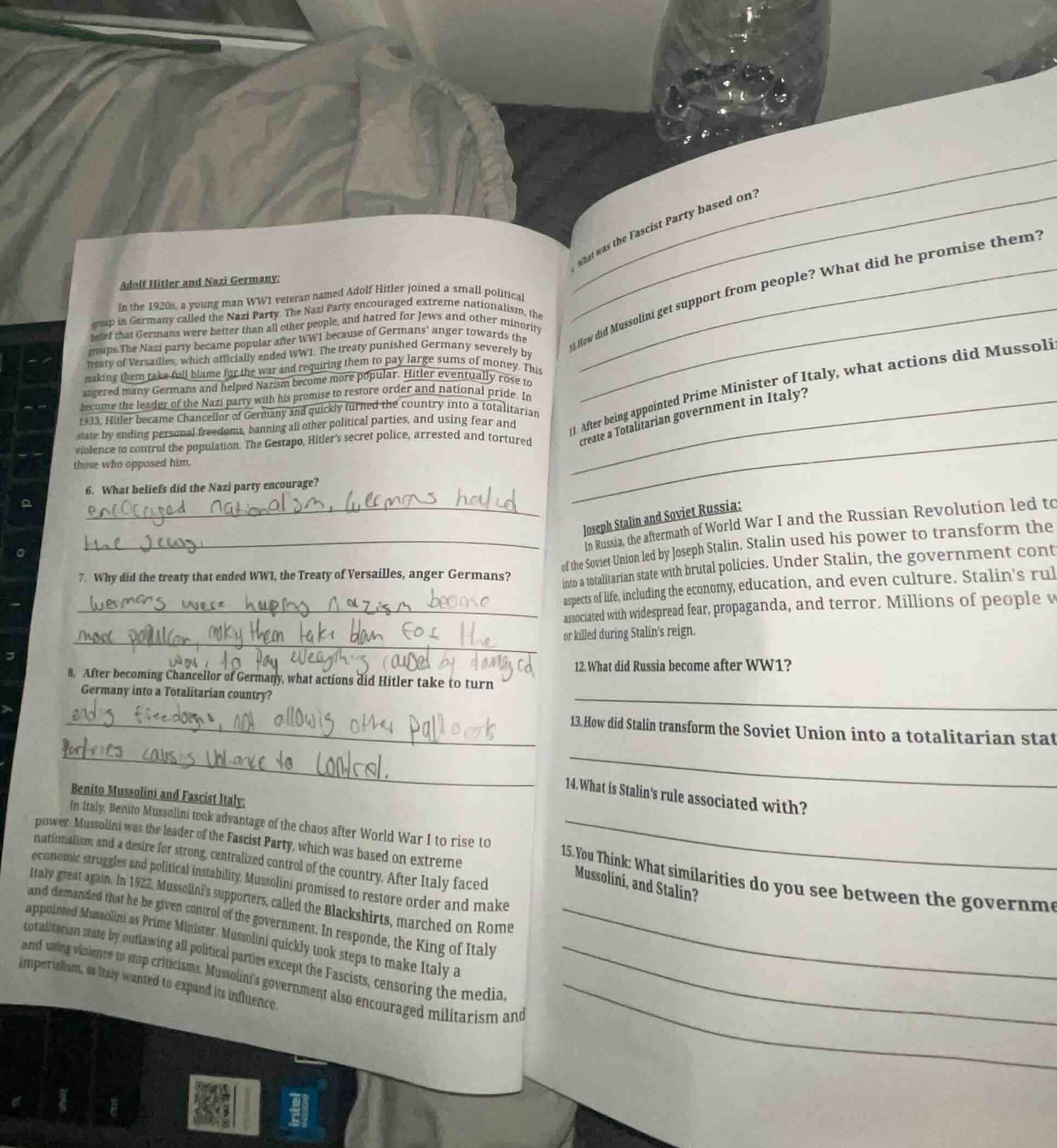
in the 1920s, a young man ww1 veteran named adolf hitler joined a small political group in germany called the nazi party. the nazi party encouraged extreme nationalism, the belief that germans were better than all other people, and hatred for jews and other minority groups. the nazi party became popular after ww1 because of germans anger towards the treaty of versailles, which officially ended ww1. the treaty punished germany severely by making them take full blame for the war and requiring them to pay large sums of money. this angered many germans and helped nazism become more popular. hitler eventually rose to become the leader of the nazi party with his promise to restore order and national pride. in 1933, hitler became chancellor of germany and quickly turned the country into a totalitarian state by ending personal freedoms, banning all other political parties, and using fear and violence to control the population. the gestapo, hitlers secret police, arrested and tortured those who opposed him.
- what beliefs did the nazi party encourage?
- why did the treaty that ended ww1, the treaty of versailles, anger germans?
- after becoming chancellor of germany, what actions did hitler take to turn germany into a totalitarian country?
benito mussolini and fascist italy:
in italy, benito mussolini took advantage of the chaos after world war i to rise to power. mussolini was the leader of the fascist party, which was based on extreme nationalism and a desire for strong, centralized control of the country. after italy faced economic struggles and political instability, mussolini promised to restore order and make italy great again. in 1922, mussolinis supporters, called the blackshirts, marched on rome and demanded that he be given control of the government. in responde, the king of italy appointed mussolini as prime minister. mussolini quickly took steps to make italy a totalitarian state by outlawing all political parties except the fascists, censoring the media, and using violence to stop criticisms. mussolinis government also encouraged militarism and imperialism, as italy wanted to expand its influence.
- what was the fascist party based on?
- how did mussolini get support from people? what did he promise them?
- after being appointed prime minister of italy, what actions did mussolini take to create a totalitarian government in italy?
joseph stalin and soviet russia:
in russia, the aftermath of world war i and the russian revolution led to the of the soviet union led by joseph stalin. stalin used his power to transform the into a totalitarian state with brutal policies. under stalin, the government controlled aspects of life, including the economy, education, and even culture. stalins rule associated with widespread fear, propaganda, and terror. millions of people were or killed during stalins reign.
- what did russia become after ww1?
- how did stalin transform the soviet union into a totalitarian state?
- what is stalins rule associated with?
- you think: what similarities do you see between the governments of hitler, mussolini, and stalin?
To answer these questions, we analyze the provided text:
Question 6: What beliefs did the Nazi party encourage?
From the text: "The Nazi Party encouraged extreme nationalism, the belief that Germans were better than all other people, and hatred for Jews and other minority groups."
Question 7: Why did the Treaty of Versailles anger Germans?
From the text: "The treaty punished Germany severely by making them take full blame for the war and requiring them to pay large sums of money. This angered many Germans..."
Question 8: How did Hitler turn Germany totalitarian?
From the text: "Hitler... turned the country into a totalitarian state by ending personal freedoms, banning all other political parties, and using fear and violence to control the population."
Question 9: What was the Fascist Party based on?
From the text: "Mussolini was the leader of the Fascist Party, which was based on extreme nationalism and a desire for strong, centralized control of the country."
Question 10: How did Mussolini gain support?
From the text: Italy faced "economic struggles and political instability. Mussolini promised to restore order and make Italy great again." His supporters (Blackshirts) marched on Rome, pressuring the King to appoint him.
Question 11: How did Mussolini create a totalitarian Italy?
From the text: "Mussolini quickly took steps to make Italy a totalitarian state by outlawing all political parties except the Fascists, censoring the media, and using violence to stop criticisms... encouraged militarism and imperialism."
Question 12: What did Russia become after WWI?
From the text: "the aftermath of World War I and the Russian Revolution led to [the creation] of the Soviet Union led by Joseph Stalin."
Question 13: How did Stalin transform the USSR?
From the text: "Stalin used his power to transform the [USSR] into a totalitarian state with brutal policies. Under Stalin, the government controlled all aspects of life... associated with widespread fear, propaganda, and terror."
Question 14: What is Stalin’s rule associated with?
From the text: "Stalin’s rule [was] associated with widespread fear, propaganda, and terror. Millions of people [were harmed or killed] during Stalin’s reign."
Question 15: Similarities between Hitler, Mussolini, Stalin?
All: Rose to power during post - WWI instability, established totalitarian regimes, suppressed opposition (banned parties, censored media), used fear/violence, promoted extreme ideologies (nationalism, authoritarian control), and centralized power.

Snap & solve any problem in the app
Get step-by-step solutions on Sovi AI
Photo-based solutions with guided steps
Explore more problems and detailed explanations
s (concise):
- Extreme nationalism, German superiority, hatred for Jews/minorities.
- Forced to take war blame, pay large reparations.
- Ended freedoms, banned parties, used fear/violence.
- Extreme nationalism, strong centralized control.
- Promised order/prosperity, Blackshirts’ Rome march pressured the King.
- Banned opposition parties, censored media, used violence, promoted militarism/imperialism.
- It became the Soviet Union (USSR).
- Brutal policies, total control over life, fear/propaganda/terror.
- Widespread fear, propaganda, terror, and mass harm/deaths.
- Totalitarian rule, suppressed opposition, used fear/violence, rose post - WWI, extreme ideologies (e.g., nationalism), centralized power.