QUESTION IMAGE
Question
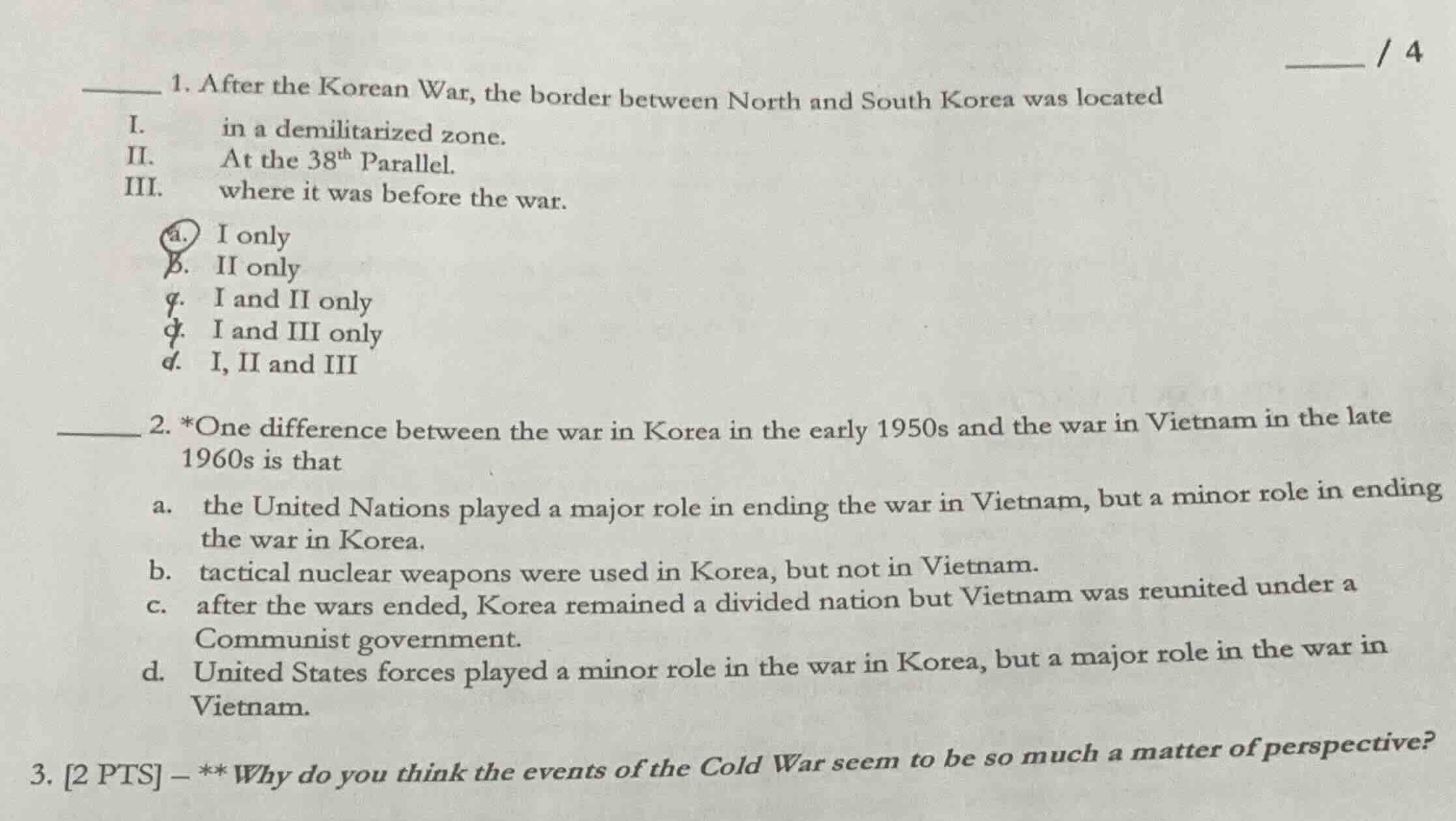
- after the korean war, the border between north and south korea was located
i. in a demilitarized zone.
ii. at the 38th parallel.
iii. where it was before the war.
a. i only
b. ii only
c. i and ii only
d. i and iii only
e. i, ii and iii
- *one difference between the war in korea in the early 1950s and the war in vietnam in the late 1960s is that
a. the united nations played a major role in ending the war in vietnam, but a minor role in ending the war in korea.
b. tactical nuclear weapons were used in korea, but not in vietnam.
c. after the wars ended, korea remained a divided nation but vietnam was reunited under a communist government.
d. united states forces played a minor role in the war in korea, but a major role in the war in vietnam.
- 2 pts - **why do you think the events of the cold war seem to be so much a matter of perspective?
Question 1
- Statement I: After the Korean War, the border between North and South Korea is in a demilitarized zone (DMZ), so I is correct.
- Statement II: The border is near the 38th Parallel (the DMZ is around the 38th Parallel), so II is correct.
- Statement III: The border after the war was essentially where it was before the war (near the 38th Parallel), so III is correct. Wait, no, actually, before the war, the border was the 38th Parallel, and after the war, the border was still near the 38th Parallel in the DMZ. Wait, the options: Let's re - check. The correct situation is that the border is in the DMZ (I), at the 38th Parallel (II), and where it was before the war (III, because before the war the border was the 38th Parallel, and after the war it was near there in the DMZ). But wait, the options have "d. I, II and III". But wait, maybe my initial thought was wrong. Wait, the Korean War ended with the armistice, and the border was established in the DMZ, which is along the 38th Parallel area, and it was similar to the pre - war border (the 38th Parallel was the pre - war division line). So I (demilitarized zone), II (38th Parallel), and III (where it was before the war) are all correct. So the answer is d. I, II and III.
- Option a: The UN played a major role in the Korean War (authorizing intervention) and a minor role in Vietnam, so a is wrong.
- Option b: Tactical nuclear weapons were not used in Korea (the US considered it but didn't use them), so b is wrong.
- Option c: After the Korean War, Korea remained divided; after the Vietnam War, Vietnam was reunited under a Communist government. This is correct.
- Option d: US forces played a major role in both the Korean War (as part of the UN forces) and the Vietnam War, so d is wrong.
The events of the Cold War seem to be a matter of perspective for several reasons:
- Ideological Differences: The Cold War was a conflict between capitalist (led by the US) and communist (led by the USSR) ideologies. Each side interpreted events through the lens of their own ideology. For example, the US saw Soviet expansion as an aggressive spread of communism, while the USSR saw its actions as supporting socialist revolutions and protecting its sphere of influence.
- National Interests and Propaganda: Each country involved had its own national interests. The US and USSR, along with their allies, used propaganda to shape domestic and international perceptions. For instance, the US portrayed Soviet actions in Eastern Europe as imperialistic, while the USSR portrayed US actions in Western Europe and around the world as attempts to dominate and exploit other nations.
- Different Historical Narratives: Countries on different sides of the Cold War (e.g., Western democracies vs. communist states, and also non - aligned countries) had different historical experiences and thus different ways of interpreting Cold War events. For example, a country in Eastern Europe that was under Soviet influence might have a different view of Soviet actions (seeing them as liberators or oppressors) compared to a country in Western Europe.
- Lack of Full Information: During the Cold War, there was a lot of secrecy (e.g., espionage, classified military operations). Different sources of information (both at the time and in hindsight) can lead to different interpretations of events. For example, the Cuban Missile Crisis was interpreted differently by the US (as a Soviet threat) and the USSR (as a response to US missile deployments in Turkey) and also by other countries.

Snap & solve any problem in the app
Get step-by-step solutions on Sovi AI
Photo-based solutions with guided steps
Explore more problems and detailed explanations
d. I, II and III