QUESTION IMAGE
Question
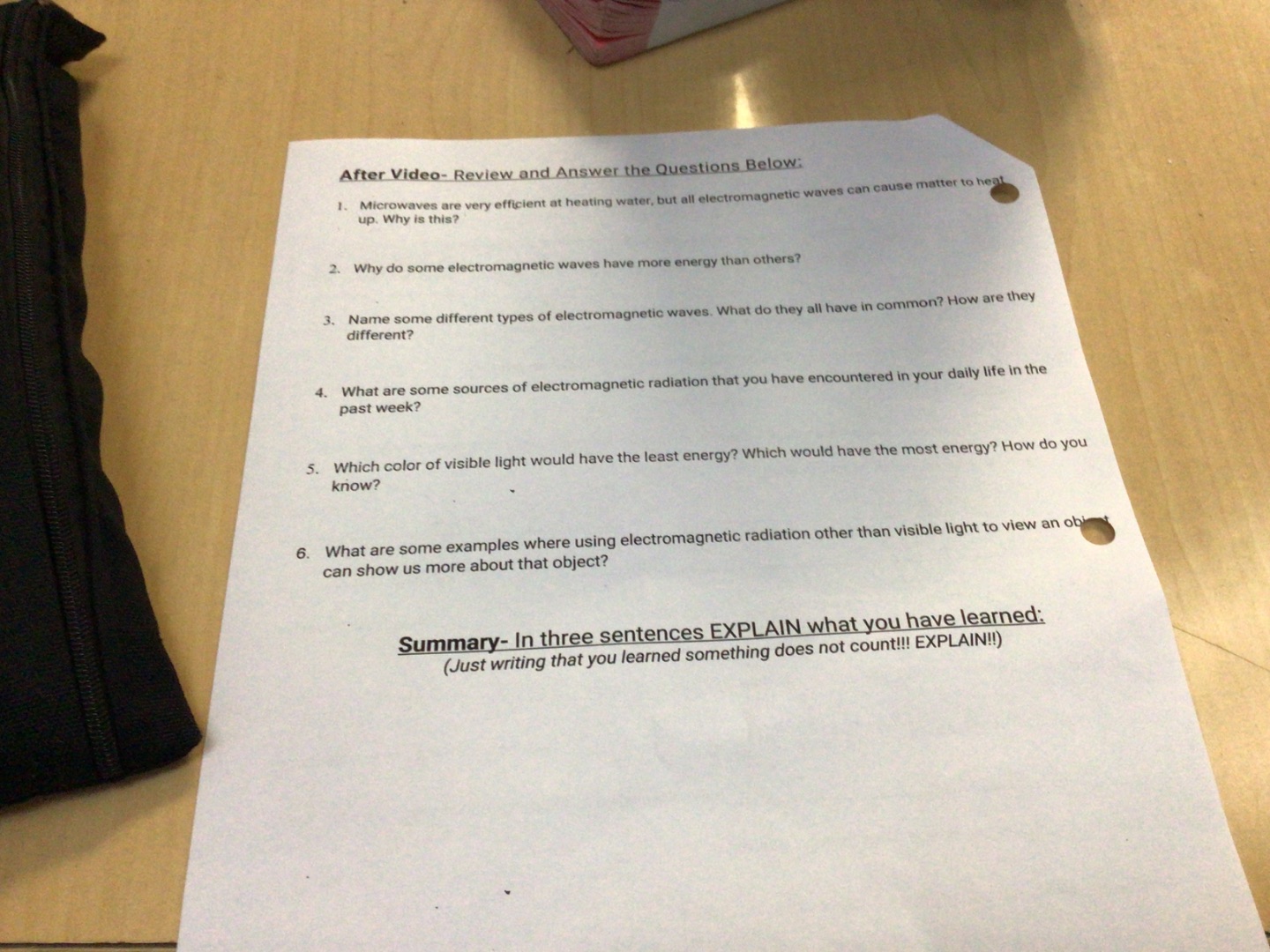
after video- review and answer the questions below:1. microwaves are very efficient at heating water, but all electromagnetic waves can cause matter to heat up. why is this?2. why do some electromagnetic waves have more energy than others?3. name some different types of electromagnetic waves. what do they all have in common? how are they different?4. what are some sources of electromagnetic radiation that you have encountered in your daily life in the past week?5. which color of visible light would have the least energy? which would have the most energy? how do you know?6. what are some examples where using electromagnetic radiation other than visible light to view an object can show us more about that object?summary- in three sentences explain what you have learned:(just writing that you learned something does not count!!! explain!!)
- Electromagnetic waves transfer energy to matter by making its particles (atoms/molecules) vibrate; this vibration generates thermal energy (heat). Microwaves target water molecules specifically, but all EM waves carry energy that interacts with matter.
- Electromagnetic wave energy depends on frequency, described by the formula $E=h
u$ where $h$ is Planck's constant and $
u$ is frequency. Higher frequency waves carry more energy.
- Examples include radio waves, microwaves, infrared, visible light, ultraviolet, X-rays, gamma rays. All are transverse waves of oscillating electric/magnetic fields that travel at the speed of light in a vacuum. They differ in frequency, wavelength, and energy, which dictates their interactions with matter.
- Common daily sources: cell phones (radio/microwaves), microwave ovens, sunlight (full EM spectrum including visible/UV), Wi-Fi routers, TV remote controls (infrared), X-rays at a doctor's office.
- Red light has the least energy in visible light, and violet light has the most. This is because visible light follows the energy-frequency relationship: red has the lowest frequency, violet has the highest frequency in the visible spectrum.
- Examples include: using infrared cameras to see heat signatures of animals or building insulation leaks; using X-rays to view bones inside the human body; using radio telescopes to observe distant celestial objects that do not emit visible light; using UV light to detect counterfeit currency or hidden biological stains.
- All forms of electromagnetic radiation, from low-energy radio waves to high-energy gamma rays, consist of oscillating electric and magnetic fields that travel at the speed of light, with their energy directly tied to their frequency. While microwaves are highly efficient at heating water due to their interaction with polar water molecules, all EM waves transfer energy to matter by exciting its particles, generating heat in the process. Beyond heating, different EM waves have unique practical uses: infrared detects heat, X-rays penetrate solid matter, and radio waves carry communication signals, each leveraging their distinct frequency and energy properties.

Snap & solve any problem in the app
Get step-by-step solutions on Sovi AI
Photo-based solutions with guided steps
Explore more problems and detailed explanations
- All electromagnetic waves carry energy; when they interact with matter, they cause the matter's particles to vibrate, which produces heat. Microwaves are just particularly efficient at exciting water molecules, but all EM waves transfer energy to matter in this way.
- The energy of an electromagnetic wave depends on its frequency (given by $E=h
u$, where $h$ is Planck's constant and $
u$ is frequency). Waves with higher frequencies have more energy, while lower frequency waves have less energy.
- Examples: radio waves, microwaves, infrared radiation, visible light, ultraviolet radiation, X-rays, gamma rays.
- Common: All are transverse electromagnetic waves that travel at the speed of light ($c=3\times10^8$ m/s) in a vacuum, made of oscillating electric and magnetic fields.
- Different: They have different frequencies, wavelengths, and energy levels, which leads to different interactions with matter.
- Examples include: cell phones (sending/receiving radio waves), microwave ovens, sunlight (visible, UV, infrared), Wi-Fi routers, TV remote controls (infrared), and medical X-rays.
- Least energy: Red light; Most energy: Violet light.
This is determined by the frequency of visible light: red has the lowest frequency in the visible spectrum, while violet has the highest, and higher frequency corresponds to higher energy ($E=h
u$).
- - Infrared cameras: Show heat signatures to detect insulation leaks or warm-blooded animals in the dark.
- X-rays: Allow viewing of bones and internal structures inside the human body that are hidden from visible light.
- Radio telescopes: Observe distant galaxies and cosmic objects that do not emit visible light, revealing details about the universe's structure.
- UV light: Exposes counterfeit currency markings that are invisible to the human eye.
- All electromagnetic radiation consists of oscillating electric and magnetic fields that travel at the speed of light, with energy levels directly linked to their frequency, from low-energy radio waves to high-energy gamma rays. While microwaves are specialized for heating water by exciting its polar molecules, every type of EM wave transfers energy to matter, causing particle vibration and heat as a universal effect. Beyond heating, unique frequency and energy properties let different EM waves serve distinct purposes: infrared detects heat, X-rays penetrate solid matter, and radio waves carry data, expanding our ability to observe and interact with the world beyond visible light.