QUESTION IMAGE
Question
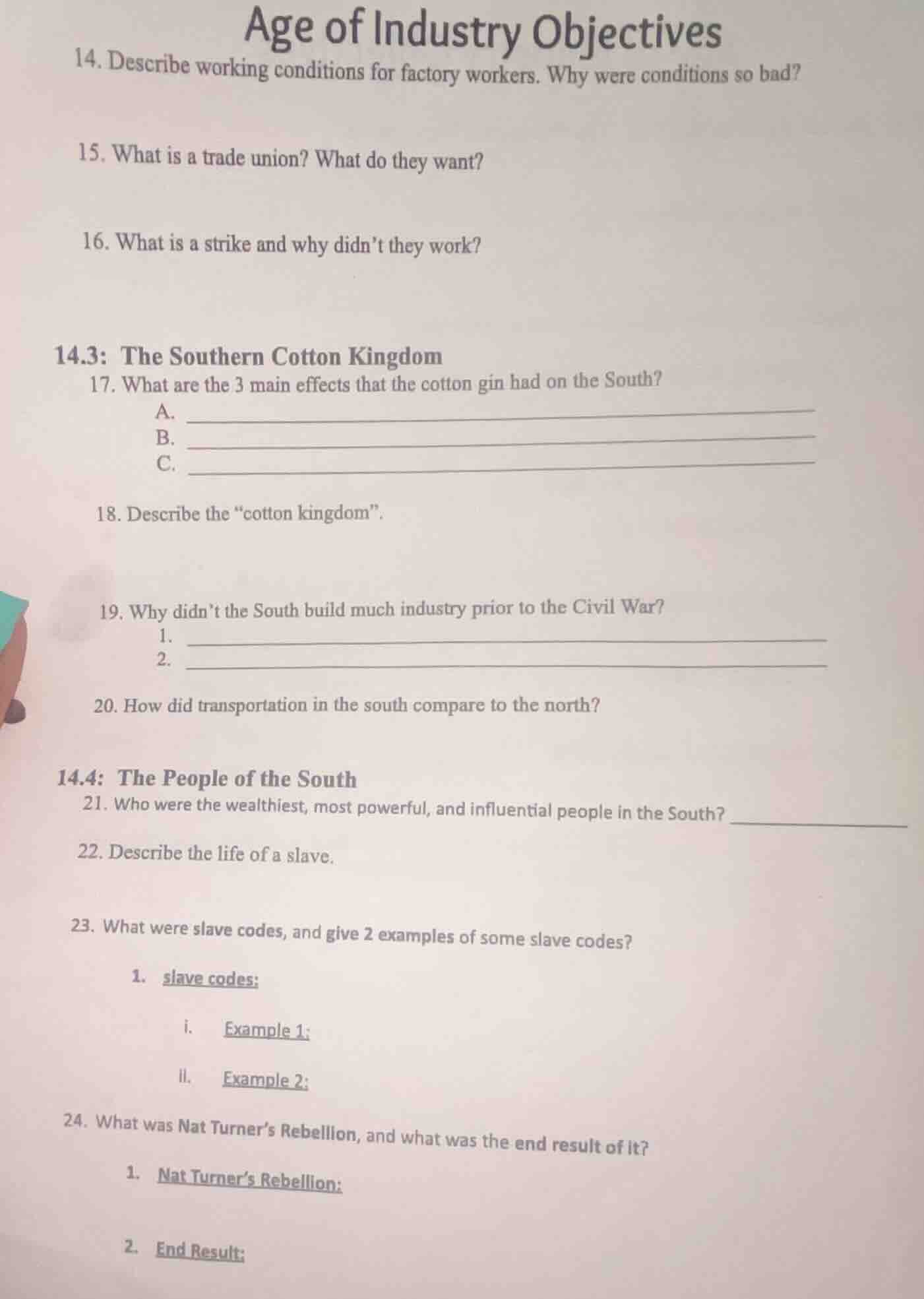
age of industry objectives
- describe working conditions for factory workers. why were conditions so bad?
- what is a trade union? what do they want?
- what is a strike and why didn’t they work?
14.3: the southern cotton kingdom
- what are the 3 main effects that the cotton gin had on the south?
a.
b.
c.
- describe the \cotton kingdom\.
- why didn’t the south build much industry prior to the civil war?
1.
2.
- how did transportation in the south compare to the north?
14.4: the people of the south
- who were the wealthiest, most powerful, and influential people in the south?
- describe the life of a slave.
- what were slave codes, and give 2 examples of some slave codes?
- slave codes:
i. example 1:
ii. example 2:
- what was nat turner’s rebellion, and what was the end result of it?
- nat turner’s rebellion:
- end result:
Question 14:
Factory workers faced long hours (12-16 hour days, 6-7 days a week), unsafe, unventilated, overcrowded factories with high injury risks, low pay, and child labor was common. Conditions were poor because there were no labor laws to regulate workplaces; factory owners prioritized maximizing profits over worker well-being, and workers had little bargaining power.
Question 15:
A trade union is an organized group of workers that advocates for their shared interests. They wanted better pay, shorter work hours, safer working conditions, and job security for their members.
Question 16:
A strike is when workers stop working collectively to protest poor conditions, low pay, or unfair management practices. They refused to work to pressure employers to meet their demands, as they had limited other ways to negotiate with powerful factory owners.
Question 17:
A. It drastically increased cotton production efficiency, making cotton a highly profitable cash crop.
B. It expanded the demand for enslaved labor, as more workers were needed to grow and process cotton.
C. It solidified the South's economic dependence on cotton agriculture, tying its economy to slavery and a single crop.
Question 18:
The "cotton kingdom" refers to the Southern U.S. in the 1800s, where cotton became the dominant, highly profitable cash crop. It stretched across the Deep South, relied heavily on enslaved labor, and made cotton the South's main economic export, shaping its social, political, and economic identity around cotton production and slavery.
Question 19:
- The South's economy was entirely focused on profitable cash crop agriculture (like cotton) using enslaved labor, so there was little incentive to invest in industry.
- Southern elites held political and economic power, and they prioritized protecting the slave-based agricultural system over industrial development.
Question 20:
Southern transportation was far less developed than the North's. The North had an extensive network of railroads, canals, and paved roads to connect industrial centers and markets. The South had far fewer railroads (most were short, local lines) and relied mainly on rivers for transporting cotton, making it harder to move goods and people compared to the North.
Question 21:
The wealthiest, most powerful, and influential people in the South were large plantation owners who owned hundreds of enslaved people and vast amounts of land for cotton and other cash crops.
Question 22:
Enslaved people endured forced, backbreaking labor (often 10+ hours a day, 6 days a week) in fields or households. They had no legal rights, could be sold away from their families at any time, faced brutal punishment for any perceived misbehavior, lived in overcrowded, poor housing, and had limited access to food, healthcare, or education.
Question 23:
- Slave codes: Strict state laws that regulated the lives of enslaved people, designed to maintain white control and prevent rebellion.
i. Example 1: Enslaved people were forbidden from learning to read or write.
ii. Example 2: Enslaved people could not gather in groups without white supervision.
Question 24:
- Nat Turner's Rebellion: A 1831 armed uprising led by enslaved man Nat Turner in Virginia. Turner and a group of enslaved people killed around 60 white people in an attempt to end slavery.
- End Result: The rebellion was violently suppressed, with Turner and over 50 other enslaved people executed. Southern states responded by passing even harsher slave codes to restrict enslaved people's movement, as…

Snap & solve any problem in the app
Get step-by-step solutions on Sovi AI
Photo-based solutions with guided steps
Explore more problems and detailed explanations
- Working conditions: Long 12-16 hour days, unsafe/overcrowded factories, low pay, child labor. Conditions were bad due to no labor regulations, profit-focused owners, and worker powerlessness.
- A trade union is an organized worker group. They want better pay, shorter hours, safer conditions, job security.
- A strike is a collective work stoppage. Workers didn't work to pressure employers to meet their demands.
- A. Boosted cotton production efficiency and profitability
B. Expanded demand for enslaved labor
C. Tied the South's economy to cotton/slavery
- The cotton kingdom was the 1800s Southern U.S., dominated by profitable cotton production, reliant on enslaved labor, and centered on the Deep South as a cotton export hub.
- 1. Focus on profitable slave-based cash crop agriculture
- Elite power prioritized protecting the plantation system
- Southern transportation was far less developed: it had far fewer railroads (mostly local lines) and relied on rivers, while the North had an extensive network of railroads, canals, and paved roads.
- Large plantation owners with hundreds of enslaved people and vast land holdings.
- Enslaved people faced forced, long hours of labor, no legal rights, family separation, brutal punishment, poor housing/food/healthcare, and no access to education.
- 1. Slave codes: Strict laws controlling enslaved people to uphold white dominance
i. Example 1: Ban on enslaved people learning to read/write
ii. Example 2: Ban on unsupervised group gatherings of enslaved people
- 1. Nat Turner's Rebellion: 1831 Virginia uprising by enslaved people led by Nat Turner, targeting white enslavers.
- End Result: The rebellion was crushed; Turner and others were executed, and harsher slave codes were enacted across the South.