QUESTION IMAGE
Question
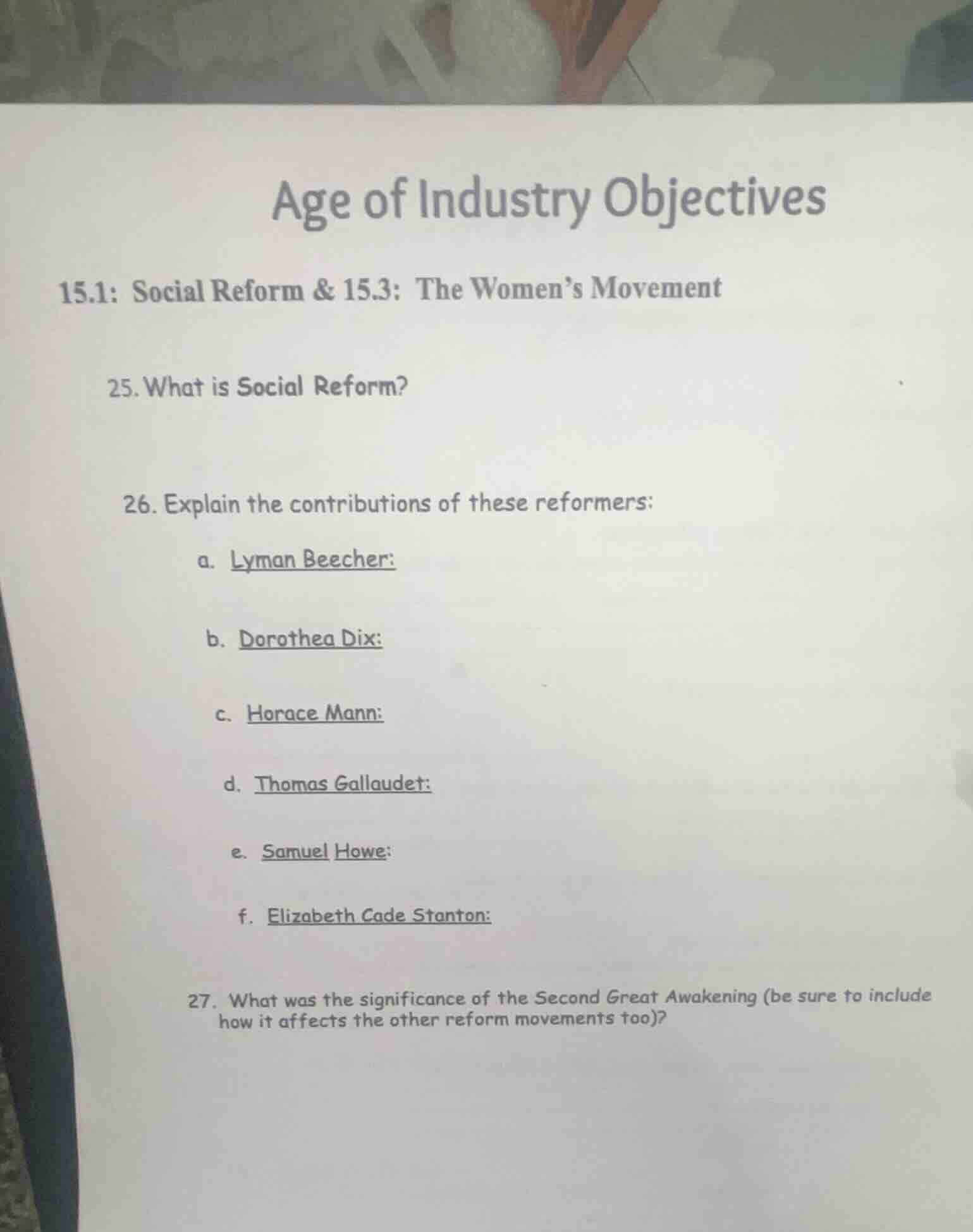
age of industry objectives
15.1: social reform & 15.3: the women’s movement
- what is social reform?
- explain the contributions of these reformers:
a. lyman beecher:
b. dorothea dix:
c. horace mann:
d. thomas gallaudet:
e. samuel howe:
f. elizabeth cade stanton:
- what was the significance of the second great awakening (be sure to include how it affects the other reform movements too)?
Question 25
Social reform refers to organized efforts to improve unjust, harmful, or outdated social institutions, practices, or conditions, aiming to create a more equitable society.
Question 26
a. Lyman Beecher: A leading temperance advocate and preacher; he promoted moral reform, pushed for laws restricting alcohol, and helped found organizations to advance temperance, framing alcohol as a threat to family and society.
b. Dorothea Dix: A reformer who exposed the horrific conditions of prisons and mental asylums; her lobbying led to the creation of state-funded mental health institutions and improved treatment for the mentally ill and incarcerated.
c. Horace Mann: Known as the "father of American public education"; he campaigned for free, tax-supported public schools, standardized curricula, and teacher training, laying the foundation for the U.S. public school system.
d. Thomas Gallaudet: Co-founded the first permanent U.S. school for the deaf (American School for the Deaf) in 1817, advancing education and advocacy for the deaf community.
e. Samuel Howe: Advocated for disabled people; he founded the Perkins School for the Blind, developed accessible teaching methods for the visually impaired, and supported other disability rights efforts.
f. Elizabeth Cady Stanton: A core leader of the U.S. women's suffrage movement; she co-organized the Seneca Falls Convention (1848), drafted the Declaration of Sentiments demanding women's right to vote and equal rights, and spent decades advocating for women's political and social equality.
Question 27
The Second Great Awakening was a 19th-century religious revival that emphasized personal salvation, moral responsibility, and social action. It inspired widespread participation in reform movements: its focus on individual moral improvement drove support for temperance, abolition of slavery, and prison/mental health reform. It also empowered marginalized groups (including women and Black Americans) to take leadership roles in reform, laying the groundwork for the women's suffrage movement by encouraging women to speak and organize publicly.

Snap & solve any problem in the app
Get step-by-step solutions on Sovi AI
Photo-based solutions with guided steps
Explore more problems and detailed explanations
- Social reform is organized, collective action to address and fix unfair, harmful, or outdated social systems, practices, or conditions, with the goal of building a more just and equitable society.
26.
a. Lyman Beecher: Led temperance reform, preached against alcohol's harms, and helped build temperance organizations to push for restrictive laws.
b. Dorothea Dix: Exposed abuses in prisons/asylums, lobbied states to create improved mental health institutions and reform carceral systems.
c. Horace Mann: Established free, tax-supported public schools, standardized education, and professionalized teaching in the U.S.
d. Thomas Gallaudet: Co-founded the first permanent U.S. school for the deaf, advancing deaf education and advocacy.
e. Samuel Howe: Founded the Perkins School for the Blind, developed accessible teaching for visually impaired people, and advocated for disability rights.
f. Elizabeth Cady Stanton: Co-led the Seneca Falls Convention, drafted the Declaration of Sentiments, and led long-term efforts for women's suffrage and equal rights.
- The Second Great Awakening was a religious revival that emphasized personal morality and social action. It was significant because it mobilized millions of Americans to participate in reform movements (temperance, abolition, prison reform) by framing social improvement as a moral duty. It also empowered women and Black Americans to take public leadership roles in these movements, directly fueling the early women's suffrage movement by normalizing women's public organizing and advocacy.