QUESTION IMAGE
Question
algebra ii sem 2
1.10.3 quiz: graphing rational functions
a. $f(x)=\frac{1}{(x-3)^2(x+1)}$
b. $f(x)=\frac{3x-1}{x-1}$
c. $f(x)=\frac{1}{(x-3)(x+1)}$
d. $f(x)=\frac{(x-3)(x+1)}{x-1}$
Step1: Identify vertical asymptotes
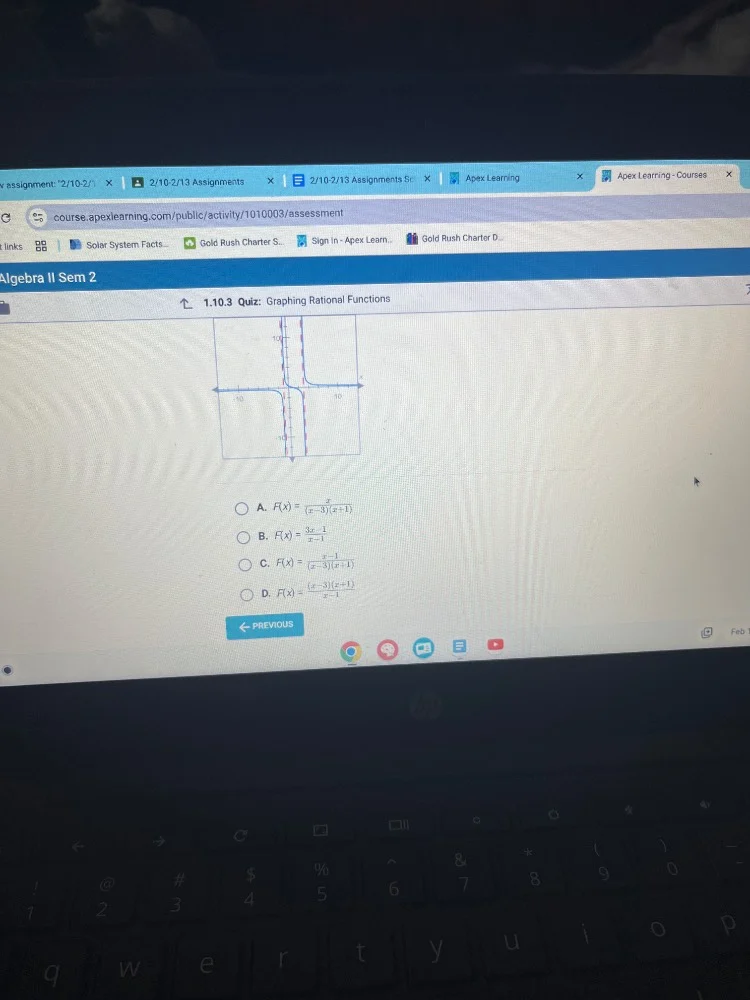
From the graph, vertical asymptotes are at $x=3$ and $x=-1$. These are the values that make the denominator of the rational function equal to 0, so the denominator should be $(x-3)(x+1)$.
Step2: Identify horizontal asymptote
The graph has a horizontal asymptote at $y=0$. For a rational function $\frac{N(x)}{D(x)}$, this occurs when the degree of the numerator is less than the degree of the denominator.
Step3: Match to options
- Option A: Degree of numerator (2) = Degree of denominator (2), horizontal asymptote would be $y=1$, not 0.
- Option B: Denominator is $(x-1)$, vertical asymptote at $x=1$, does not match.
- Option C: Denominator is $(x-3)(x+1)$ (matches vertical asymptotes), numerator degree (0) < denominator degree (2), horizontal asymptote $y=0$ (matches graph).
- Option D: Degree of numerator (2) = Degree of denominator (1), no horizontal asymptote (has oblique asymptote), does not match.

Snap & solve any problem in the app
Get step-by-step solutions on Sovi AI
Photo-based solutions with guided steps
Explore more problems and detailed explanations
C. $F(x)=\frac{1}{(x-3)(x+1)}$