QUESTION IMAGE
Question
algebra:
name emely
algebra: concepts & connections unit 5
georgia’s k-12 mathematics standards
date 04/7/25
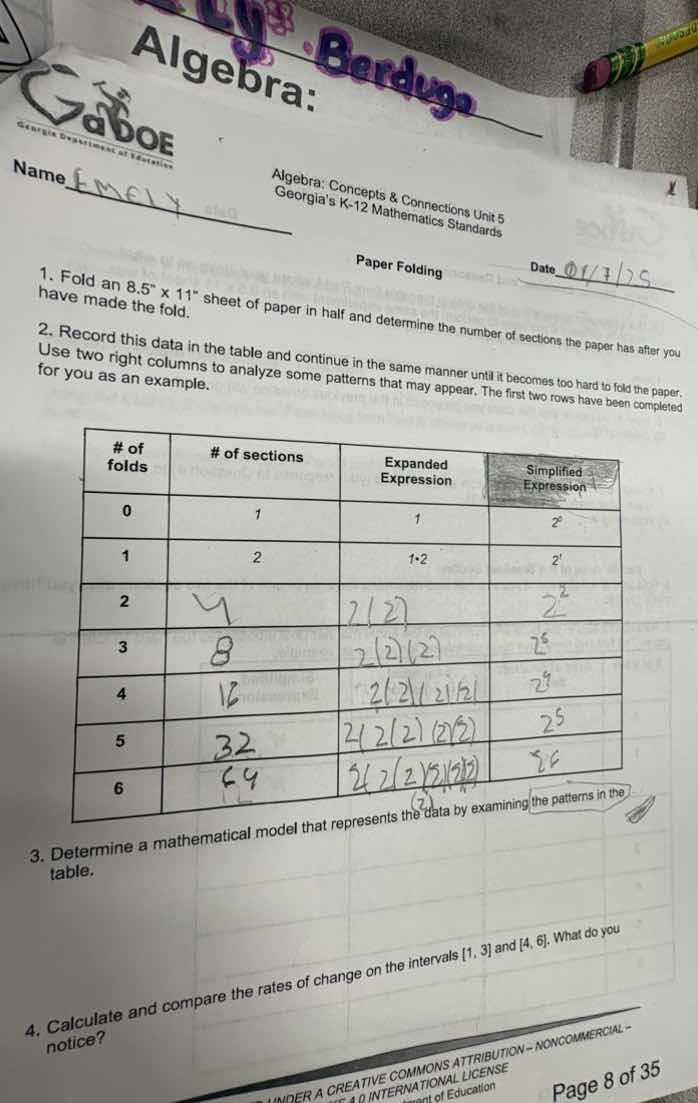
paper folding
- fold an 8.5” x 11” sheet of paper in half and determine the number of sections the paper has after you have made the fold.
- record this data in the table and continue in the same manner until it becomes too hard to fold the paper. use two right columns to analyze some patterns that may appear. the first two rows have been completed for you as an example.
| # of folds | # of sections | expanded expression | simplified expression |
|---|---|---|---|
| 1 | 2 | $1\cdot2$ | $2^1$ |
| 2 | 4 | $2(2)$ | $2^2$ |
| 3 | 8 | $2(2)(2)$ | $2^3$ |
| 4 | 16 | $2(2)(2)(2)$ | $2^4$ |
| 5 | 32 | $2(2)(2)(2)(2)$ | $2^5$ |
| 6 | 64 | $2(2)(2)(2)(2)(2)$ | $2^6$ |
- determine a mathematical model that represents the data by examining the patterns in the table.
- calculate and compare the rates of change on the intervals 1, 3 and 4, 6. what do you notice?
Step1: Completar la tabla de datos
Para cada pliegue, el número de secciones se duplica cada vez.
- Pliegue 2: $2 \times 2 = 4$, expresión expandida $2(2)$, simplificada $2^2$
- Pliegue 3: $2 \times 4 = 8$, expresión expandida $2(2)(2)$, simplificada $2^3$
- Pliegue 4: $2 \times 8 = 16$, expresión expandida $2(2)(2)(2)$, simplificada $2^4$
- Pliegue 5: $2 \times 16 = 32$, expresión expandida $2(2)(2)(2)(2)$, simplificada $2^5$
- Pliegue 6: $2 \times 32 = 64$, expresión expandida $2(2)(2)(2)(2)(2)$, simplificada $2^6$
Step2: Encontrar el modelo matemático
Observar la relación entre el número de pliegues ($n$) y secciones ($S$):
Cuando $n=0$, $S=1=2^0$; $n=1$, $S=2=2^1$; así que el modelo es $S=2^n$.
Step3: Calcular tasas de cambio
La tasa de cambio se calcula como $\frac{\Delta S}{\Delta n} = \frac{S_2 - S_1}{n_2 - n_1}$
- Intervalo [1,3]: $\frac{2^3 - 2^1}{3-1} = \frac{8-2}{2} = 3$
- Intervalo [4,6]: $\frac{2^6 - 2^4}{6-4} = \frac{64-16}{2} = 24$

Snap & solve any problem in the app
Get step-by-step solutions on Sovi AI
Photo-based solutions with guided steps
Explore more problems and detailed explanations
- Tabla completada:
| # of folds | # of sections | Expanded Expression | Simplified Expression |
|---|---|---|---|
| 1 | 2 | $1 \cdot 2$ | $2^1$ |
| 2 | 4 | $2(2)$ | $2^2$ |
| 3 | 8 | $2(2)(2)$ | $2^3$ |
| 4 | 16 | $2(2)(2)(2)$ | $2^4$ |
| 5 | 32 | $2(2)(2)(2)(2)$ | $2^5$ |
| 6 | 64 | $2(2)(2)(2)(2)(2)$ | $2^6$ |
- Modelo matemático: $S = 2^n$, donde $n$ es el número de pliegues y $S$ es el número de secciones.
- Tasa de cambio en [1,3]: 3; Tasa de cambio en [4,6]: 24. Se observa que la tasa de cambio aumenta rápidamente a medida que aumenta el número de pliegues, ya que la relación es exponencial.