QUESTION IMAGE
Question
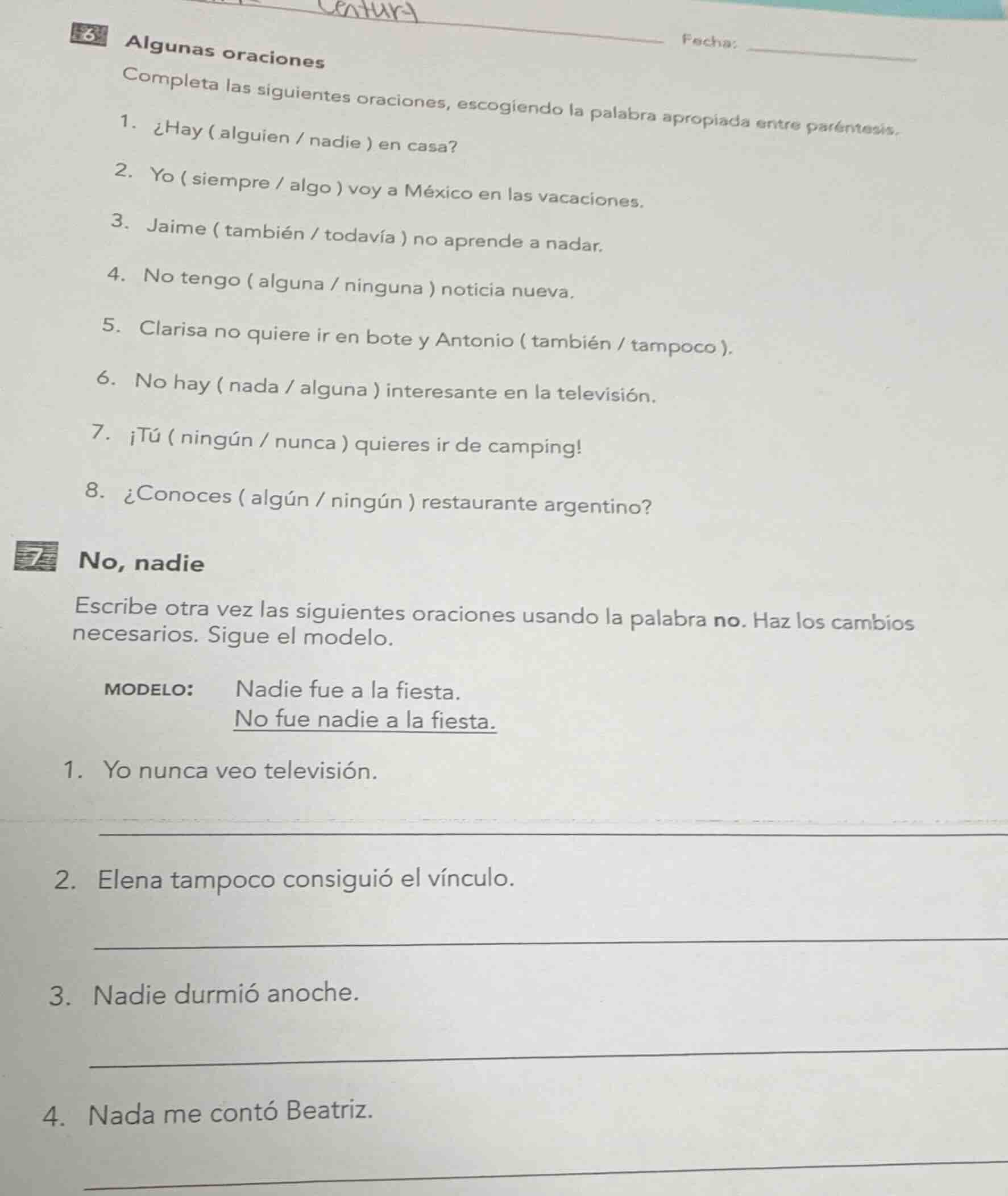
6 algunas oraciones
completa las siguientes oraciones, escogiendo la palabra apropiada entre paréntesis.
- ¿hay ( alguien / nadie ) en casa?
- yo ( siempre / algo ) voy a méxico en las vacaciones.
- jaime ( también / todavía ) no aprende a nadar.
- no tengo ( alguna / ninguna ) noticia nueva.
- clarisa no quiere ir en bote y antonio ( también / tampoco ).
- no hay ( nada / alguna ) interesante en la televisión.
- ¡tú ( ningún / nunca ) quieres ir de camping!
- ¿conoces ( algún / ningún ) restaurante argentino?
7 no, nadie
escribe otra vez las siguientes oraciones usando la palabra no. haz los cambios necesarios. sigue el modelo.
modelo: nadie fue a la fiesta.
no fue nadie a la fiesta.
- yo nunca veo televisión.
_________________________
- elena tampoco consiguió el vínculo.
_________________________
- nadie durmió anoche.
_________________________
- nada me contó beatriz.
_________________________
Response
Part 1: Completa las oraciones (Fill in the sentences)
- Explanation for 1: "¿Hay alguien en casa?" means "Is there anyone at home?". "nadie" would mean "Is there no one at home?" but the common question is about presence, so "alguien".
- Answer: alguien
- Explanation for 2: "Yo siempre voy a México en las vacaciones." "siempre" means "always", "algo" means "something" and doesn't fit here.
- Answer: siempre
- Explanation for 3: "Jaime todavía no aprende a nadar." "todavía" means "still", "también" means "also" and doesn't fit the negative context of "no aprende".
- Answer: todavía
- Explanation for 4: "No tengo ninguna noticia nueva." "ninguna" is used in negative sentences, "alguna" is for positive or questions.
- Answer: ninguna
- Explanation for 5: "Clarisa no quiere ir en bote y Antonio tampoco." "tampoco" is used in negative agreements, "también" is for positive agreements.
- Answer: tampoco
- Explanation for 6: "No hay nada interesante en la televisión." "nada" is used in negative sentences, "alguna" is for positive or questions and doesn't fit with "interesante" (a singular - like concept here in terms of the phrase structure).
- Answer: nada
- Explanation for 7: "¡Tú nunca quieres ir de camping!" "nunca" means "never", "ningún" is an adjective (e.g., "ningún libro") and doesn't fit here.
- Answer: nunca
- Explanation for 8: "¿Conoces algún restaurante argentino?" "algún" is used in questions for "some", "ningún" is for negative statements.
- Answer: algún
Part 2: No, nadie (Rewrite sentences with "no")
- Explanation for 1: Following the model, we move "nunca" to after "no" and adjust the sentence. The original is "Yo nunca veo televisión." So we rewrite it as "No veo nunca televisión." (But more accurately, in Spanish, the correct form is "No veo televisión nunca." but following the model's structure where we place the negative element with "no", the model has "No fue nadie...", so we do "No veo nunca televisión." (or more natural "No veo televisión nunca." but the model's structure is to put the "nadie" - like element after "no", so here "nunca" is the element. So "No veo nunca televisión."
- Answer: No veo nunca televisión.
- Explanation for 2: Original: "Elena tampoco consiguió el vínculo." Following the model, we use "no" and place "tampoco" after. So "No consiguió el vínculo Elena tampoco." Wait, no, the model is "No fue nadie a la fiesta." So for "Elena tampoco consiguió el vínculo", we rewrite as "No consiguió el vínculo Elena tampoco." (or more accurately "No consiguió Elena tampoco el vínculo." but the model's structure is subject - verb - object with the negative element. Wait, the model: "Nadie fue a la fiesta." → "No fue nadie a la fiesta." So "Elena tampoco consiguió el vínculo." → "No consiguió el vínculo Elena tampoco." (But more standard: "No consiguió Elena tampoco el vínculo." or "No tampoco consiguió Elena el vínculo." But following the model's pattern of putting the "tampoco" - like element after "no" and the verb, it's "No consiguió tampoco Elena el vínculo." Wait, no, the model has "No fue nadie a la fiesta." So the structure is "No + verb + element + rest". So "Elena tampoco consiguió el vínculo." → "No consiguió tampoco Elena el vínculo." But maybe better: "No consiguió el vínculo Elena tampoco." (But the correct way in Spanish is "No consiguió tampoco Elena el vínculo." but to follow the model, the model's "nadie" is after the verb, so here "tampoco" is after the verb. So "No consiguió tampoco Elena el vínculo."…

Snap & solve any problem in the app
Get step-by-step solutions on Sovi AI
Photo-based solutions with guided steps
Explore more problems and detailed explanations
Part 1: Completa las oraciones (Fill in the sentences)
- Explanation for 1: "¿Hay alguien en casa?" means "Is there anyone at home?". "nadie" would mean "Is there no one at home?" but the common question is about presence, so "alguien".
- Answer: alguien
- Explanation for 2: "Yo siempre voy a México en las vacaciones." "siempre" means "always", "algo" means "something" and doesn't fit here.
- Answer: siempre
- Explanation for 3: "Jaime todavía no aprende a nadar." "todavía" means "still", "también" means "also" and doesn't fit the negative context of "no aprende".
- Answer: todavía
- Explanation for 4: "No tengo ninguna noticia nueva." "ninguna" is used in negative sentences, "alguna" is for positive or questions.
- Answer: ninguna
- Explanation for 5: "Clarisa no quiere ir en bote y Antonio tampoco." "tampoco" is used in negative agreements, "también" is for positive agreements.
- Answer: tampoco
- Explanation for 6: "No hay nada interesante en la televisión." "nada" is used in negative sentences, "alguna" is for positive or questions and doesn't fit with "interesante" (a singular - like concept here in terms of the phrase structure).
- Answer: nada
- Explanation for 7: "¡Tú nunca quieres ir de camping!" "nunca" means "never", "ningún" is an adjective (e.g., "ningún libro") and doesn't fit here.
- Answer: nunca
- Explanation for 8: "¿Conoces algún restaurante argentino?" "algún" is used in questions for "some", "ningún" is for negative statements.
- Answer: algún
Part 2: No, nadie (Rewrite sentences with "no")
- Explanation for 1: Following the model, we move "nunca" to after "no" and adjust the sentence. The original is "Yo nunca veo televisión." So we rewrite it as "No veo nunca televisión." (But more accurately, in Spanish, the correct form is "No veo televisión nunca." but following the model's structure where we place the negative element with "no", the model has "No fue nadie...", so we do "No veo nunca televisión." (or more natural "No veo televisión nunca." but the model's structure is to put the "nadie" - like element after "no", so here "nunca" is the element. So "No veo nunca televisión."
- Answer: No veo nunca televisión.
- Explanation for 2: Original: "Elena tampoco consiguió el vínculo." Following the model, we use "no" and place "tampoco" after. So "No consiguió el vínculo Elena tampoco." Wait, no, the model is "No fue nadie a la fiesta." So for "Elena tampoco consiguió el vínculo", we rewrite as "No consiguió el vínculo Elena tampoco." (or more accurately "No consiguió Elena tampoco el vínculo." but the model's structure is subject - verb - object with the negative element. Wait, the model: "Nadie fue a la fiesta." → "No fue nadie a la fiesta." So "Elena tampoco consiguió el vínculo." → "No consiguió el vínculo Elena tampoco." (But more standard: "No consiguió Elena tampoco el vínculo." or "No tampoco consiguió Elena el vínculo." But following the model's pattern of putting the "tampoco" - like element after "no" and the verb, it's "No consiguió tampoco Elena el vínculo." Wait, no, the model has "No fue nadie a la fiesta." So the structure is "No + verb + element + rest". So "Elena tampoco consiguió el vínculo." → "No consiguió tampoco Elena el vínculo." But maybe better: "No consiguió el vínculo Elena tampoco." (But the correct way in Spanish is "No consiguió tampoco Elena el vínculo." but to follow the model, the model's "nadie" is after the verb, so here "tampoco" is after the verb. So "No consiguió tampoco Elena el vínculo."
- Answer: No consiguió tampoco Elena el vínculo.
- Explanation for 3: Original: "Nadie durmió anoche." Following the model "No fue nadie a la fiesta.", we rewrite it as "No durmió nadie anoche."
- Answer: No durmió nadie anoche.
- Explanation for 4: Original: "Nada me contó Beatriz." Following the model, we rewrite it as "No me contó nada Beatriz." (or "No contó me nada Beatriz." but the correct object - pronoun order is "me" before the verb, so "No me contó nada Beatriz."
- Answer: No me contó nada Beatriz.