QUESTION IMAGE
Question
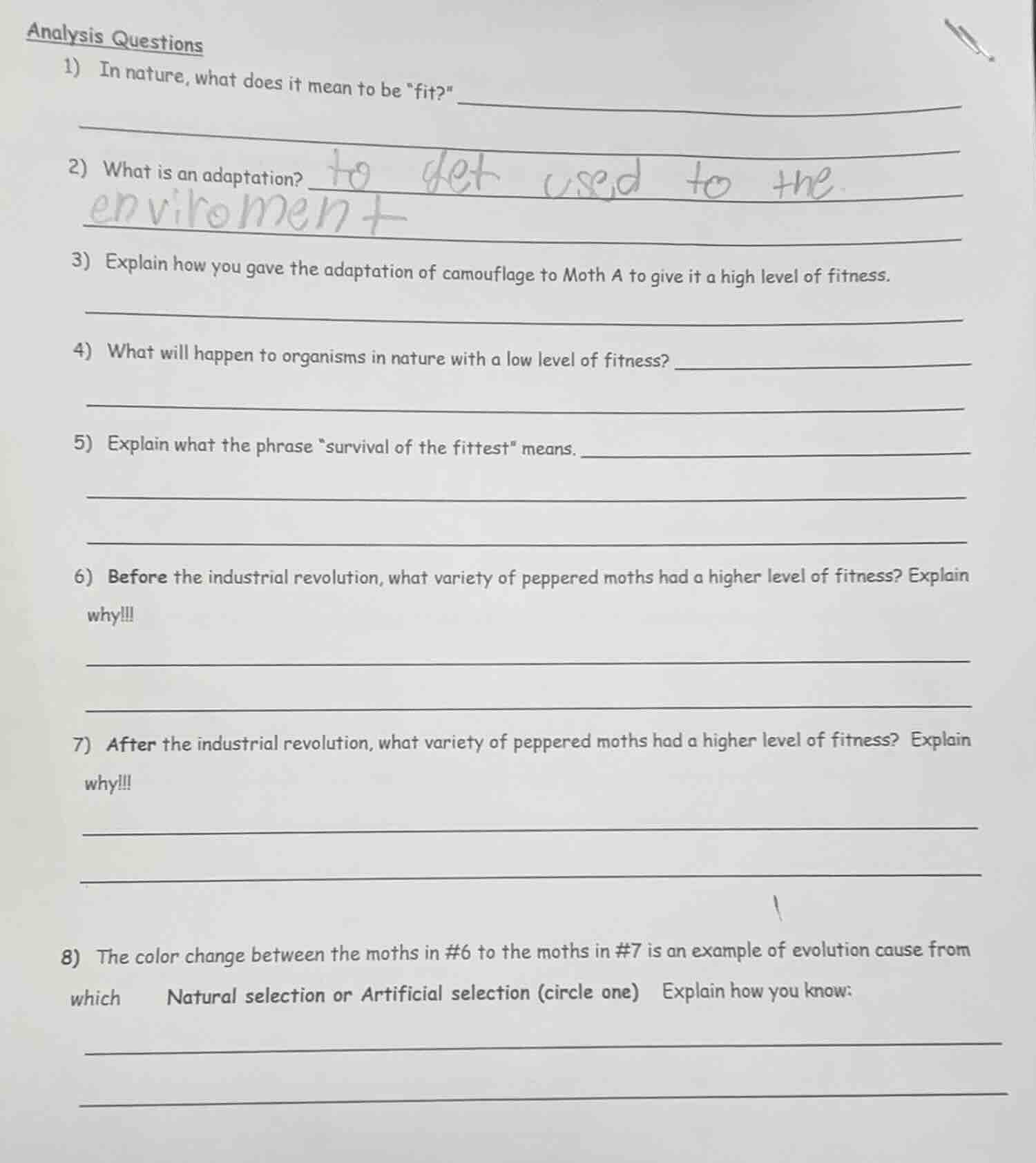
analysis questions
- in nature, what does it mean to be \fit?\
- what is an adaptation?
- explain how you gave the adaptation of camouflage to moth a to give it a high level of fitness.
- what will happen to organisms in nature with a low level of fitness?
- explain what the phrase \survival of the fittest\ means.
- before the industrial revolution, what variety of peppered moths had a higher level of fitness? explain why!!!
- after the industrial revolution, what variety of peppered moths had a higher level of fitness? explain why!!!
- the color change between the moths in #6 to the moths in #7 is an example of evolution cause from which natural selection or artificial selection (circle one) explain how you know:
Brief Explanations
- In evolutionary terms, fitness refers to an organism's ability to survive in its environment, find a mate, and produce viable offspring that can also reproduce.
- An adaptation is a heritable trait or characteristic that develops over generations, helping an organism survive and reproduce better in its specific environment.
- Camouflage allows Moth A to blend into its surrounding environment, making it harder for predators to spot. This increases the moth's chance of surviving long enough to mate and pass on its camouflage trait to offspring, thus boosting its fitness.
- Organisms with low fitness are less likely to survive to reproductive age, or will produce fewer viable offspring. Over time, their traits will become less common in the population, and they may face local extinction if conditions do not change.
- "Survival of the fittest" means that organisms with traits best suited to their environment (highest fitness) are the most likely to survive, reproduce, and pass their advantageous traits to the next generation. This leads to the gradual spread of beneficial traits in a population.
- Before the industrial revolution, light-colored peppered moths had higher fitness. Tree trunks were light-colored (covered in lichen), so the light moths could camouflage themselves from bird predators, while dark moths were easily spotted and eaten.
- After the industrial revolution, dark-colored peppered moths had higher fitness. Industrial soot coated tree trunks, darkening them. Dark moths now blended into the environment, avoiding predation, while light moths were visible and targeted by birds.
- This is natural selection. The change in moth color frequency was driven by environmental changes (soot-covered trees) and predation, not by humans intentionally selecting for specific traits. The traits that improved survival were naturally favored and became more common in the population.

Snap & solve any problem in the app
Get step-by-step solutions on Sovi AI
Photo-based solutions with guided steps
Explore more problems and detailed explanations
- It means an organism can survive, mate, and produce viable, reproducing offspring.
- A heritable trait that improves survival/reproduction in an environment.
- Camouflage hides Moth A from predators, letting it survive to reproduce.
- They will likely die before reproducing, or produce few offspring; their traits will decline in the population.
- Organisms with environment-suited traits survive, reproduce, and pass on those traits.
- Light-colored peppered moths. Tree trunks were light (lichen-covered), so they camouflaged and avoided predation.
- Dark-colored peppered moths. Soot darkened tree trunks, letting dark moths camouflage and avoid predation.
- Natural selection (circle this). The trait shift was driven by environmental changes and predation, not human-directed selection.