QUESTION IMAGE
Question
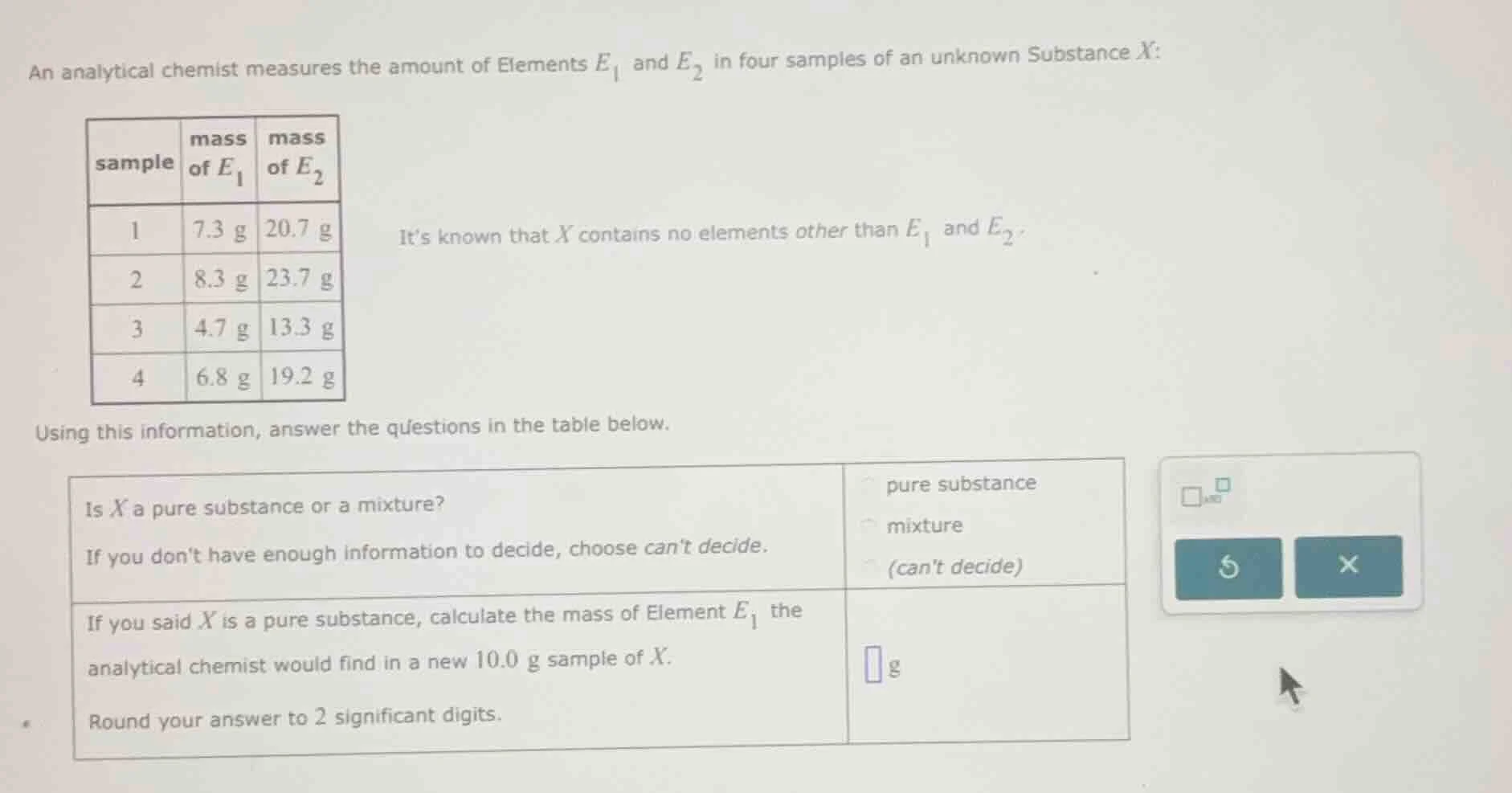
an analytical chemist measures the amount of elements $e_1$ and $e_2$ in four samples of an unknown substance $x$:
sample | mass of $e_1$ | mass of $e_2$
--- | --- | ---
1 | 7.3 g | 20.7 g
2 | 8.3 g | 23.7 g
3 | 4.7 g | 13.3 g
4 | 6.8 g | 19.2 g
its known that $x$ contains no elements other than $e_1$ and $e_2$.
using this information, answer the questions in the table below.
- is $x$ a pure substance or a mixture?
if you dont have enough information to decide, choose cant decide.
options:
pure substance
mixture
(cant decide)
- if you said $x$ is a pure substance, calculate the mass of element $e_1$ the analytical chemist would find in a new 10.0 g sample of $x$.
round your answer to 2 significant digits. ____ g
Step1: Calculate mass ratio for Sample 1
$\frac{\text{mass of } E_1}{\text{mass of } E_2} = \frac{7.3}{20.7} \approx 0.3526$
Step2: Calculate mass ratio for Sample 2
$\frac{\text{mass of } E_1}{\text{mass of } E_2} = \frac{8.3}{23.7} \approx 0.3502$
Step3: Calculate mass ratio for Sample 3
$\frac{\text{mass of } E_1}{\text{mass of } E_2} = \frac{4.7}{13.3} \approx 0.3534$
Step4: Calculate mass ratio for Sample 4
$\frac{\text{mass of } E_1}{\text{mass of } E_2} = \frac{6.8}{19.2} \approx 0.3542$
Step5: Find average $E_1$ fraction
$\text{Total mass of } E_1 = 7.3+8.3+4.7+6.8 = 27.1\ \text{g}$
$\text{Total mass of } X = (7.3+20.7)+(8.3+23.7)+(4.7+13.3)+(6.8+19.2) = 104.0\ \text{g}$
$\text{Fraction of } E_1 = \frac{27.1}{104.0} \approx 0.2606$
Step6: Calculate $E_1$ in 10.0 g sample
$\text{Mass of } E_1 = 10.0 \times 0.2606 \approx 2.6\ \text{g}$

Snap & solve any problem in the app
Get step-by-step solutions on Sovi AI
Photo-based solutions with guided steps
Explore more problems and detailed explanations
Is X a pure substance or a mixture? pure substance
Mass of Element $E_1$ in 10.0 g sample: 2.6 g