QUESTION IMAGE
Question
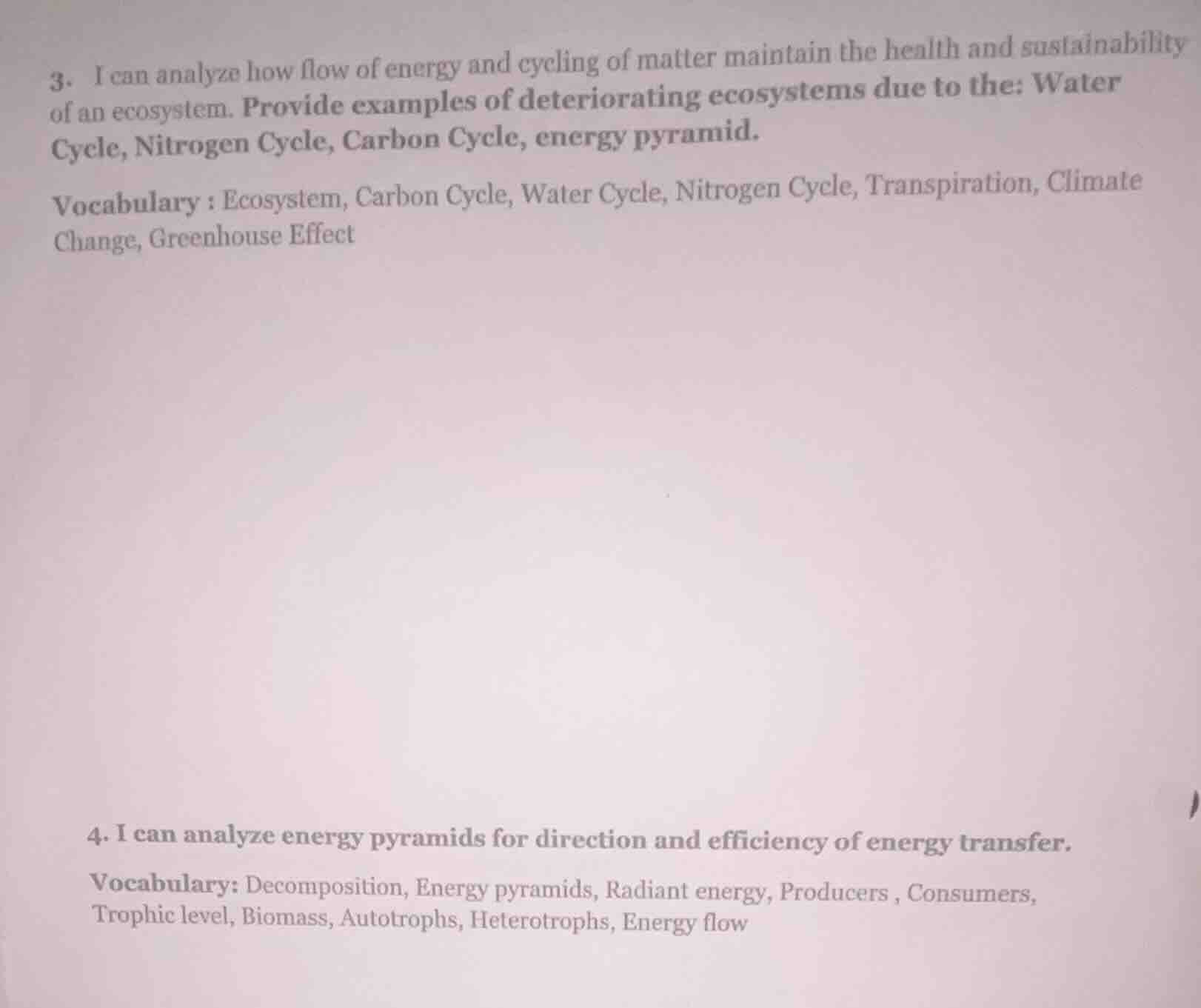
- i can analyze how flow of energy and cycling of matter maintain the health and sustainability of an ecosystem. provide examples of deteriorating ecosystems due to the: water cycle, nitrogen cycle, carbon cycle, energy pyramid.
vocabulary : ecosystem, carbon cycle, water cycle, nitrogen cycle, transpiration, climate change, greenhouse effect
- i can analyze energy pyramids for direction and efficiency of energy transfer.
vocabulary: decomposition, energy pyramids, radiant energy, producers, consumers, trophic level, biomass, autotrophs, heterotrophs, energy flow
Brief Explanations
For Question 3:
- Water Cycle: Deforestation reduces transpiration, disrupting local precipitation patterns. This leads to desertification of forest ecosystems, as less water is recycled into the atmosphere, drying out soil and killing plant life.
- Nitrogen Cycle: Agricultural overuse of synthetic nitrogen fertilizers causes nutrient runoff into aquatic ecosystems. This triggers eutrophication: excess nitrogen fuels algal blooms, which block sunlight and deplete oxygen when they die, creating dead zones where most aquatic organisms cannot survive (e.g., the Gulf of Mexico dead zone).
- Carbon Cycle: Fossil fuel burning releases excess carbon dioxide into the atmosphere, amplifying the greenhouse effect. This drives climate change, which is deteriorating Arctic ecosystems: rising temperatures melt sea ice, destroying critical habitat for polar bears and reducing hunting grounds, threatening their survival.
- Energy Pyramid: Overhunting of top consumers (e.g., wolves in Yellowstone National Park historically) disrupts the energy pyramid. Without top predators, herbivore populations explode, overgrazing plant producers. This collapses the base of the energy pyramid, reducing food and habitat for other species and destabilizing the entire forest ecosystem.
For Question 4:
Energy pyramids illustrate that energy flows unidirectionally, from radiant energy captured by autotroph (producer) base trophic levels up through heterotroph (consumer) levels. Only ~10% of energy transfers between each trophic level; the rest is lost as heat or used for metabolism. For example, in a grassland ecosystem:
- Direction: Radiant energy from the sun is converted to chemical energy by grass (producers, trophic level 1). This energy moves to rabbits (primary consumers, trophic level 2), then to foxes (secondary consumers, trophic level 3).
- Efficiency: If grass has 10,000 kcal of biomass energy, rabbits only receive ~1,000 kcal, and foxes receive ~100 kcal. Decomposers break down all levels, releasing remaining energy as heat, completing the unidirectional flow.

Snap & solve any problem in the app
Get step-by-step solutions on Sovi AI
Photo-based solutions with guided steps
Explore more problems and detailed explanations
Question 3 Answers:
- Water Cycle: Deforestation-induced desertification of forest ecosystems.
- Nitrogen Cycle: Eutrophication and dead zones in aquatic ecosystems from fertilizer runoff.
- Carbon Cycle: Arctic ecosystem deterioration from climate change driven by excess atmospheric CO₂.
- Energy Pyramid: Yellowstone ecosystem destabilization from historical wolf overhunting.
Question 4 Answers:
- Direction of Energy Transfer: Unidirectional, moving from radiant energy → producers → primary consumers → secondary consumers → decomposers (energy is not recycled back to lower trophic levels).
- Efficiency of Energy Transfer: Approximately 10% of energy is passed between consecutive trophic levels; the remaining 90% is lost as heat or used for organismal metabolism.