QUESTION IMAGE
Question
analyzing a linear combination of a system of equations
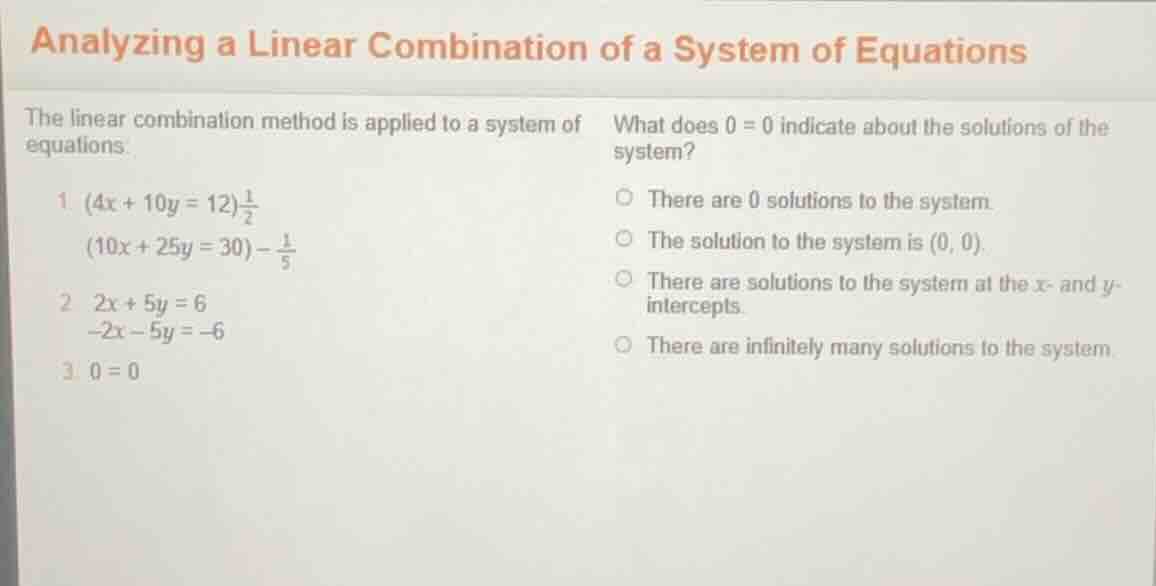
the linear combination method is applied to a system of equations:
- $(4x + 10y = 12)\frac{1}{2}$
$(10x + 25y = 30) - \frac{1}{5}$
- $2x + 5y = 6$
$-2x - 5y = -6$
- $0 = 0$
what does $0 = 0$ indicate about the solutions of the system?
\\(\circ\\) there are 0 solutions to the system.
\\(\circ\\) the solution to the system is $(0, 0)$.
\\(\circ\\) there are solutions to the system at the $x$- and $y$-intercepts.
\\(\circ\\) there are infinitely many solutions to the system.
When solving a system of linear equations, arriving at a true statement like $0=0$ means the two original equations are equivalent (they represent the same line). Every point on that line is a solution, so there are infinitely many solutions. The other options are incorrect: 0 solutions would result in a false statement like $0=5$, $(0,0)$ is only one specific solution, and intercepts are just specific points not the full set of solutions.

Snap & solve any problem in the app
Get step-by-step solutions on Sovi AI
Photo-based solutions with guided steps
Explore more problems and detailed explanations
There are infinitely many solutions to the system.