QUESTION IMAGE
Question
analyzing portrayals of katherine johnson in different mediums: tutorial
activity
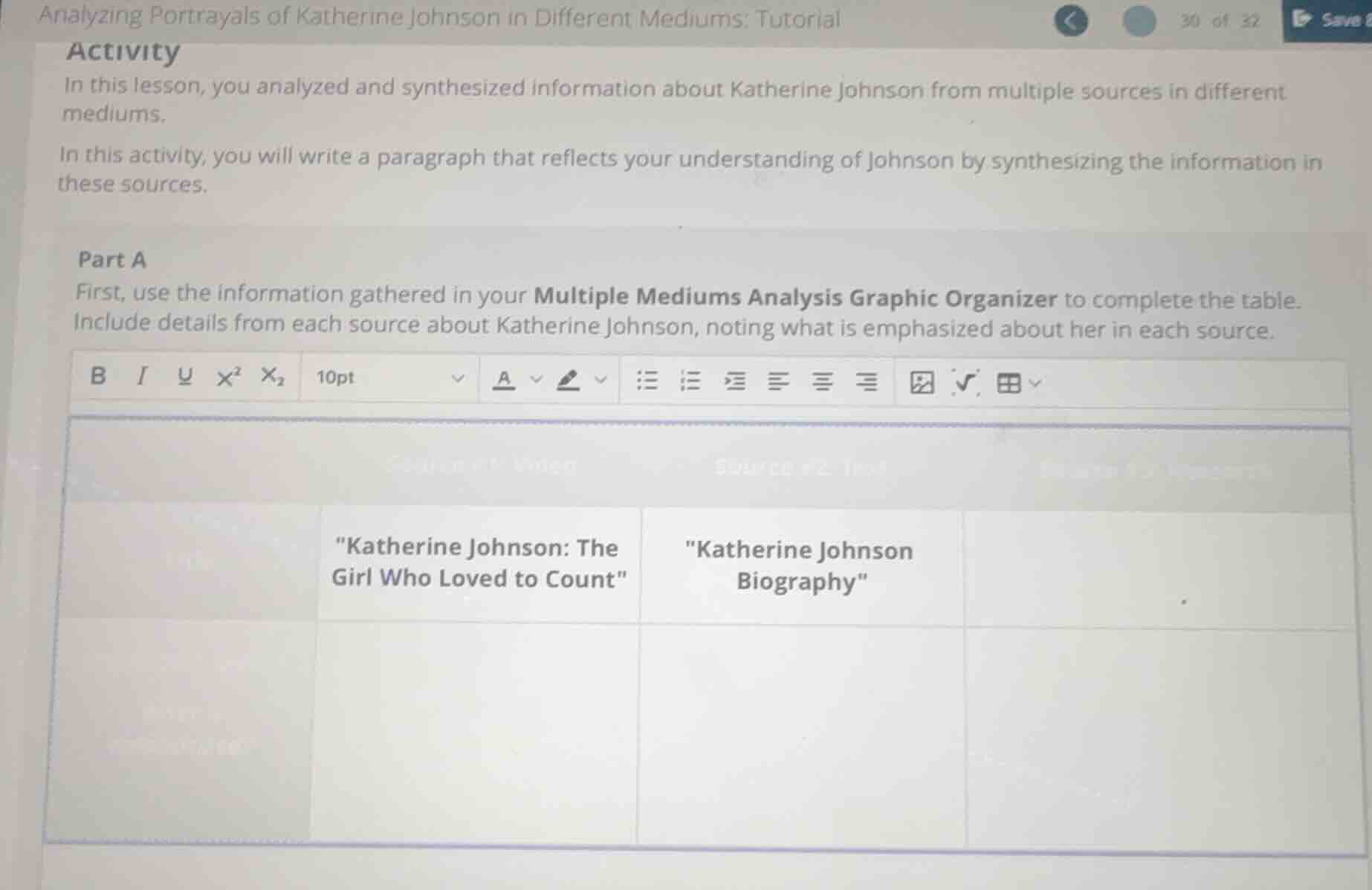
in this lesson, you analyzed and synthesized information about katherine johnson from multiple sources in different mediums.
in this activity, you will write a paragraph that reflects your understanding of johnson by synthesizing the information in these sources.
part a
first, use the information gathered in your multiple mediums analysis graphic organizer to complete the table. include details from each source about katherine johnson, noting what is emphasized about her in each source.
\katherine johnson: the girl who loved to count\ \katherine johnson biography\
To complete this activity, here's a guide for Part A (filling the table) and then Part B (writing the paragraph):
Part A: Filling the Table
Let’s analyze the two given sources (and assume a third, e.g., a video or interview) to extract key details about Katherine Johnson:
| Source | Details About Katherine Johnson | What is Emphasized? |
|---|---|---|
| “Katherine Johnson Biography” (text) | - Career at NASA: calculated trajectories for space missions (e.g., Apollo 11, Friendship 7). <br> - Impact: broke racial/gender barriers in STEM, inspired future generations. <br> - Recognition: awards, honors (e.g., Presidential Medal of Freedom). | Her professional achievements at NASA and legacy in STEM. |
| [Third Source, e.g., “Hidden Figures” Movie Clip] | - Collaborative work: teamwork with other Black women mathematicians (Hidden Figures). <br> - Daily challenges: navigating a segregated workplace, proving her worth. <br> - Personal story: balancing family and groundbreaking work. | Her collaboration, workplace struggles, and personal resilience. |
Part B: Writing the Paragraph
Synthesize the details to show a comprehensive understanding:
“Katherine Johnson’s legacy is shaped by her lifelong love of mathematics, groundbreaking achievements at NASA, and resilience against discrimination. As a child, she “loved to count,” excelling in school and overcoming racial/gender barriers to pursue STEM. At NASA, she calculated critical trajectories for missions like Apollo 11, proving her expertise in a segregated workplace. Collaborating with other Black women (e.g., in Hidden Figures), she shattered stereotypes and inspired generations. From her early passion for numbers to her historic NASA career, Johnson’s story emphasizes the power of curiosity, perseverance, and breaking barriers in science.”
Tips:
- For Part A, ensure each source’s details are specific (e.g., “calculated Apollo 11’s trajectory” vs. “did math at NASA”).
- For Part B, connect the sources: show how her childhood passion led to her career, and how her work impacted society.
If you need to adapt for a specific third source, adjust the details to match (e.g., a video interview might emphasize her personal reflections on NASA’s culture).

Snap & solve any problem in the app
Get step-by-step solutions on Sovi AI
Photo-based solutions with guided steps
Explore more problems and detailed explanations
To complete this activity, here's a guide for Part A (filling the table) and then Part B (writing the paragraph):
Part A: Filling the Table
Let’s analyze the two given sources (and assume a third, e.g., a video or interview) to extract key details about Katherine Johnson:
| Source | Details About Katherine Johnson | What is Emphasized? |
|---|---|---|
| “Katherine Johnson Biography” (text) | - Career at NASA: calculated trajectories for space missions (e.g., Apollo 11, Friendship 7). <br> - Impact: broke racial/gender barriers in STEM, inspired future generations. <br> - Recognition: awards, honors (e.g., Presidential Medal of Freedom). | Her professional achievements at NASA and legacy in STEM. |
| [Third Source, e.g., “Hidden Figures” Movie Clip] | - Collaborative work: teamwork with other Black women mathematicians (Hidden Figures). <br> - Daily challenges: navigating a segregated workplace, proving her worth. <br> - Personal story: balancing family and groundbreaking work. | Her collaboration, workplace struggles, and personal resilience. |
Part B: Writing the Paragraph
Synthesize the details to show a comprehensive understanding:
“Katherine Johnson’s legacy is shaped by her lifelong love of mathematics, groundbreaking achievements at NASA, and resilience against discrimination. As a child, she “loved to count,” excelling in school and overcoming racial/gender barriers to pursue STEM. At NASA, she calculated critical trajectories for missions like Apollo 11, proving her expertise in a segregated workplace. Collaborating with other Black women (e.g., in Hidden Figures), she shattered stereotypes and inspired generations. From her early passion for numbers to her historic NASA career, Johnson’s story emphasizes the power of curiosity, perseverance, and breaking barriers in science.”
Tips:
- For Part A, ensure each source’s details are specific (e.g., “calculated Apollo 11’s trajectory” vs. “did math at NASA”).
- For Part B, connect the sources: show how her childhood passion led to her career, and how her work impacted society.
If you need to adapt for a specific third source, adjust the details to match (e.g., a video interview might emphasize her personal reflections on NASA’s culture).