QUESTION IMAGE
Question
analyzing tables for exponential relationships
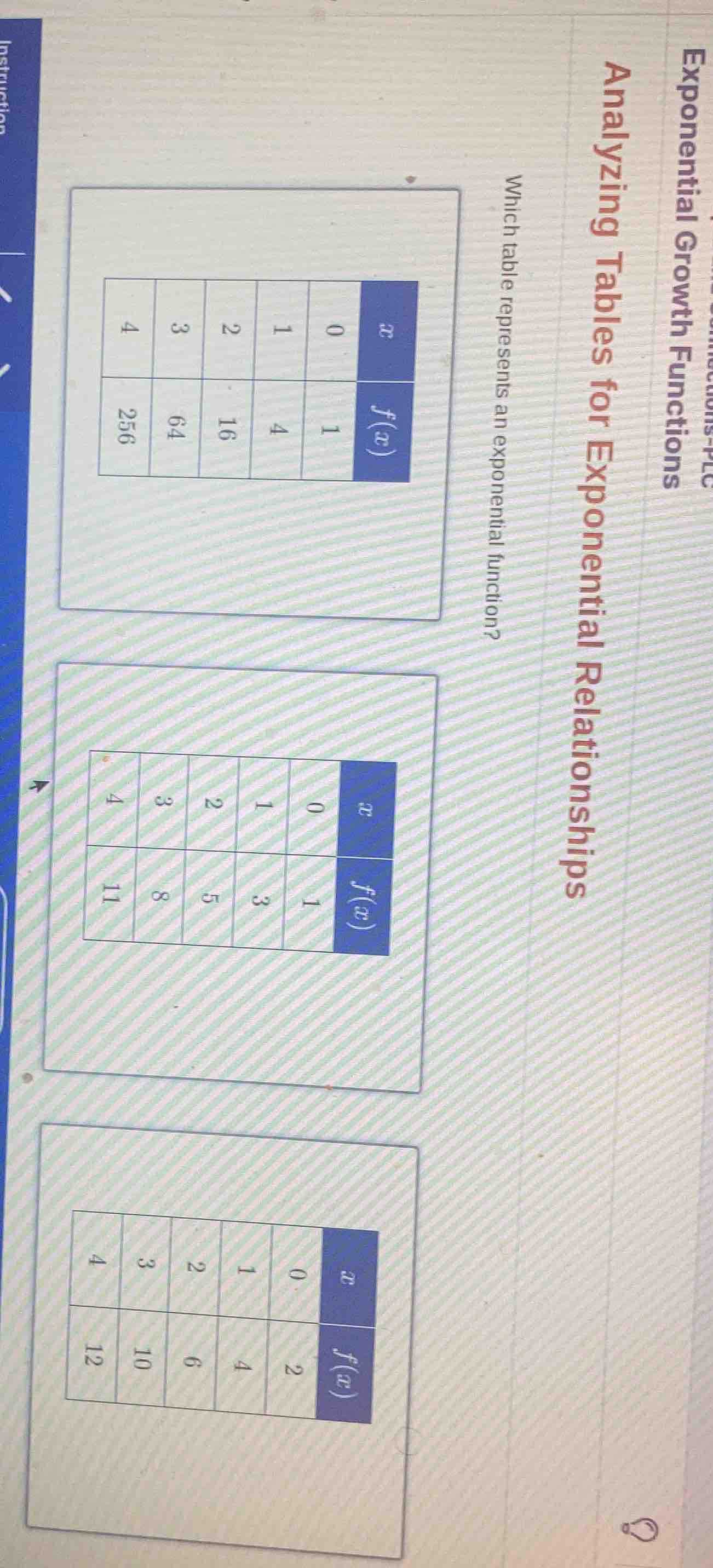
which table represents an exponential function?
(three tables are shown with x and f(x) values:
first table: x: 0,1,2,3,4; f(x): 1,4,16,64,256
second table: x: 0,1,2,3,4; f(x): 1,3,5,8,11
third table: x: 0,1,2,3,4; f(x): 2,4,6,10,12)
Step1: Recall exponential function rule
An exponential function has a constant ratio between consecutive $f(x)$ values when $x$ increases by 1, following $f(x)=a(b)^x$ where $b>0, b
eq1$.
Step2: Check first table ratios
Calculate $\frac{f(x_{n+1})}{f(x_n)}$:
$\frac{4}{1}=4$, $\frac{16}{4}=4$, $\frac{64}{16}=4$, $\frac{256}{64}=4$
Step3: Check second table ratios
Calculate $\frac{f(x_{n+1})}{f(x_n)}$:
$\frac{3}{1}=3$, $\frac{5}{3}\approx1.67$, $\frac{8}{5}=1.6$, $\frac{11}{8}=1.375$
Step4: Check third table ratios
Calculate $\frac{f(x_{n+1})}{f(x_n)}$:
$\frac{4}{2}=2$, $\frac{6}{4}=1.5$, $\frac{10}{6}\approx1.67$, $\frac{12}{10}=1.2$

Snap & solve any problem in the app
Get step-by-step solutions on Sovi AI
Photo-based solutions with guided steps
Explore more problems and detailed explanations
The first table (with $x$ values 0,1,2,3,4 and $f(x)$ values 1,4,16,64,256) represents an exponential function.